Musk Sends NVIDIA's Most Advanced Chips to Space, and Orbit Is the Least of Starmind's Problems
SpaceX has filed with the FCC to launch up to a million satellites for its Starmind project, with the first batch of AI1 satellites set to run on NVIDIA's Vera Rubin GPUs. But radiation exposure and cost issues could make the 2027 launch timeline far tougher than it sounds.
Sending data centers into space sounds like a solution—until you actually run the numbers. SpaceX recently filed an application with the Federal Communications Commission (FCC) to launch up to a million satellites, forming an orbital data center system called Starmind. It's one of Elon Musk's most ambitious projects yet, and the chip he's chosen happens to be the one the industry widely agrees is least suited for space.
During SpaceX's Q2 earnings call in early August this year, Musk said Starmind's first satellites, AI1, are "not some far-off future thing," claiming launches would begin as early as 2027—a timeline that sounds rushed even by Musk's typically optimistic standards.
72 chips, 210kW of solar power: one satellite, one server rack
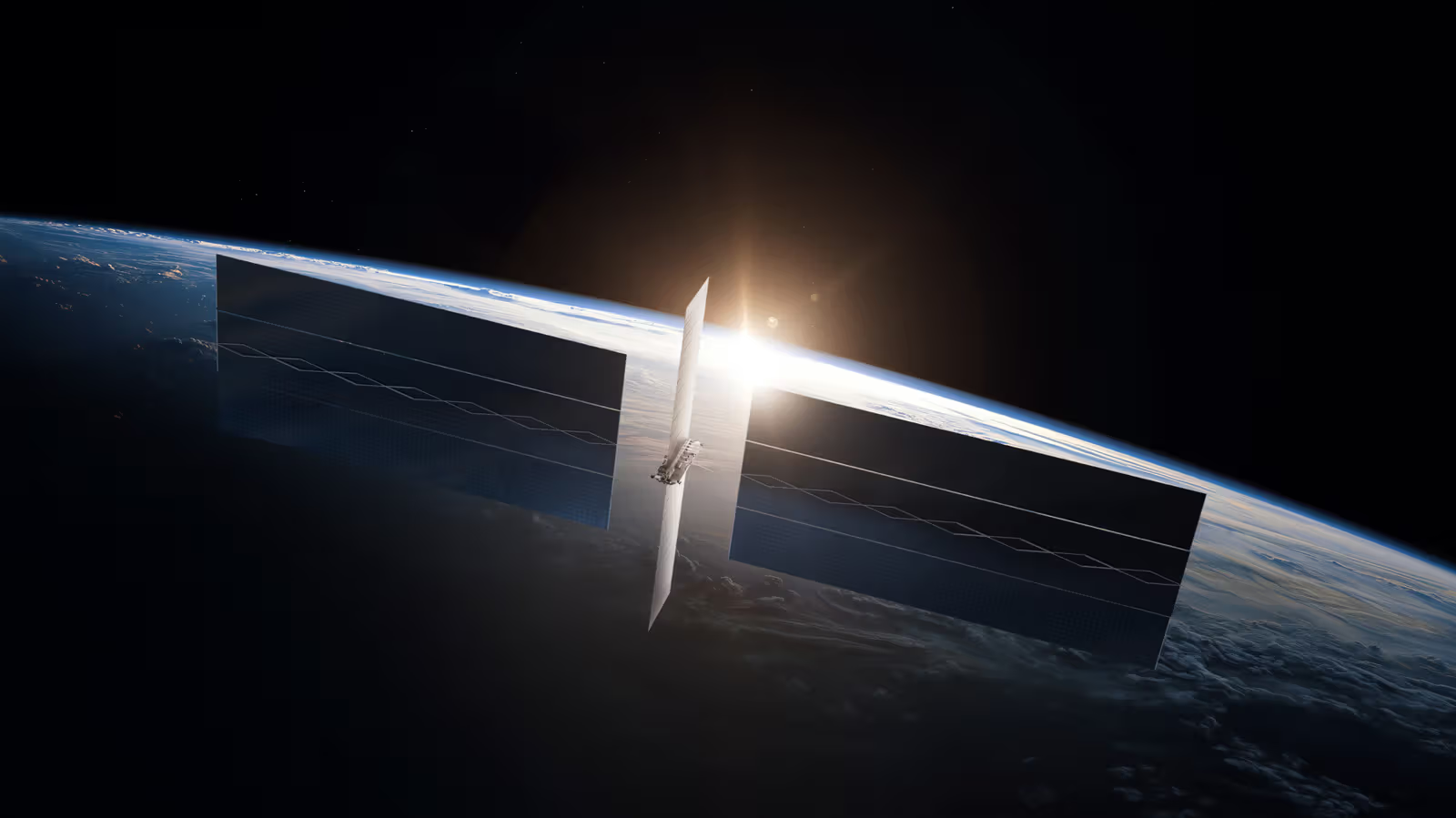
According to SpaceX's post on X, the AI1 satellites will run on NVIDIA's Vera Rubin GPUs and Vera CPUs as the core of what's being called "data center-grade computing in space," built on NVIDIA's Vera Rubin NVL72 rack platform—dubbed Space-1 by SpaceX. NVIDIA says the Vera Rubin module delivers up to 25 times the AI computing power of its predecessor, the H100 GPU.
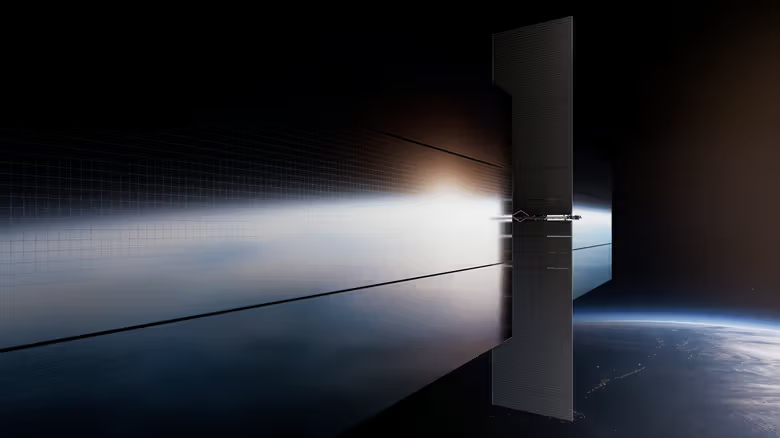
Each satellite is expected to carry roughly 72 NVIDIA chips—effectively a full NVIDIA server rack—generating an average of 175kW of computing power. The satellites will orbit in a near-constant sun-facing sync, with solar panel arrays projected to generate 210kW, freeing xAI's growth from what Musk calls the constraints of "Earth's power grid, land, and heat dissipation." As for the massive heat generated by all that computing, SpaceX's solution is a 1,700-square-foot liquid-cooled radiator that dumps heat straight into the vacuum of space. In the long run, Starmind will also lean on Terafab, the $119 billion chip fab jointly funded by SpaceX and Tesla—but until that's up and running, NVIDIA is the only supplier that can keep pace with the timeline.
On the earnings call, Musk explained why he chose Vera Rubin, calling it "the best architecture": "We think the NVL72 VR computer design is far better than the standard rack-based design." He said SpaceX intends to "deploy this system both on the ground and in orbit," claiming the approach is "cheaper" and "more efficient."
The more advanced the chip, the more it fears radiation
The problem is, the most advanced chip isn't necessarily the best choice for a space environment. Benjamin Lee, a professor of electrical and systems engineering at the University of Pennsylvania, warned in an Engadget interview back in February: the newer a chip's architecture, the more susceptible it is to "bit flips" caused by radiation sources like solar storms in low Earth orbit—forcing the 0s and 1s that make up binary code to swap.
Lee explained that this stems from newer chips using smaller transistors: "the amount of charge needed to represent a 1 decreases as transistors shrink." While shrinking transistors delivers more computing power, it also turns what was once a minor issue within Earth's atmosphere into a challenge that space-bound semiconductors now have to confront head-on.
Advocates for orbital data centers argue that modern AI systems already have built-in mechanisms to detect and correct these kinds of errors. Starcloud, the startup that sent an NVIDIA H100 GPU into orbit last November, believes orbital data centers can match the operational lifespan of ground-based facilities. Google's own research found that its V6e Trillium TPU compute modules can operate reliably in orbit for roughly five years.
Lee isn't fully convinced. He points out that the real issue isn't whether bit flips can be detected and corrected, but whether running that correction process over and over will leave orbital computing noticeably behind ground-based systems: "Even though modern computer architectures can detect—and sometimes correct—these errors, doing so repeatedly still slows things down and adds overhead to computing in space." In other words, radiation may not doom Starmind outright, but it's likely to saddle it with an inherent efficiency penalty that ground-based rivals simply don't have to deal with.
Cost and rockets: two hurdles more pressing than radiation
Musk has consistently downplayed the difficulty of getting AI1 into orbit. In a promotional video released this past June, he said: "There's no magic here that doesn't already exist," adding that "a huge part of this is technology we've already developed for the Starlink V3 satellites."
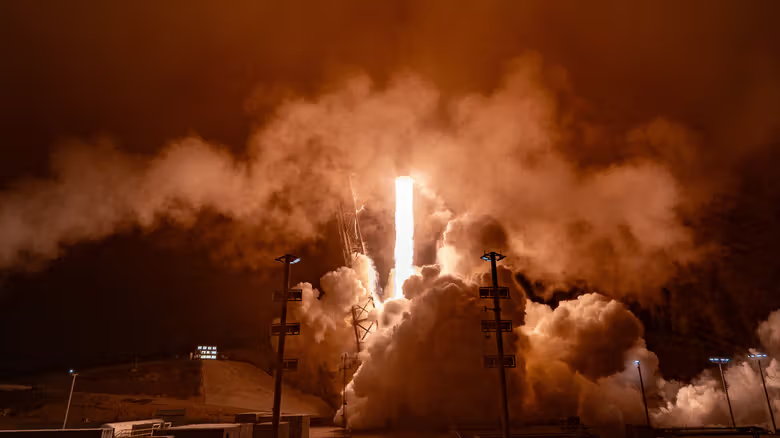
But the obstacles in front of him are pretty concrete. A policy brief released by consulting firm Bain in July 2026 notes that launch costs for data center satellites need to fall between $50 and $100 per kilogram to be economically viable. Right now, SpaceX's Falcon Heavy costs roughly $1,500 per kilogram to launch—a far cry from breakeven. Making matters worse, the AI1 satellites are too large to launch on a Falcon 9, so everything hinges on Starship, which is still in development. That means SpaceX would need to run Starship at a launch cadence far beyond the current global daily average just to sustain a million-satellite constellation.
Once in orbit, maintenance is another headache. Most expect SpaceX to simply launch new satellites with updated tech to replace old ones rather than send anyone up to fix them. Research released by Meta alongside its Llama 3 model shows that even hardware trained on the ground experiences failures roughly every three hours on average. When that kind of failure happens in low Earth orbit—an orbit growing increasingly crowded thanks to a million satellites—the risk of collisions with space debris or other satellites, and the environmental controversy that would follow, remain questions nobody has answered yet.