Last year, Daniel Ek — Spotify's founder and current executive chairman — dropped $694 million into defense tech startup Helsing. That single investment triggered the loudest backlash in the platform's history, with some artists pulling their catalogs in protest. And the result? Spotify's revenue, profit, and monthly active users all kept climbing last quarter. 293 million paid subscribers, 761 million monthly active users — the numbers didn't budge despite the controversy.
Then there's the AI problem. Spotify plans to slap "AI Personas" labels on AI-generated artists, but the system relies on self-reporting, backed up by human and AI review to catch trending accounts — which basically sounds like offloading the responsibility onto whoever's honest enough to flag themselves. The AI cover/remix licensing deal it struck with Universal will become a Premium add-on, theoretically putting a bit more money in artists' pockets — probably the only part of this whole saga that's remotely defensible.
If all this has you thinking about switching platforms, here's something you need to understand first: streaming payouts don't work on a clean "X cents per play" basis. Every platform first skims roughly 30% of revenue for operating costs, then splits the remainder based on "streamshare" — an artist's percentage of total plays on the platform. And that money usually doesn't land directly in an artist's pocket; it goes to labels or distributors first, who then divvy it up according to contract terms. That's why "fractions of a cent per stream" sounds absurd — but that's literally how the mechanism is built.
Switch to another giant, and not much actually changes
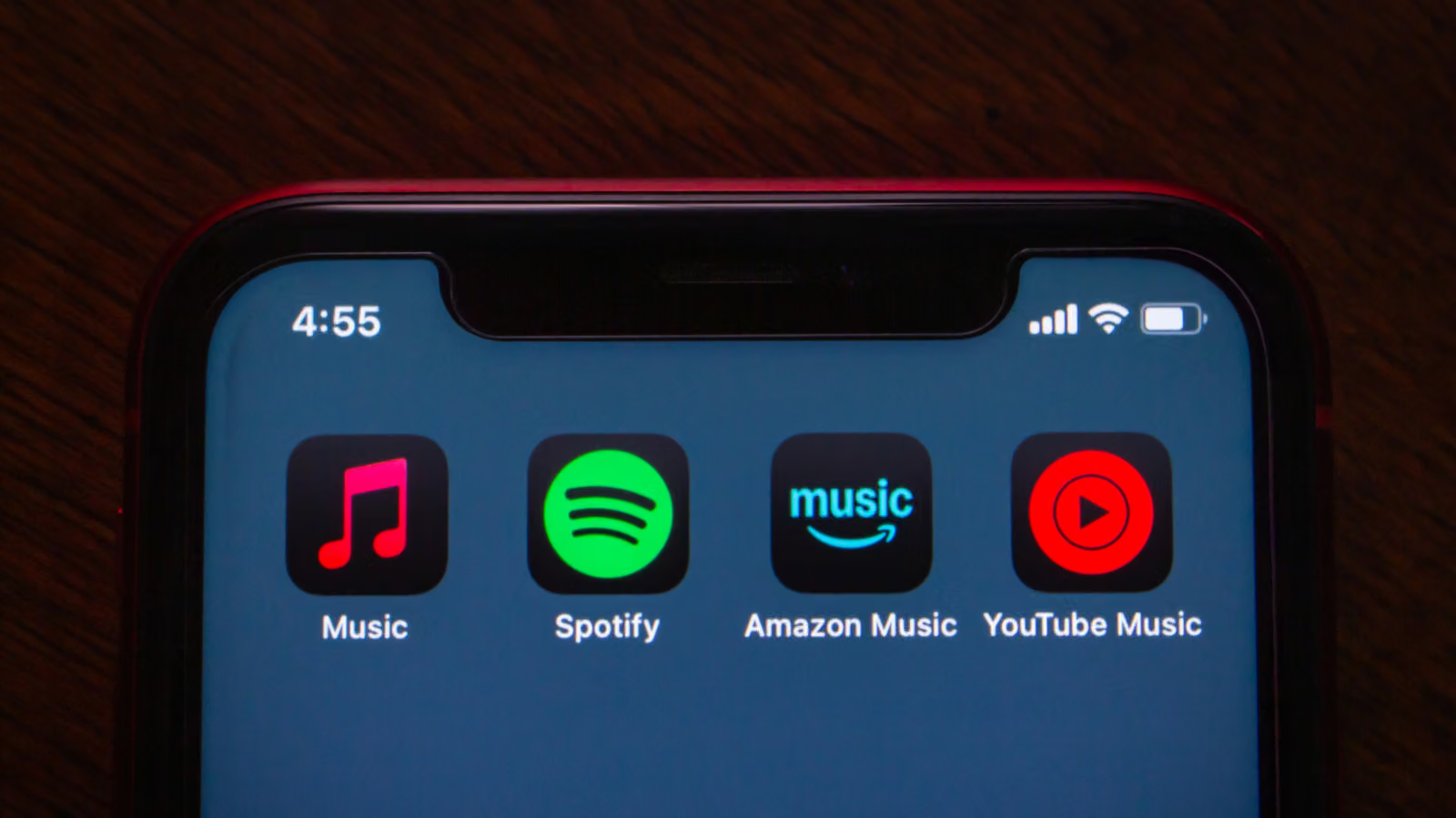
Apple Music runs $11/month, Amazon Music and YouTube Music are both $12 (Amazon Prime members get $1 off), and YouTube Premium is $16 — though that gets you ad-free across the entire site plus YouTube Music. These three do offer some practical perks over Spotify: Apple Music lets you mix your own music files with the subscription catalog and supports Dolby Atmos, while YouTube Music skips lossless audio but taps into YouTube's massive user-upload library. The differences here are about experience, not ethics — after all, switching to Apple, Amazon, or Google just means feeding a different tech giant.
If you actually want transparent payouts, look at these instead
Tidal used to be the poster child for "artist-friendly" streaming, once passing up to 10% of subscription revenue directly to the artists a user listened to most. But that "direct artist payouts" system got scrapped in 2023. Tidal is now under Block (the parent company of Square and Cash App), and it didn't respond when asked about payment details.
Deezer's approach is more concrete: after taking its 30% cut, the remainder gets distributed by streamshare — plus multipliers. Plays triggered by a user manually searching for a specific song or artist count double; artists with over 500 monthly unique listeners and more than 1,000 monthly plays also get double weighting — stack both conditions and you can hit 4x. Background white noise or simulated thunderstorm content earns nothing, and Deezer classifies 85% of AI-generated music plays as fraudulent, refusing to pay out on those — though the company notes AI music currently accounts for only 1-3% of total plays on the platform.
Qobuz takes the high-res audio route, with a base plan at $13/month (drops to $10.83/month on annual billing), streaming FLAC up to 24-bit/192kHz, plus a Sublime tier at $180/year. It's one of the few platforms to publish actual payout figures: in fiscal year 2024, it paid rights holders an average of $0.01873 per stream — roughly $18.73 per 1,000 plays. Average annual revenue per user was $121.13, which the company describes as several times the industry average of $22.38.
Coda Music is a newcomer built around social-style recommendations rather than algorithms — profile pages look like social media feeds, with recent plays, public playlists, and curated album sections. CEO Randy Fusee revealed that as of April 2026, the average payout per stream was $0.014 — slightly below Qobuz's published figure. Users can also designate one artist to receive $1 directly from their monthly subscription fee, though that artist has to opt into the program first, and in practice, many artists users want to pick don't yet qualify.
Vocana goes even further — its entire catalog is 100% independent artists, and the payout logic is essentially "whoever you listen to gets the money." Company president Neil Sheehan gives an example: if a user spends 50% of their listening time on a single artist, after deducting platform and licensing costs, that artist walks away with roughly half of that user's royalty pool. It's currently in a free beta, with a planned $9/month price point once it launches fully — but since it lacks a mainstream catalog, it's not really a direct Spotify substitute.
If you'd rather just buy music outright, Bandcamp remains the most direct channel for actually getting money into independent artists' and labels' hands, with plenty of format options too. The Qobuz Store offers lossless downloads at CD quality and above, with discounts for Sublime subscribers. As for buying albums straight from an artist's own website — whether that's even an option usually depends on whether they're locked into a major label deal.