From 1GB to 1TB: Why USB Flash Drives Can Never Go Back to Small Capacities
Back in 2002, 1GB was top-tier spec. Today, even Kingston's entry-level models start at 64GB. Engadget breaks down the evolution of NAND technology and cost structures to explain why small-capacity flash drives have all but vanished from the market.
In early 2002, JMTek's USBDrive made industry headlines with a maximum capacity of 1GB. Today, that number wouldn't even cover a photo dump—Kingston's current DataTraveler lineup mostly starts at 64GB, with some models reaching 512GB. According to Engadget, this gap didn't happen by chance; it's the result of NAND flash memory technology and cost structures undergoing dramatic, simultaneous shifts.
The price collapse has been just as staggering. USB flash storage plummeted from over $8,000 per GB in the early days to just 94 cents per GB by 2013. But the components a flash drive needs haven't gone away: the USB connector, controller chip, circuit board, casing, plus one or more memory chips. It's not that a 1GB drive can't be made anymore—it's just become a product that no longer makes economic sense.
What's Really Changing Inside the Chip
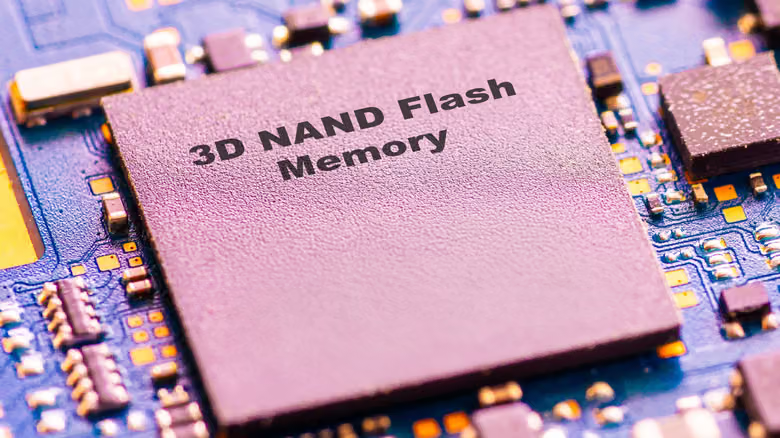
The real breakthrough happened inside the memory chip itself. For decades, NAND manufacturers kept shrinking memory cells while packing more bits into each one, eventually developing 3D NAND technology that stacks these cells vertically. This let manufacturers keep piling on capacity without requiring users to lug around an extra backpack for storage.
2005 offers a concrete example: Toshiba and SanDisk jointly announced an 8Gb (gigabit) NAND chip capable of storing 1GB of data on a single chip. The chip was less than 5% larger than its 4Gb predecessor, yet capacity had doubled. At the time, both companies stated in their announcement that this chip would become the "mainstream production" standard, driving significant cost reductions across their flash storage product lines.
Capacity numbers climbed rapidly after that. In 2004, a 2.1GB Verbatim Store 'n Go cost $250; by 2013, Kingston had already launched a 1TB DataTraveler, while the 512GB version in that same lineup carried a hefty price tag of $1,750. The TLC NAND commonly found in USB drives today—a technology that packs three bits into a single memory cell—has become the go-to choice for cost-sensitive consumer storage. While both capacity and speed have grown, bigger capacity doesn't automatically mean faster performance; the controller chip and USB interface play just as big a role.
Making a Small-Capacity Version Doesn't Save Much Money
Shrinking a 64GB flash drive down to 1GB doesn't magically make all the other components disappear. A low-capacity version still needs a controller chip, connector, circuit board, casing, and packaging, and still has to go through assembly, shipping, and retail placement. When high-density NAND is already cheap enough at scale, cutting capacity doesn't proportionally cut the final product cost.
There was no clear capacity threshold where manufacturers collectively declared "8GB replaces 1GB"—this shift happened gradually over time. One concrete example: Microsoft's Windows installation media tool requires a blank flash drive with at least 8GB of space, meaning a 1GB drive can't even handle the most basic everyday tasks anymore.
MLC (multi-level cell) NAND is also facing production pressure these days. Reports indicate that global MLC NAND production capacity is projected to shrink by 41.7% annually by 2026, as major suppliers scale back or halt production to redirect resources toward newer manufacturing processes. This could lead to a seemingly paradoxical outcome: an older type of NAND actually rising in price due to shrinking supply.
Small-capacity flash drives haven't disappeared entirely—they've simply retreated into industrial and embedded applications, where compatibility, durability, or fixed hardware specs often matter more than stacking up capacity. Delkin's industrial USB flash drives start at 1GB, while Apacer goes even smaller, with its industrial USB flash drive lineup bottoming out at just 256MB.