Old Clothes, Steel Cage, No Glue: A Fashion-Trained Architect "Welds" Building Material With a Hacked 3D Printer
Taylor Leung swapped a 3D printer's extruder for five heated metal needles, using no adhesive at all to melt down fast fashion's discarded polyester garments into a porous material—then turned it into chairs, walls, columns, and eventually a full-scale shed.
A desktop 3D printer has had its original extruder nozzle removed and replaced with five metal needles that heat up. Underneath isn't a spool of filament, but a whole box of old clothes packed into a mild-steel cage. The needle tips move through the fabric pile square by square, following a pre-programmed G-code path—this isn't printing, exactly. The designer has his own name for it: "digital soldering."
This is Fast Fashion Architecture, a material research project developed in 2022 by London-based interdisciplinary designer Taylor Leung at The Bartlett School of Architecture, in collaboration with Chung Yin Jeffrey Kwong, Chao-An Chang, Chong Li, and Jiali Yan, under Leung's own practice 12103 Design Studio. The project tackles fast fashion's messiest byproduct: non-biodegradable synthetic-fiber garments and factory offcuts—polyester-blend fabrics that are notoriously hard to break down or repurpose through conventional recycling.
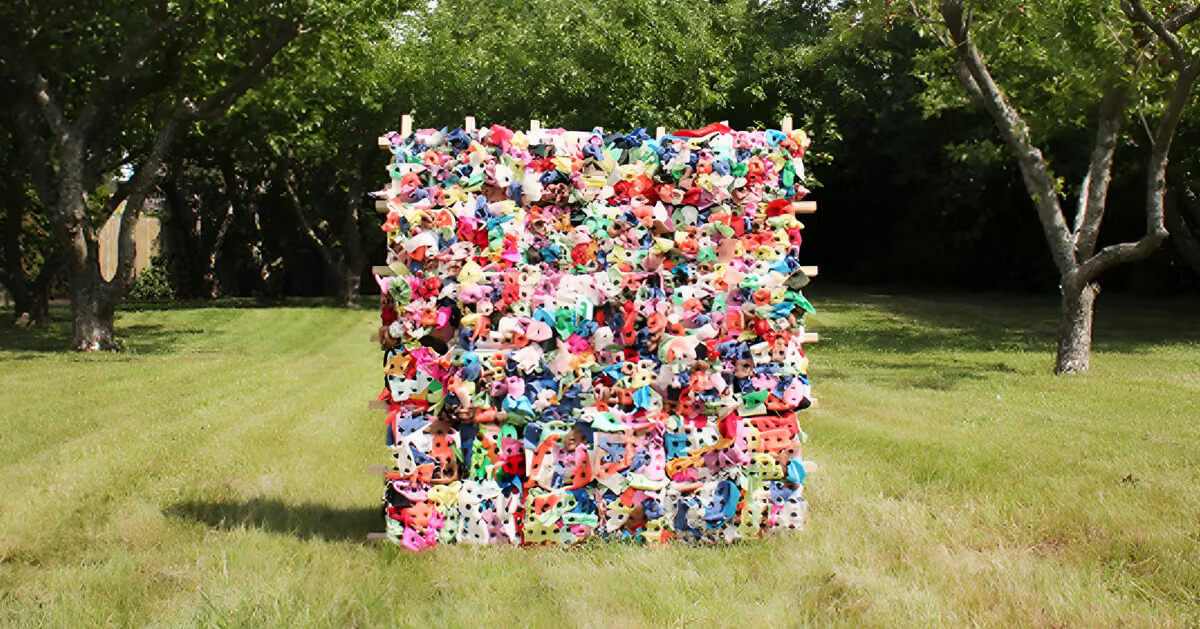
Their process starts by sorting and cutting fabric by color and material, then packing it into a mild-steel cage and heating it—no glue, resin, or adhesive of any kind involved. The thermoplastic fibers fuse together into porous chunks, and the garments' original colors, patterns, textures, even their flaws, all survive the process. Every resulting block looks different, because it still remembers what clothing it used to be.
That modified 3D printer is the key to controlling all this randomness. The five heated needles move via custom G-code, and by adjusting temperature, density, and spacing, the team can dictate exactly how the fibers bond and what structure they form. It's a system of digital repeatability layered on top of each fabric's inherent unpredictability—and that's the most compelling part of the whole project: the material itself is uncontrollable, but the fabrication method is precise to a fault.
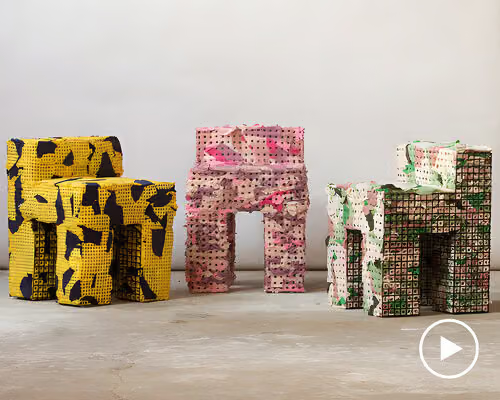
The testing trajectory for the finished material is equally deliberate. It starts with material samples, moves to an outdoor wall, then a chair series called Soft Brutal, and scales up further into a structural column—where the cross-section of steel cage and fabric filling is deliberately exposed on the column, becoming part of the visible structure rather than hidden infill. The system eventually expanded into a prototype shed at Grymsdyke Farm, pairing CNC-cut timber framing with heat-fused fabric units. The shed takes on a pyramidal form, echoing the tent as humanity's most primal form of shelter, while its shape also resembles a heap of discarded clothing—the material's origin and its final form collapse into one another. The team also carried out a follow-up study scaling the same system up to the size of a three-story residence, called the Soft Brutal House, testing whether heat-fused fabric units could extend from furniture and components into a complete architectural system.
Leung's own background explains a lot about why this project looks the way it does: he studied fashion at London College of Fashion before earning his architecture master's with distinction at The Bartlett. Fast Fashion Architecture won a Bronze Award at the 2022 Bartlett B-Pro Architectural Design showcase. The sensitivity to material, body, color, and pattern that his fashion training instilled gets carried directly into his architectural material research—and that's what sets this project apart from typical "recycled material" case studies. It's not just turning waste into something new; it's laying bare the shared logic of cutting and piecing that runs through both industries.
The project currently remains in the material research and prototyping stage. The design team has not announced a timeline for mass production or any path to commercialization.