Fragments Reborn Turns Cracks into Design in Bangkok
Sumanatsya Voharn’s exhibition runs through November 22 at BACC pop-up Gallery G1 in Seacon Square Srinakarin. Cups, plates and old wood reveal different ways of joining materials.
Fragments Reborn presents Sumanatsya Voharn’s exploration of old objects, fragments and reassembly at BACC pop-up Gallery G1 from October 3 to November 22, 2026. The venue is on the third floor of MUNx2 at Seacon Square Srinakarin, not the main BACC building in central Bangkok. Wood, ceramics, bricks and natural elements enter a craft and design context, inviting another look at things once dismissed as damaged or useless while retaining their traces.
A missing piece can create a different outline
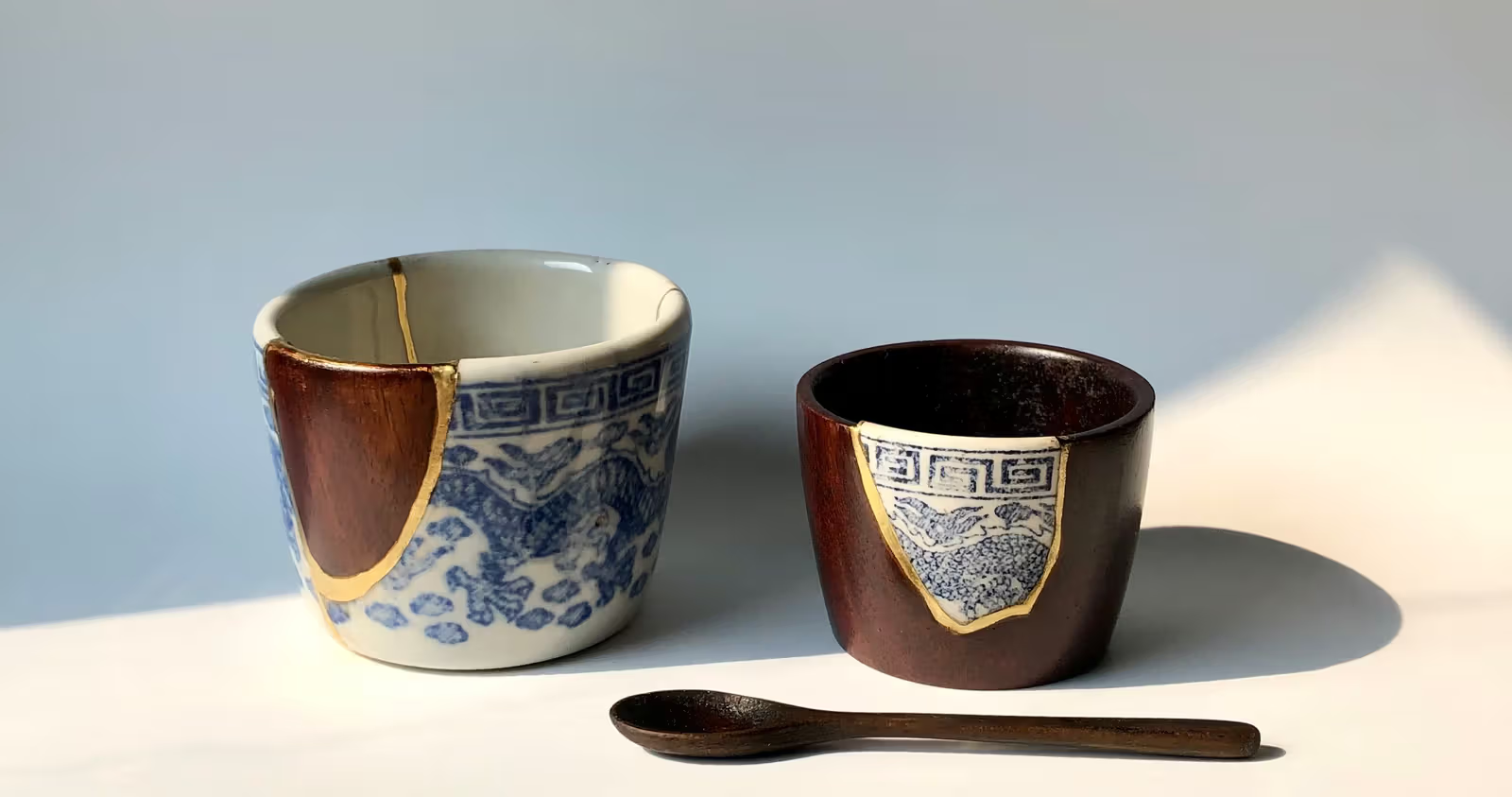
One official image pairs a large and a small cup, joining blue-and-white patterns with deep brown areas. Gold-coloured lines emphasise their borders. A seam continues down the larger cup’s inner wall; the smaller appears to incorporate patterned ceramic within a different material forming its body. A dark spoon in front offers a cue to scale and everyday use. Old and new areas are not made identical, so looking begins with difference.
This visual relationship differs from a repair intended to hide the break: curves, interrupted patterns and material boundaries become part of the composition. Gold colour alone does not identify the metal, adhesive or a particular repair method. The exhibition asks about collection, reassembly and changing value, rather than offering a making tutorial that a photograph could reconstruct. The way each detail meets another rewards slower comparison.
Old timber and plates make support part of the picture
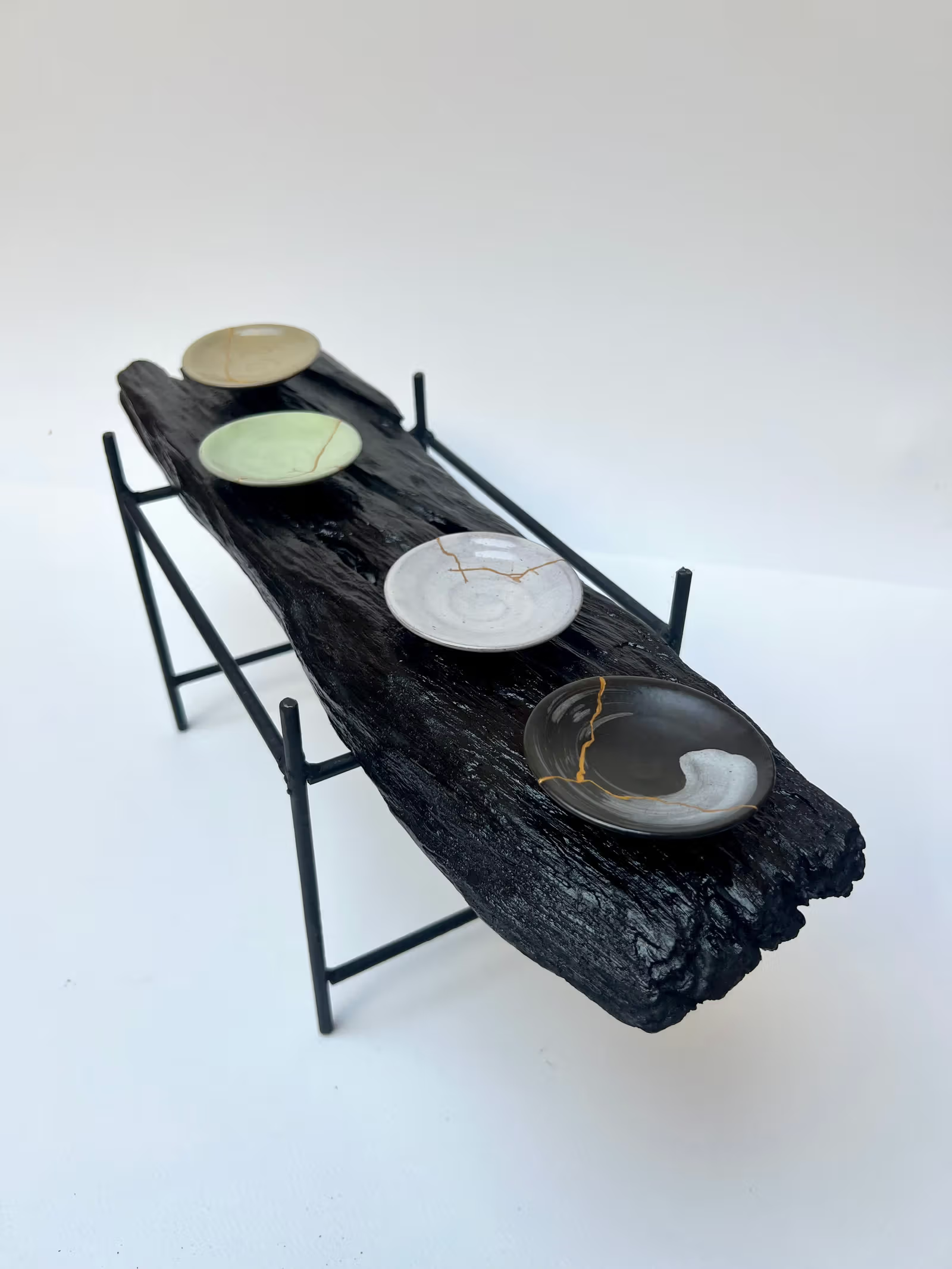
Another official photograph arranges four shallow plates along a dark, irregularly surfaced timber plank, held by slender metal supports. The plates differ in colour, and gold-coloured joins branch across several surfaces. The plank’s fissures and unevenness contrast with smoother curved dishes. The understated supports help make old wood more than background: it participates in carrying, arranging and establishing the distance of a view.
Official exhibition image: shallow plates arranged on a supported old timber plank.
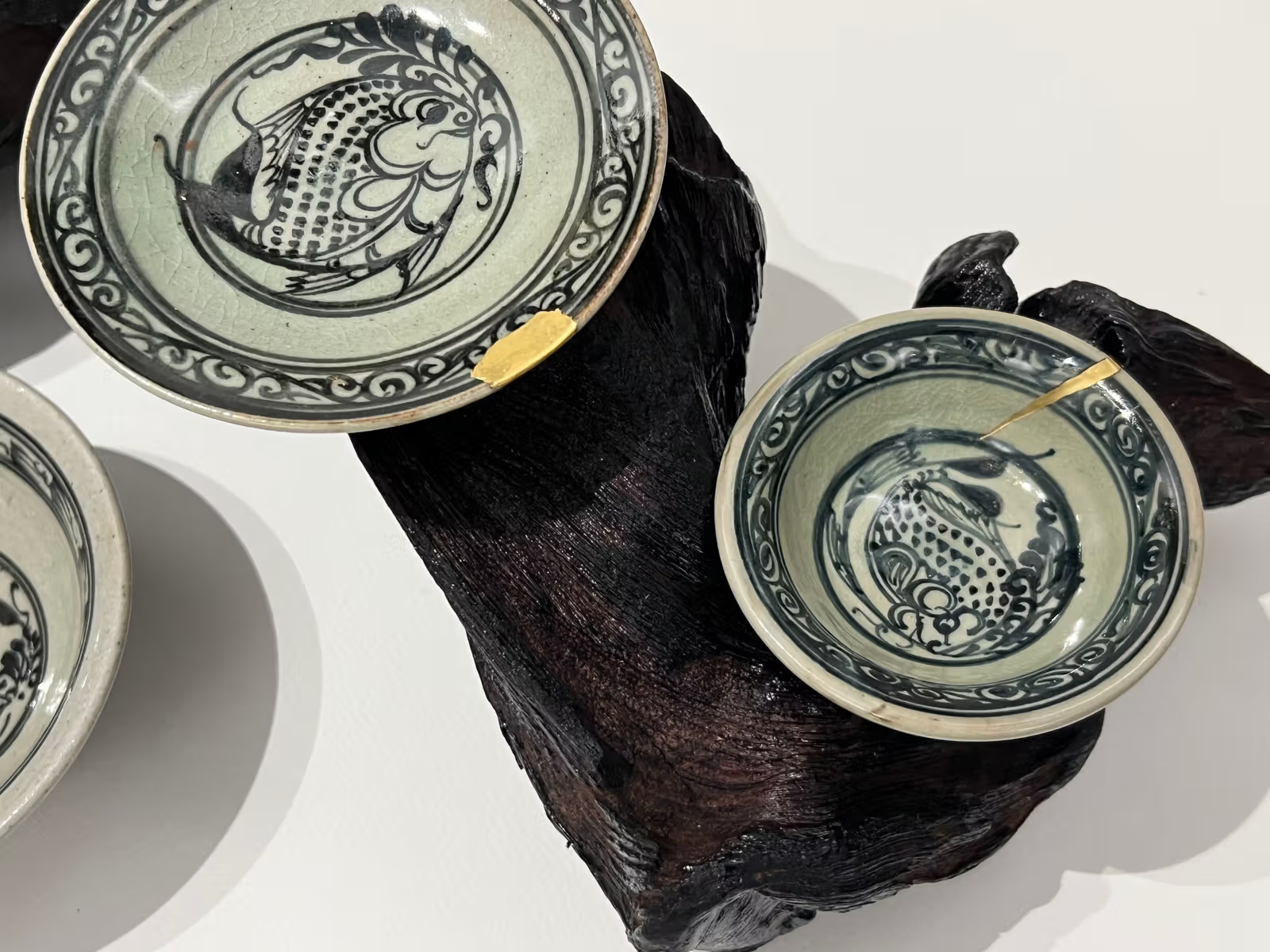
A close-up of fish-patterned plates shifts attention to how an image crosses damage. Dark grey fish, curling rim patterns and fine cracks remain legible, while gold-coloured areas at missing edges change the reading of a complete circle. Two plates rest beside dark wooden pieces; one has a broader loss and another a narrower interruption extending inward from the edge. They do not have to return to an ageless new condition to merit attention.
Official exhibition image: fish-patterned plates with visible repaired areas.
Sustainability as a question, not a verdict on materials
The organiser-provided description relates the works to traditional craft, memories of living and reconsideration of natural materials. It also describes an intention to preserve everyday usability. That does not mean every exhibit can be handled or has become a mass-produced product. The page gives no prices, complete count or individual dimensions. Instead of starting with a shopping list, ask what the added part changes when an object’s original pattern, damage and purpose remain present.
The gallery is in Zone 4 on MUNx2’s third floor at Seacon Square Srinakarin, Prawet, Bangkok. Listed hours are daily 11:00–19:00; MRT Suan Luang Rama 9 can inform travel planning. The source has no publication date, and the exhibition began October 3 rather than opening anew on October 30. Confirm the day’s arrangements and admission conditions with the venue. Taking time over edges, joins and support structures reveals more than simply deciding that an object has been repaired.