The antenna itself won't complain. Starlink Mini was designed to fit in a backpack, mount on top of an RV, or prop up on a balcony, but if someone just leaves it sitting in the same backyard for six months, official materials do acknowledge that this small satellite dish supports both fixed and mobile use. The issue isn't the hardware—it's the U.S. subscription structure: Starlink Mini is tied to the company's Roam plan, not the Residential plan built for long-term settled users.
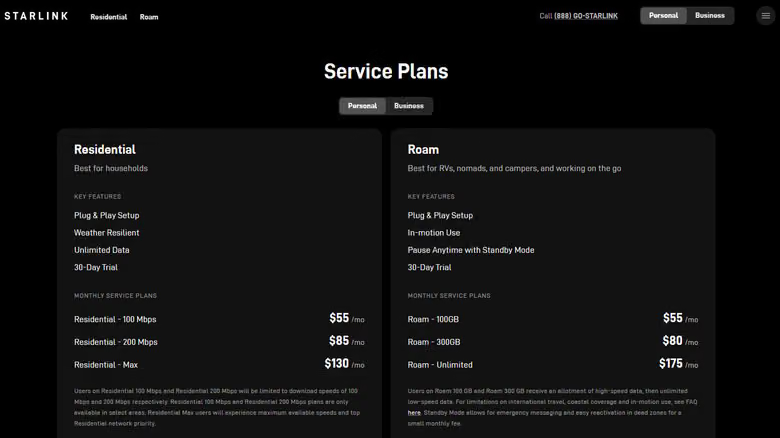
The Roam plan comes in three tiers: the entry-level option costs $55/month for 100GB of high-speed data, the 300GB version is $80/month, and the unlimited data version runs $175/month. Residential plans also start at $55/month, which corresponds to 100Mbps speeds, with 200Mbps at $85/month, and the top-tier Residential Max at $130/month with no data cap. On the surface both sides share a $55 entry price, but what you actually get is not equivalent.
Once you burn through your high-speed data, speeds get throttled
Once a Roam plan subscriber uses up their monthly high-speed data allowance, the rest of the billing cycle gets downgraded to unlimited but slow speeds. In other words, a Roam 100GB user paying $55/month is really just getting a limited pool of high-speed data—clearly a worse deal compared to a Residential 100Mbps user paying the same monthly fee. To completely avoid the data cap, you'd have to jump straight to Roam Unlimited at $175/month, which is $45 more than Residential Max's $130.
Speed priority doesn't favor long-term users either. Starlink reserves its highest Residential network priority for Residential Max customers, while officially warning that Roam plan speeds may slow down during network congestion. In effect, someone who permanently leaves their Mini at home might end up paying more for unlimited data than a Residential Max customer, while using a service that was originally optimized for mobile scenarios—not for being fixed at the same doorstep day after day.