17 Years After Analog TV Died, Digital TV Is Walking the Same Path — Minus the Safety Net
Congress legislated in 1996, the mandatory switch happened in 2009, and 97.5% of households were ready: the analog-to-digital transition was an upgrade handled with care. Now ATSC 3.0 is set to repeat that journey, but this time the FCC isn't offering a timeline — or subsidies.
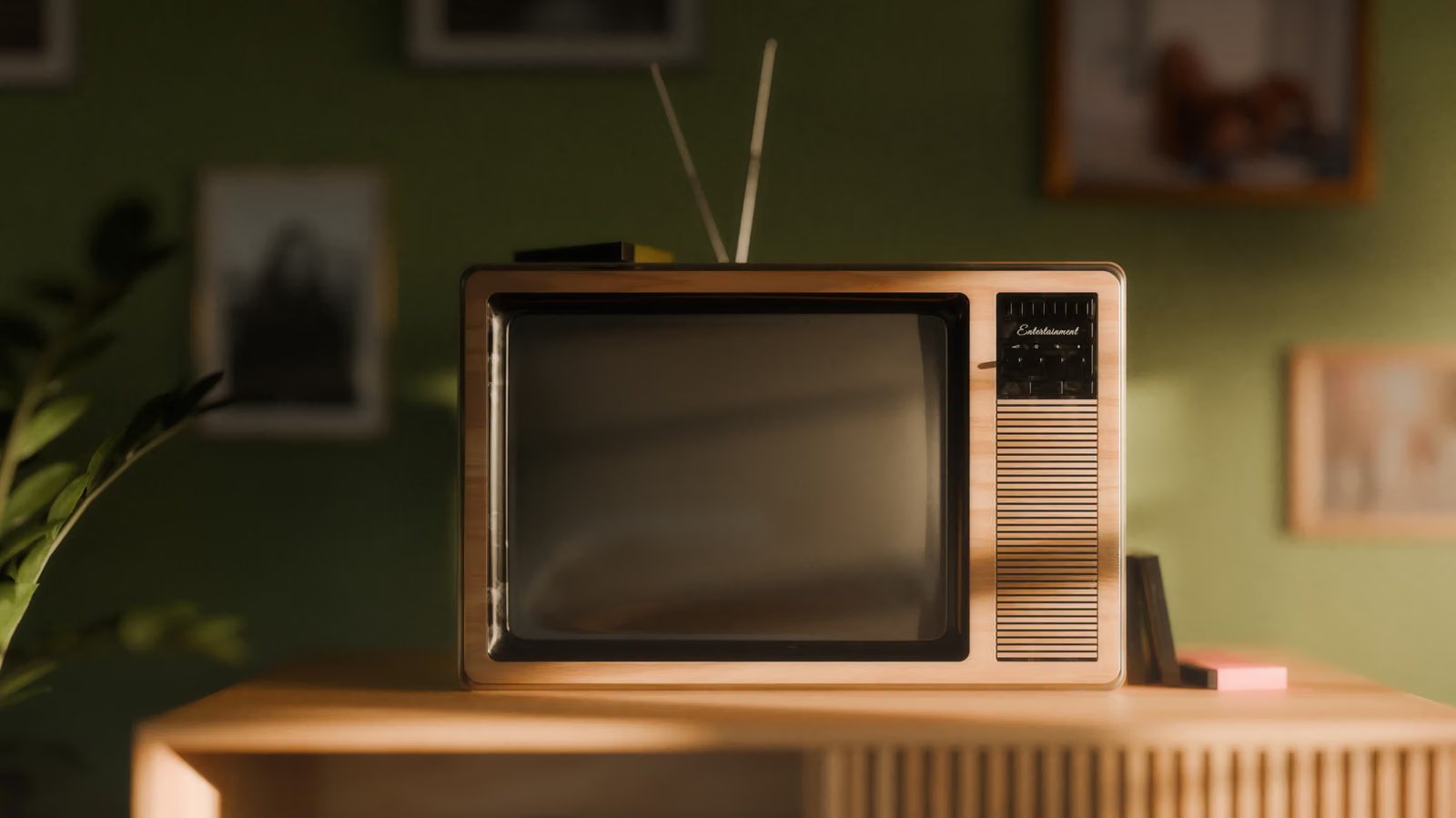
Let's get one thing straight: the analog TV we're talking about here is a different animal from the film cameras and cassette players that are trendy right now. It's not an aesthetic choice people picked back up — it's a technology the government officially phased out. American broadcasters didn't fully shut down analog signals until 2009. How late is that? People were already scrolling through their iPhones while watching static-flecked analog TV.
The principle behind analog TV is pretty straightforward. A camera converts light into electronic signals — the American standard runs 30 frames per second — and turns those pulses into rows of pixels that record color and brightness, paired with horizontal and vertical sync signals that tell the TV where to draw the picture and when to move to the next frame. This whole package is called a composite video signal, broadcast over VHF and UHF bands much like radio, with the picture riding on AM channels and audio on FM channels — sound and image travel separately.
The difference with digital signals comes down to "continuous" versus "discrete" — analog values can be anything within a range, while digital converts all picture and sound into binary code made of 0s and 1s, compresses it into data packets, and transmits it via radio waves, satellite, or cable. Once the TV receives the packets, it reconstructs tens of thousands of pixels into corresponding red, green, and blue intensities. Early compression used MPEG-2, while NextGen TV switched to H.265, which is more efficient and bandwidth-friendly — the same frequency band can now carry more channels, and picture quality can exceed ten times the resolution of NTSC analog signals.
1996 to 2009: A 13-Year Road to Transition
Congress made its move back in 1996, authorizing stations to add new channels for simulcasting digital signals, letting analog and digital run side by side for years. It wasn't until 2009 that all full-power stations were required to go fully digital — older analog TVs needed converter boxes, while new TVs came with built-in tuners. According to Nielsen data, by the time the FCC's deadline arrived, roughly 97.5% of American households were ready for the switch. This wasn't an overnight change — it was 13 years propped up by Congress, industry, and consumer education working together.
ATSC 3.0: Same Upgrade Playbook, Missing Safety Net
NextGen TV — otherwise known as ATSC 3.0 — represents digital TV's next evolutionary leap: it folds internet protocol (IP) into the broadcast signal, promising 4K resolution, better audio, more channels, and multicasting. In theory, this is the same kind of leap as the analog-to-digital switch, but consumers clearly aren't buying in as enthusiastically this time, even with strong industry backing. To watch ATSC 3.0, you'll need a compatible TV or an adapter.
The difference lies in the support system. Last time's transition came with a congressionally set timeline, plus education campaigns and coupons to help households buy new equipment. This time, the FCC hasn't put forward a congressional-level conversion schedule or budgeted for a similar subsidy program. Making matters worse, broadcasters are pushing to add digital rights management (DRM) encryption to the signal — the Electronic Frontier Foundation (EFF) warns this essentially privatizes what was once public airwaves. About one-fifth of American households still rely on antennas for free over-the-air TV, and they'll be hit hardest if the FCC allows broadcasters to fully shut down ATSC 1.0 signals.
John Bergmayer, legal director at digital rights advocacy group Public Knowledge, put it bluntly in an op-ed: the pain of transition tends to hit hardest those who depend on the service most — including access to emergency alerts, news, and public service broadcasting. Last time, the analog-to-digital switch went smoothly not because the technology was so advanced, but because people were willing to spend 13 years building a proper safety net. Whether NextGen TV will follow the same script remains an open question.