A suit can retain its lapels and buttons while making the body appear freer. Shown in Paris in June 2026, COMME des GARÇONS HOMME PLUS Spring/Summer 2027 imagined what might follow the end of war under “If The War Were To End..” Revisiting that June collection, the focus is how Rei Kawakubo changes familiar menswear order: stripes no longer demand neatness, and hats do more than contain the head.
Stripes become moving lines rather than fixed order
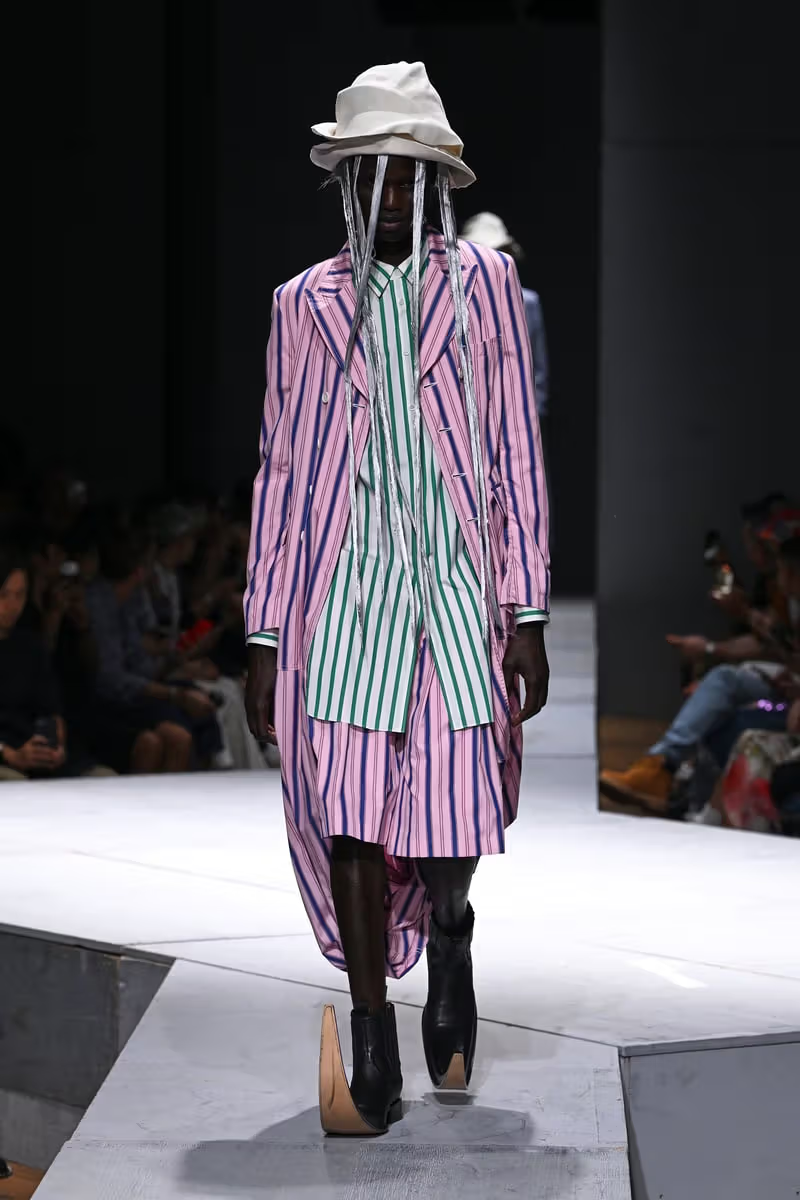
The opening layers pink, purple and mint-green stripes across coats, shirts and lower garments, retaining different intervals and directions. From afar, tailoring’s vertical line remains; close up, it divides into layers. As coats open with movement, stripes become more than a flat pattern. They travel with hems, folds and the body, loosening a surface often used to express correctness.
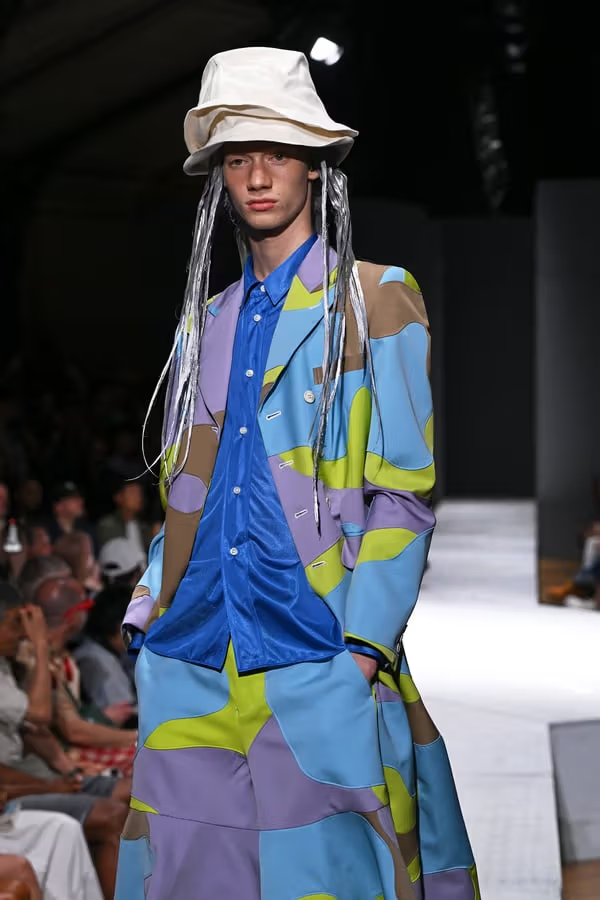
The same colour blocks change density across tailoring and outerwear.
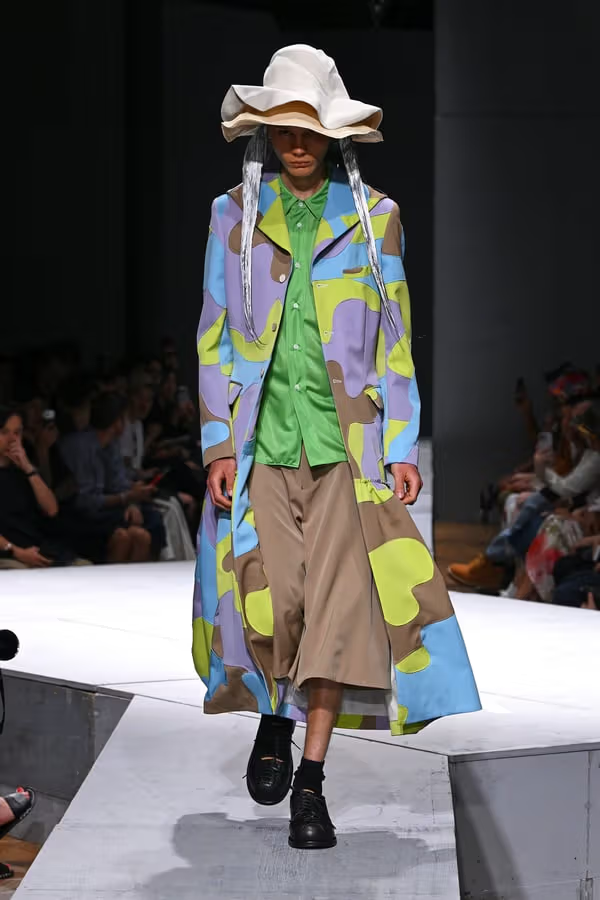
Pastel camouflage changes the method. Blue, pink and yellow-green blocks create soft boundaries, meeting bright shirts and khaki bottoms. Designs moving from straight checks towards organic curves make dissolving borders visible in how patterns enter each other. Pockets, collars and plackets remain, while the surface begins to rewrite their formality.
Pastel camouflage replaces hard borders with organic blocks.
Double hats and pointed shoes stretch proportion at both ends
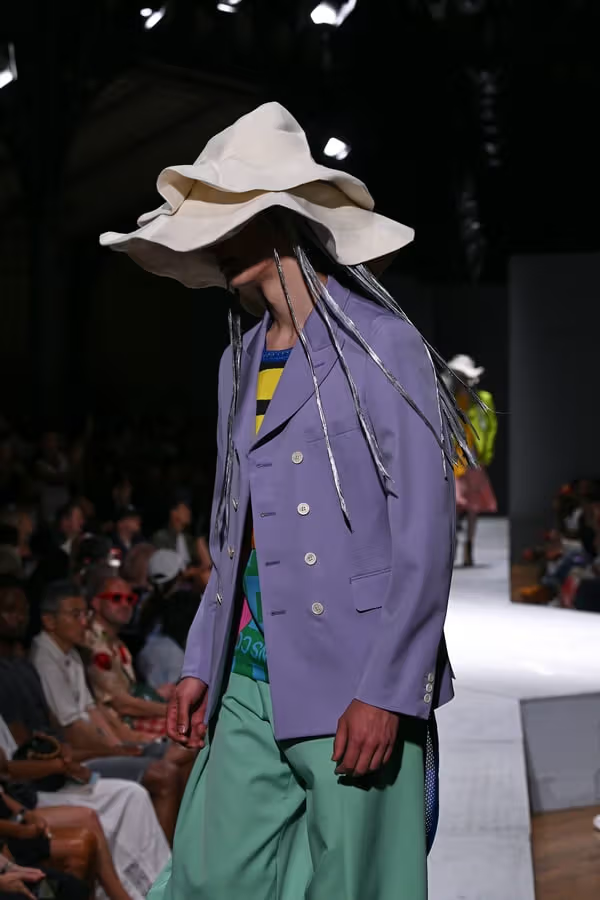
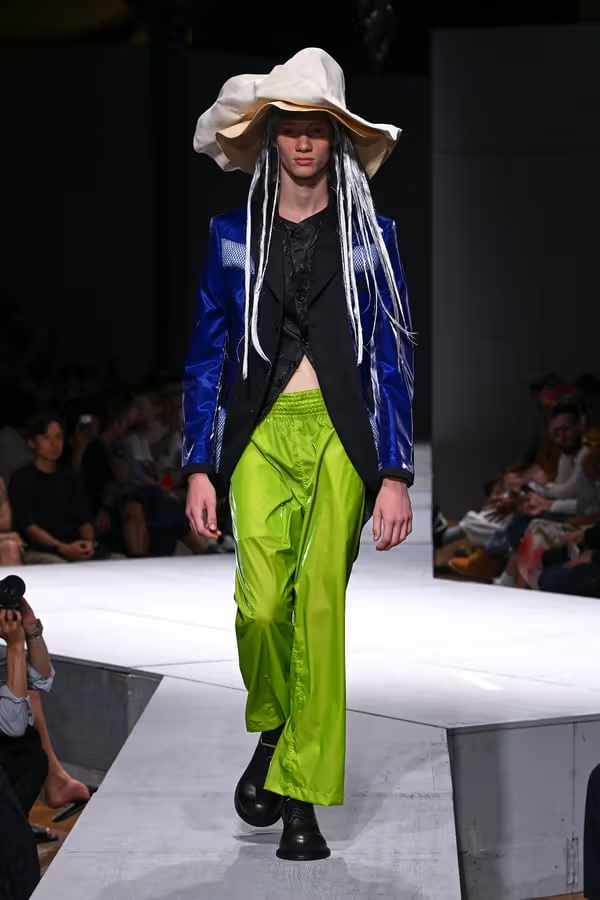
HIZUME’s collaborative hats combine two irregular brims with trailing strips. White and pale crowns stand out against the dark background. Strips run beside the face and down the chest, joining head and clothes, while outward brims contrast with long, narrow coats. Accessories become structures that alter the figure’s proportions, rather than a small final addition.
HIZUME double hats change the relationship between head and shoulders.
Footwear also addresses the body’s limits. Pointed shoes seen in Spring/Summer 2015 return through a Mexicana collaboration, alongside styling with Nike, George Cox and other footwear. Extended toes create tension with wider trouser hems, pulling the eye from the hat to the ground. These are different runway combinations, not confirmation that every shoe is a separately announced collaboration with its own price and retail channels.
After a black foundation, colour becomes collective movement
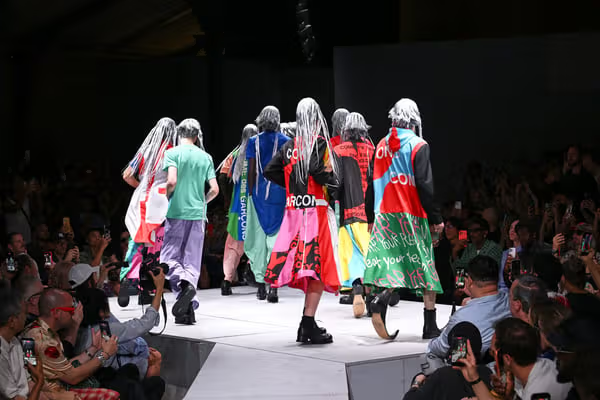
Black remains important, but red, pink and vivid green repeatedly enter, turning dark jackets into frames for other messages. In the finale, models in strong graphic clothing run along the runway together. The looseness built through cloth and proportion becomes group movement. The theme develops over time, from one person’s clothes to a space occupied by many bodies.
Black and bright colours continue to meet towards the end.The finale extends the theme through collective movement.
The useful everyday idea is not to copy an entire runway outfit. Compare the scale of two stripes, reveal one bright inner layer, or adjust upper and lower proportions through a brim and trouser hem. This June presentation is best read as a design retrospective now. Product information still depends on formal local announcements, keeping the runway’s visual proposal distinct from a retail list.