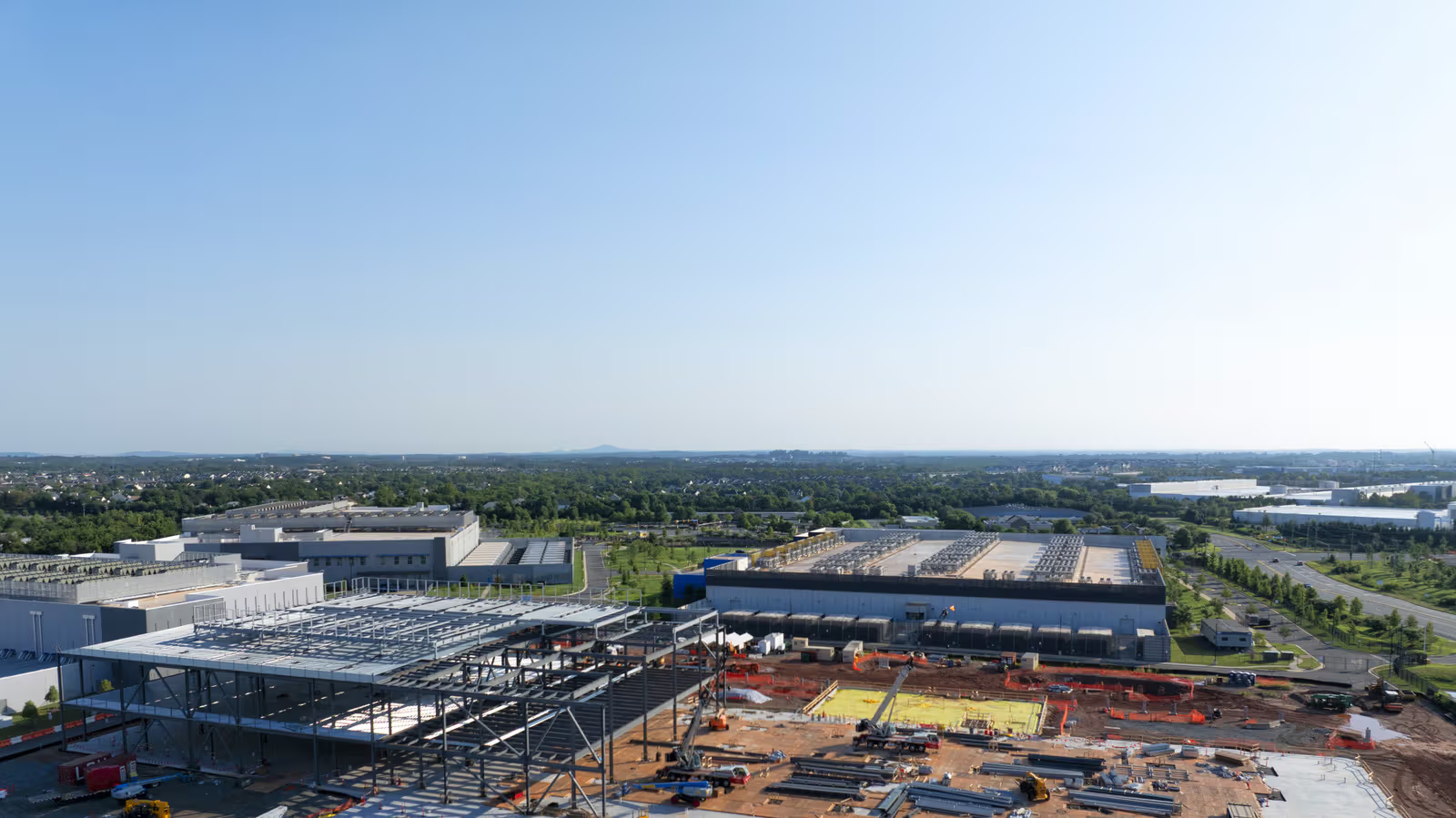
A thermal imaging aerial drone flew over the DataOne construction site in Vineland, New Jersey. The lens showed 62 gas-fired generators as huge as coupling cars, at least 45 of which were running at the same time. This is a picture released after an investigation by Floodlight and the Guardian. It is also the first time that the largest AI data center under construction on the East Coast has been accused of possibly violating federal law.
DataOne, about 40 miles from Philadelphia, is part of a $17 billion partnership between Microsoft and Nebius, a Dutch AI infrastructure company, to gain access to AI computing power. The facility has been plagued by controversy since construction began in 2025: noise complaints, zoning disputes, resident protests, and lawsuits filed by residents are still ongoing. The site is just one mile from two schools.
The problem is not the generators themselves, but whether they are operating legally. Bruce Buckheit, a former U.S. Environmental Protection Agency (EPA) official, said that any site using such generators must obtain a final permit "before they can be used, and especially before they are actually fired up." The aerial footage showed a row of units that were clearly in operation, but none of them had received a permit. Buckheit's conclusion was straightforward: DataOne's actions "violated federal law" and the company should immediately cease operations and pay fines for "illegal emissions."
A spokesman for the New Jersey Department of Environmental Protection confirmed half of that story: The agency "has not issued any permits and there are no permit applications under review for the generators at DataOne's Vineland site." However, the spokesperson also added that the agency still needs to make a "complete compliance determination", which means that it has not yet formally determined whether it is illegal or not. DataOne did not respond to specific questions about unlicensed generators, saying only that the company "continues to be committed to complying with all applicable environmental and permitting regulations" - a statement that is clearly inconsistent with the picture shown in the aerial footage. The Vineland City Council has also issued stop-work orders on this construction site many times. Neither Nebius nor Microsoft has responded to the accusations.
Putting this matter into perspective will make it clearer: DataOne will be a behemoth of 2.7 million square feet when completed. Generally, data centers that support cloud services are usually only about 100,000 square feet, a gap of more than an order of magnitude. Not only are gas generators noisy, but their emissions are also linked to health problems such as asthma and heart disease, which is one of the core reasons for nearby residents to file lawsuits.
Buckheit made a comment on the whole incident: "This industry seems to value speed to market more than anything else." He believes that the people behind DataOne "seem to believe that it is better to kill first and ask for forgiveness later than to apply for permission in advance." The sentence did not name Microsoft or Nebius, but it was particularly jarring to read next to a construction site a mile from the school where 45 of 62 generators were already running.