The secret behind cutting the monthly rent in half: MVNO rents the same signal tower, not the same bill
Monthly rents for AT&T, T-Mobile, and Verizon are often close to a hundred dollars, but virtual telecommunications companies such as Mint Mobile and Visible use the same base stations, and the prices are much lower.
The monthly rental price of a mobile phone is nearly US$100. This is the normal price for postpaid plans of the three major telecom operators AT&T, T-Mobile and Verizon. Most plans start at least US$50. If you want to get those "free mobile phone" offers, you often have to bundle them with the most expensive plan, and the bill is stuffed with a lot of additional services that you don't even use.
But the three companies do not have exclusive rights to the entire signal. There is a whole group of service providers in the market called MVNOs (mobile virtual network operators). They do not build base stations or wireless networks. Instead, they rent large amounts of bandwidth from MNOs (mobile network operators) with physical infrastructure, such as AT&T, T-Mobile, and Verizon, and then sell them to consumers at lower prices. In other words, users who subscribe to Mint Mobile are actually still walking on T-Mobile's network - Mint is a brand of T-Mobile. The difference is that when the network is congested, MNO's direct customers will be prioritized for resource allocation, while MVNO users may experience slower speeds.
The way MVNOs reduce costs is not just by renting the Internet. Most operators do not have physical stores, and customer service relies entirely on the phone or online; mobile phone installments use third-party services such as Affirm instead of being handled by telecom operators themselves; and subscriptions such as streaming platforms are rarely bundled into monthly rental plans. By omitting these links, the price will naturally come down. Most MVNOs adopt a prepaid (prepaid) model instead of postpaid (monthly settlement); traditional contract binding is not common nowadays. Instead, "free mobile phones" are packaged with 24 to 36 months of bill discounts - if the contract is terminated midway, the remaining phone payment must be absorbed by yourself, and the application still requires a credit check.
Differences in prices and plans between the four service providers
Mint Mobile is famous for "the longer the number of prepaid months, the lower the unit price." When ordering a 12-month plan, the 6GB level can be as low as $15 per month; further upwards, there are 17GB, 23GB and the so-called "unlimited" 50GB options.
Visible is an MVNO owned by Verizon. Its main plan is priced at US$275 per year (converted to US$25 per month, tax included) and provides unlimited data, even if you use your phone as a hotspot to share the Internet. Higher-end plans can use Verizon's Ultra Wideband 5G and come with a few days of international roaming.
US Mobile has the greatest flexibility: you can choose one of the three major telecommunications networks when applying. If you want to change networks later, you only need to pay a US$2 handling fee. If you subscribe to the Unlimited Premium plan, you can switch for free at any time. It also provides family plans with multiple lines sharing a data pool, or customized options to combine calls, text messages, and data quotas.
Google Fi Wireless is suitable for users who often go abroad. The Unlimited Premium plan is $65 per month, which is more expensive, but it includes 50GB of data and can be used directly in most countries. There is no need to buy additional passes or worry about overage fees, and you can access the Internet as soon as you land. If the monthly usage is not fixed, the Flexible plan costs US$20 per month including calls and text messages, and data is priced at US$10 per GB. International roaming is also supported.
Conversion process and ten years of use experience
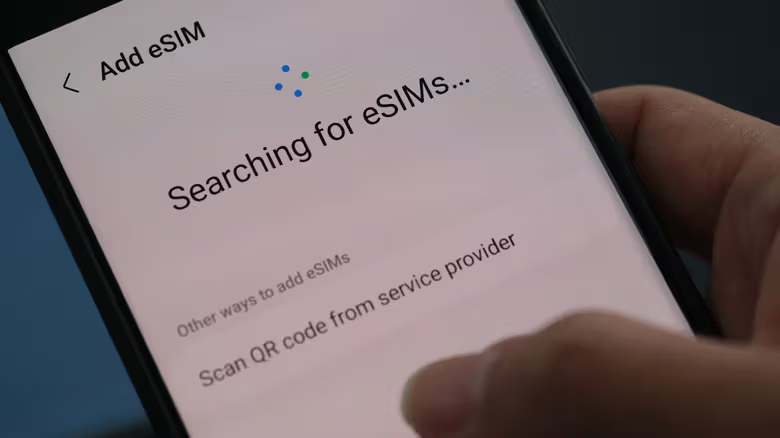
Switching to an MVNO is not complicated. On the official websites of most operators, you can check whether your location is covered and whether your original mobile phone is compatible. If the phone is still in installments with the original telecom provider, the balance must be paid in full before transferring it out; if you want to keep the old phone, follow the original telecom provider's process to apply for unlocking, otherwise you will have to buy another phone from the new operator. The number can be ported directly. Most mobile phones support eSIM (models after iPhone 14 no longer have physical SIM card slots). The connection settings can be completed through the operator's app without waiting for the physical card to be sent.
Engadget author Ben Stegner started using MVNOs at the end of 2015, first using Project Fi, the predecessor of Google Fi, until switching to Mint Mobile in mid-2020. He said that except for occasional minor situations, he never felt that he was using a "second-rate network" and the speed was sufficient to meet all daily needs. He only uses a few GB of data every month, buys bare-metal mobile phones from the original manufacturers, and doesn't subscribe to many other services. Therefore, the combination of "free mobile phones" and "unlimited data" from major telecommunications companies is not cost-effective for him. He also mentioned that during his subscription to Mint, the data volume of the lowest-end plan was gradually adjusted from 3GB when he first joined, to 4GB in 2021, 5GB in 2023, and to 6GB in 2026, and the price has never changed.
If you are using a plan from the three major telecom providers, first calculate how much data you actually consume per month - you don't need to have "unlimited" data. Buying a bare machine with a cheap plan may save you money in the long run.