Flash memory is ubiquitous, but a wave of price increases in 2026 is breaking its comfort zone
NAND flash memory relies on the behind-the-scenes remedy of the controller to cover up wear and speed issues, but TrendForce predicts that NAND contract prices will rise sharply for two consecutive quarters in 2026, and AI and data center demand are bringing the price issue to the sun.
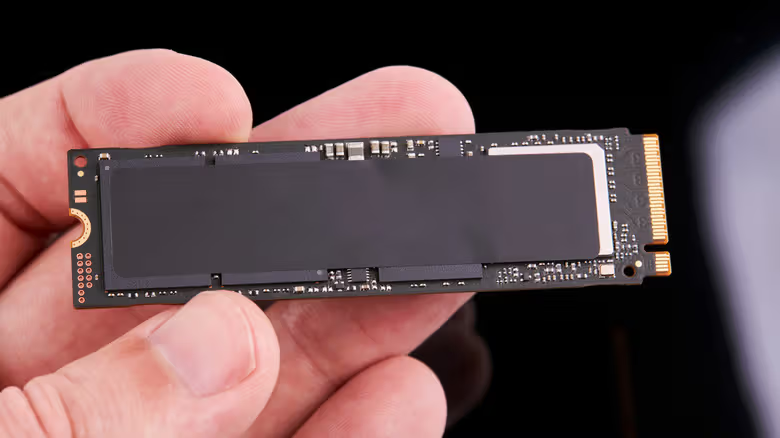
From the flash drive dangling on the keychain to the invisible chip hidden in every mobile phone and every SSD, NAND flash memory has long completed an invisible upgrade. It relies on memory cells that store charges in the insulating layer to record data. It will not disappear even if the power is turned off. It is small in size and large in capacity, so it is stuffed into various devices such as SSDs, smart phones, and memory cards.
However, this technology has had two inherent flaws from the beginning: the cost per unit capacity is higher than that of traditional hard drives, it will wear out after writing and erasing too many times, and the speed is far slower than system RAM. Most users won't notice these problems, and the reason is simple - modern storage devices spend a lot of time cleaning up the mess behind the scenes for flash memory.
3D stacking and QLC reduce costs at the expense of durability
NAND can achieve its current density by relying on the 3D NAND structure of vertically stacked memory cells, coupled with TLC and QLC designs, so that each memory cell can store three or four bits of data. This approach has indeed lowered the cost per unit capacity, and also allows SSDs to no longer rely on rotating disks and read-write heads. The boot speed and shock resistance have also been improved. Anyone who has changed to an SSD will remember that after booting, the computer no longer needs to "breed" for a long time before being willing to open the browser.
However, the number of writes and erasures that each memory cell can withstand is limited. The more bits you cram in, the narrower the error margin between voltage ranges becomes, which is why QLC NAND typically has lower endurance and performance than simpler designs. The old name "flash read-only memory" is actually a bit misleading, because flash memory can be erased and rewritten.
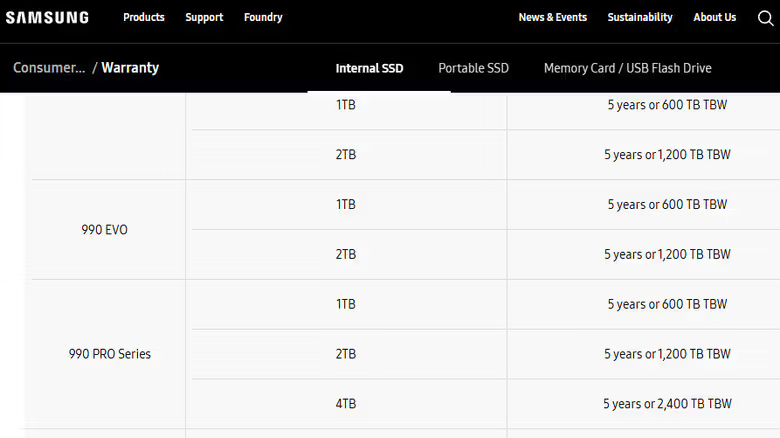
The controller minimizes wear and tear problems to a level that is imperceptible to users through wear leveling, error correction, replacing unstable blocks, and retaining spare capacity. The TRIM and garbage collection mechanisms deal with another NAND quirk—data can be written in smaller page units, but erasing can be done in larger block units. Samsung provides a five-year or 600TB write capacity warranty for the 1TB 990 Pro, but this does not mean that the hard drive will be reimbursed if it reaches 600TB. Samsung has not clearly stated the end of its lifespan - important data still needs to be backed up.
Durability can be compensated for by algorithms, but the price cannot.
Compared with the issue of wear and tear, price is a shortcoming of flash memory that is more difficult to cover up. Traditional hard drives are still a cheaper and large-capacity option in scenarios such as backup and large media libraries that do not require high speed. According to TrendForce’s forecast, NAND contract prices will increase by 70% to 75% in a single quarter in the second quarter of 2026, and will rise by another 10% to 15% in the third quarter. This is due to tight supply and the continued increase in AI and data center demand.
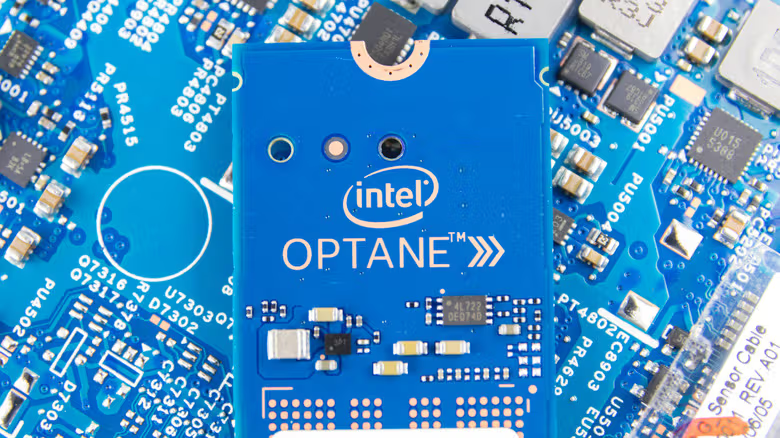
Due to these shortcomings of flash memory, some people have actually thought about replacing it. Phase-change memory (Phase-change memory) was regarded as a potential alternative as early as 2006. Intel later launched Optane, which also tried to get stuck between DRAM and NAND, focusing on being faster and more durable than NAND, but Intel began to close Optane in 2022. Research on MRAM, ferroelectric memory, etc. is still ongoing, but there is no candidate that can truly replace NAND as mainstream storage. At the same time, the number of layers in commercial 3D NAND has exceeded 300, and this technology obviously has no plans to stop.