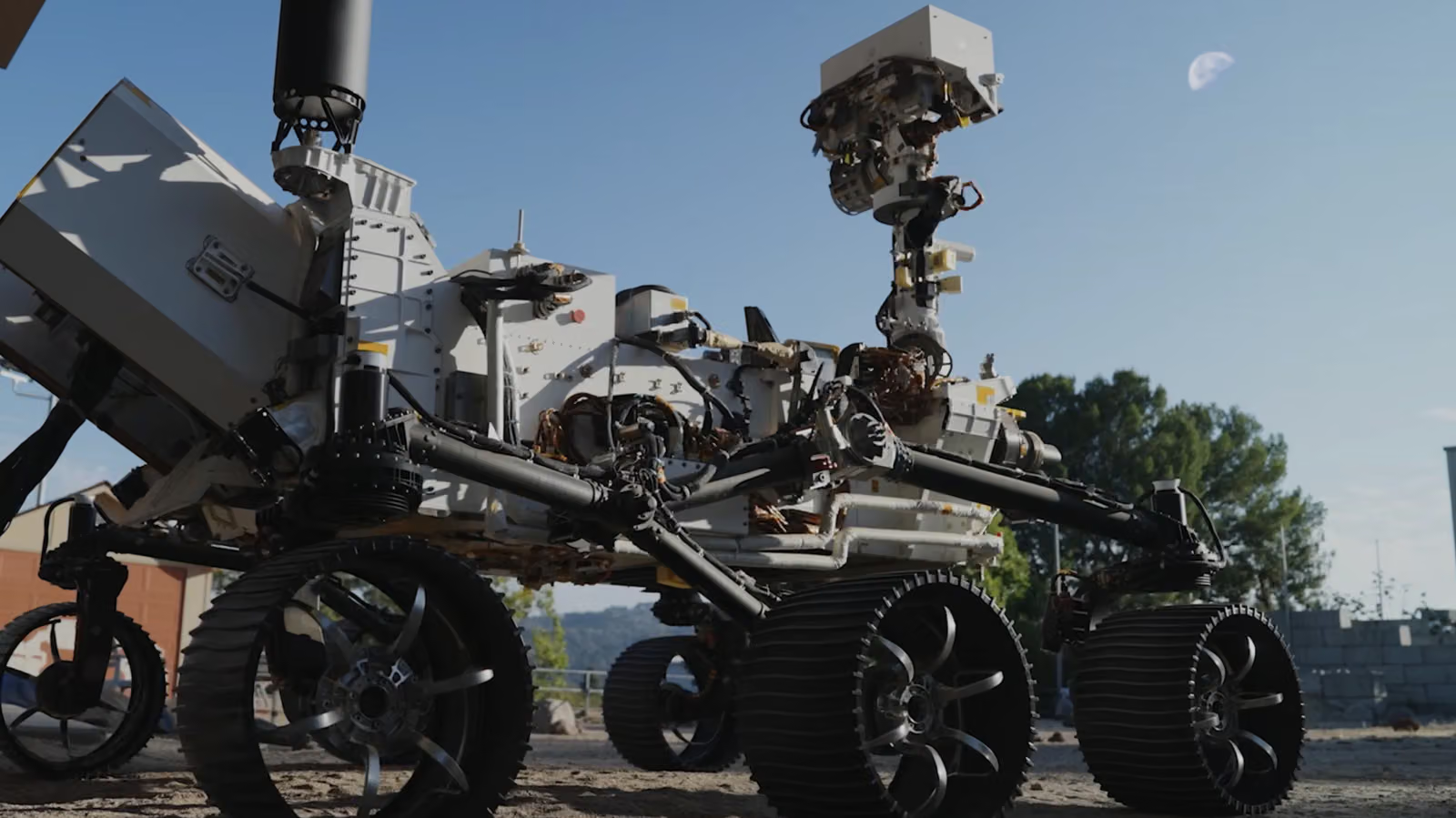
Curiosity and Perseverance each have a full-scale replica on Earth, whose job has always been to help their Mars-bound counterparts test new functions—engineers would run commands on these Earth-based twins first to confirm everything worked before sending instructions up to Mars. They were never built to leave Earth. Now that arrangement is being upended: NASA plans to actually send one of them—or a hybrid combining both—to the Moon.
The rover is currently called PROMISE, short for Polar Rover for Observation, Mapping and In-Situ Exploration, a new proposal NASA put forward in late June this year. According to reports from Ars Technica, the BBC, and The Planetary Society (the nonprofit founded by Carl Sagan), the rover is built on the chassis of a Perseverance engineering test vehicle. NASA's official reveal video opens with footage of Perseverance landing on Mars before cutting to this Earth-based twin—but according to official statements, PROMISE is actually a hybrid of both the Perseverance and Curiosity engineering test rovers, potentially carrying features from both.
Before the rename, PROMISE was known as OPTIMISM, or Operational Perseverance Twin for Integration of Mechanisms and Instruments Sent to Mars. NASA Administrator Jared Isaacman addressed the decision during a briefing on lunar base plans: "We've had years of operational experience with these two rovers, and this hardware represents a real investment of taxpayer dollars. So someone asked: 'What if we sent it to the Moon?' ... This would bring a pretty significant capability to the Moon's south pole in a short amount of time."
A Rover That Doesn't Need Sunlight to Explore
NASA plans to use PROMISE to scout the Moon's south pole—a region considered a top candidate for future lunar bases due to its abundant water ice deposits—with mission objectives including mapping the lunar surface and subsurface structures. The rover will be equipped with a Multi-Mission Radioisotope Thermoelectric Generator (MMRTG), which converts heat from the natural decay of plutonium fuel into electricity, allowing it to operate without relying on sunlight.
Carlos García-Galán, program manager for the lunar base initiative, explained the significance of this power source: "With a nuclear RTG on board for a lunar mission, we can go anywhere we want, regardless of lighting conditions. Surviving the lunar night is going to be one of the biggest challenges for this capability, and it's something we don't have to worry about at all."
That said, PROMISE is still very much in the concept stage. OPTIMISM itself isn't flight-ready yet and will need a series of modifications and upgrades. According to The Planetary Society, the rover currently lacks temperature-control sensors, scientific instruments suitable for an actual flight mission, a communications system, and a power generator—and its components haven't yet been tested against the coarse, sharp lunar dust it would encounter. In other words, there's still a substantial amount of engineering work needed to turn this lab-bound stand-in into a Moon-ready explorer.
The Planetary Society estimates that the PROMISE project could cost NASA somewhere between $700 million and $1.3 billion, with a launch unlikely before the early 2030s.