Panasonic Lumix L10 review: In the retro craze when fixed focus is dominant, it chooses to install a zoom lens
The Panasonic Lumix L10, priced at US$1,500, is equipped with a 24-75mm equivalent zoom lens and a 20.3-megapixel sensor. It takes a different route in a retro camera with a fixed focus lens, and tested the continuous shooting, focus and image quality performance.
Putting a 24-75mm equivalent zoom lens into a pocket camera is not a common thing in this retro camera craze. Fujifilm's X100 VI, Ricoh's GR series, and even several popular Leica cameras are all fixed-focus lenses - you have to walk back and forth with your feet to compose a picture. The Lumix L10 launched by Panasonic this time goes in the opposite direction, using the zoom lens as a selling point, directly targeting ordinary players who want to easily shoot events, parties, and travel.
Engadget reporter Steve Dent took this camera on a trip to northern Canada to actually test the practicality of the zoom lens during the trip. He used macro mode to shoot dragonflies and wildflowers in British Columbia, and also used continuous shooting to track wild animals and portraits. The overall score was 8.7 out of 10. His conclusion is straightforward: the image quality, speed, and control are all above par. The only thing that makes people hesitate is the price of US$1,500.
Take over from LX100 II, weight in exchange for better control
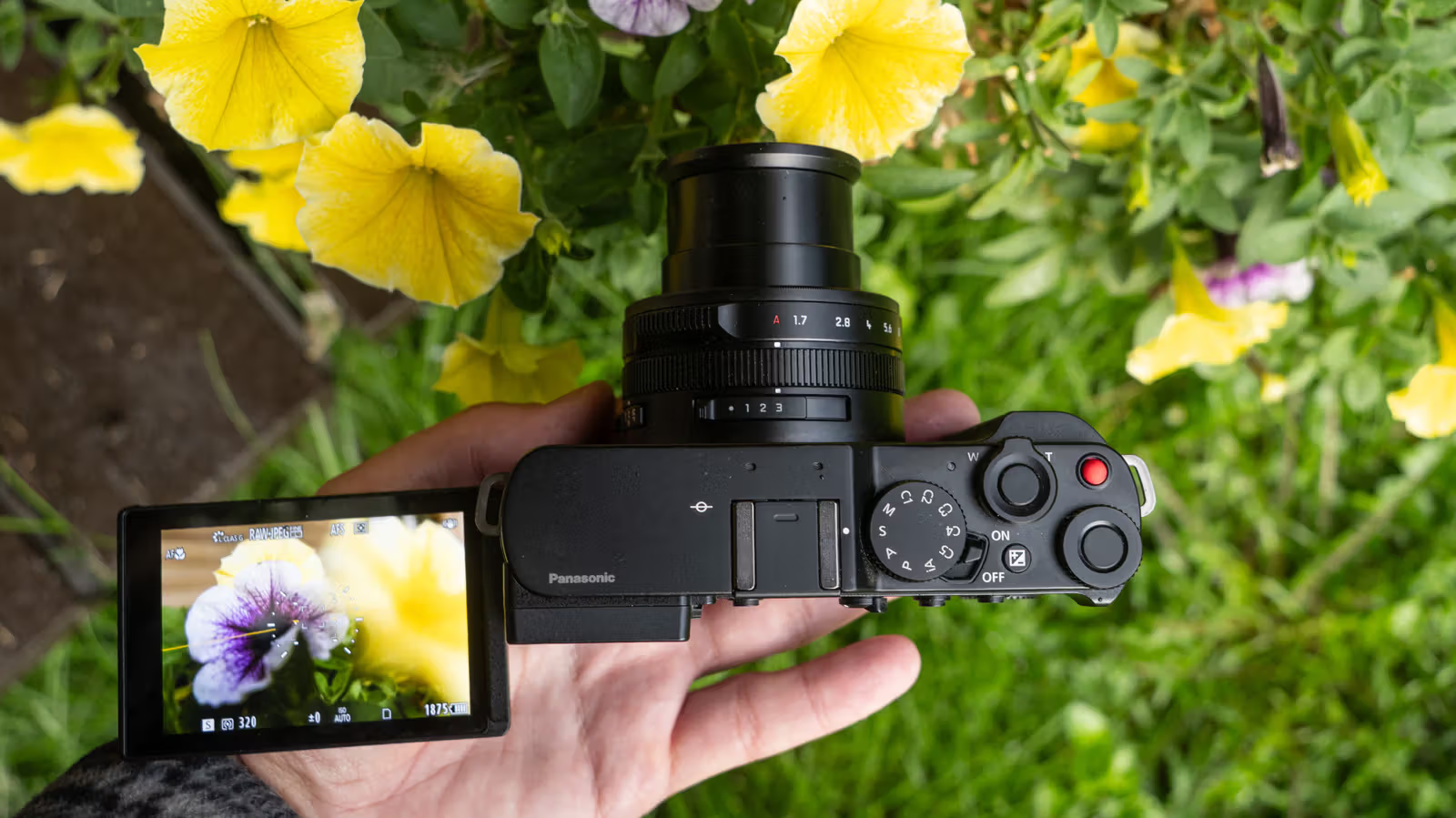
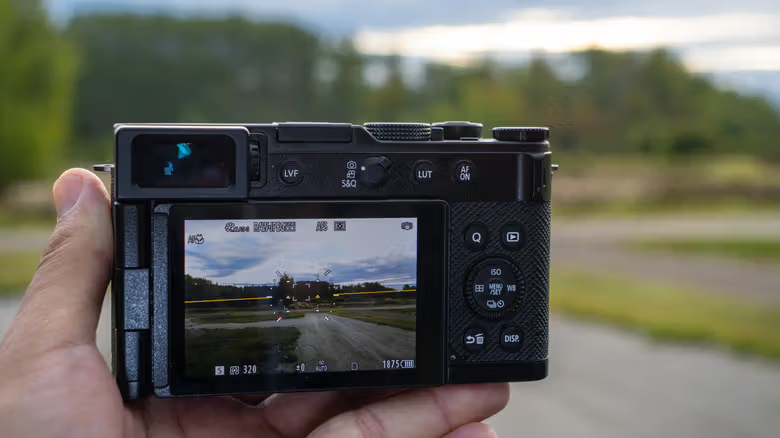
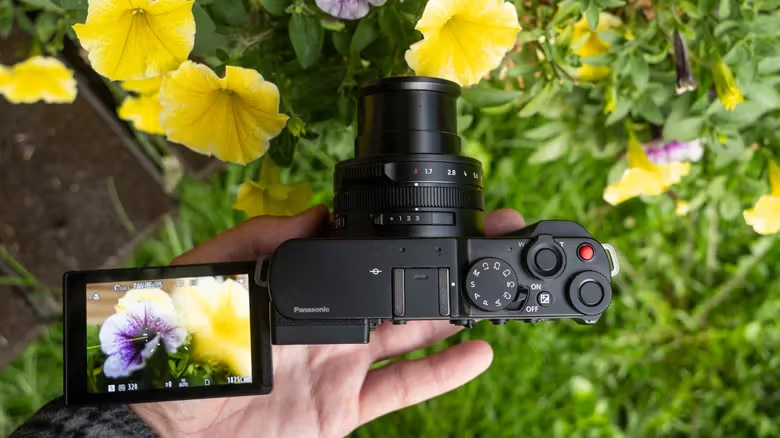
The L10 is the successor to the Panasonic LX100 II, but its size is significantly enlarged: it weighs 508 grams, which is much heavier than the 392 grams of the LX100 II, and therefore lacks the lightness that a pocket camera should have. The body retains two dials, a photo/video/S&Q switch key, and a dozen configurable buttons, and also adds a four-stage aspect ratio switch key. Originally, the shutter speed and exposure compensation dials on the LX100 were removed, and Dent thinks this trade-off is not a pity.
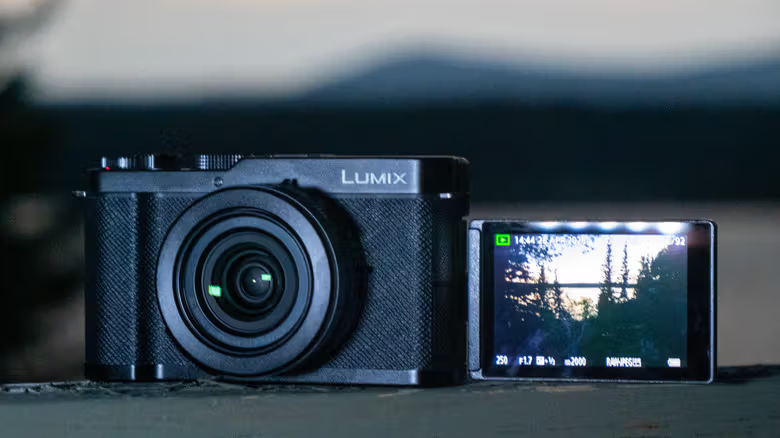
The lens follows the LX100 II's 24-75mm f/1.7-2.8 equivalent Leica zoom lens. The aperture is large enough and the image is quite sharp. In macro mode, the wide-angle end can focus to 3 centimeters, and the telephoto end can focus to 30 centimeters. The screen has been upgraded to a fully flippable 1.8 million-dot screen, which is much more practical than the fixed screen of the LX100 II, and is helpful for selfies and video shooting. The viewing window has a resolution of 2.34 million dots. Although it is not top-notch, it at least has this feature more than the Canon PowerShot V1 of the same level - the latter does not have a viewing window at all.
The battery is a full-size DMW-BLK22, which can be used with many Panasonic cameras. It can take 420 pictures on a single charge, view 1,000 pictures in power-saving mode, and record 4K 60p for 100 minutes. The SD UHS II slot is separated into a separate compartment, making it easier to change cards, which is not common in small cameras.
The photosensitive element has been upgraded, and the continuous shooting speed has more than doubled.
The interior of the L10 is replaced with a Four Thirds sensor cut from the GH9 II, with a resolution of 20.3 million pixels, which is a bit higher than the 17 million pixels of the previous generation. The continuous shooting speed has also been greatly improved: the mechanical shutter with continuous autofocus can reach 9 frames per second, and it can reach 30 frames per second in electronic shutter mode, far behind the 5.5 frames per second of the LX100 II, and also surpassing its main rivals RX100 VII (up to 20fps) and Fujifilm X100 VI (20fps).
The focus system is replaced with phase hybrid focus, with a total of 779 focus points, replacing the less stable contrast focus of the LX100 II. Dent's actual focusing success rate is good when shooting wildlife and portraits, although it is not as reliable as the latest models from Sony and Canon. The camera supports AI subject recognition and can recognize people, animals and vehicles. The recognition of dogs and deer is stable, but it can occasionally be inaccurate in complex forest scenes.
The stabilization system only relies on optical anti-shake of the lens, and the body itself does not have five-axis anti-shake. This is where this camera loses to the X100 VI on the specification sheet. Optical anti-shake works well when the shutter speed is as slow as about one-fifth of a second, but it is obviously difficult to shoot while walking. Although electronic anti-shake adds a little more smoothness, it has to sacrifice a section of the frame to crop, so the effect is still limited.
Aspect ratio can be switched with one click, and the LUT button can be directly connected to the customized color tone.
There is an exclusive aspect ratio switch key on the side of the fuselage, which can quickly switch between 4:3, 3:2, 16:9, and 1:1. It is very convenient for those who want to shoot JPEG directly for sharing. This design also appears on Fujifilm GFX 100RF and other models. Another practical button is the "LUT" button - in addition to Panasonic's built-in styles, such as L. Classic Gold and Leica Monochrome, users can also download or create their own tones through the Lumix Lab App and apply them to photos and videos instantly.
The image quality performance is the most surprising part of the L10 this time. At low ISO, there is less noise than the LX100 II and more details. The cropping space becomes larger as the resolution increases. The colors of JPEG are pleasing straight out, and there is little need for post-production adjustments. The dual-gain sensor has a good low-light performance in the Micro Four Thirds specification. Noise is almost invisible below ISO 2,500, and it is still controllable all the way to ISO 12,800 - but small sensors have limits after all, and noise will quickly get out of control when underexposed. RAW files retain enough room for adjusting dark and bright areas, and the camera also has a built-in dynamic range optimization function. It also uses high and low gain circuits to synthesize images to bring out more details in bright light scenes. This is a function that the LX100 II does not have.
The video specifications exceed the target, but the body does not have a fan to limit the recording time.
Although Panasonic positions the L10 as a camera-first model, the video specifications are actually quite solid: it supports up to 5.6K 60fps, provides 10-bit and V-Log formats, and can shoot at 120fps in 4K specifications. The body does not have a fan to dissipate heat, so the continuous recording time is limited - 4K 60fps will overheat after about 10 minutes, while 4K 30fps can shoot for 20 minutes. It is not suitable for shooting weddings or long-term events. Phase focus operates smoothly during video recording, without the common focus problem of the LX100 II; the ISO lower limit for V-Log recording is 500, which is much lower than the 2,000 of the GH6, making it easier to take into account the dynamic range when shooting log material in the sun.
The Panasonic Lumix L10 has a suggested retail price of US$1,500, which is the same price as the Sony RX100 VII and slightly cheaper than the US$1,800 of the Fujifilm X100 VI. The X100 VI has a more solid body and a larger sensor; the RX100 VII relies on its 24-200mm f/2.8-4.5 telephoto lens, but uses a smaller 1-inch sensor. Among the three cameras, Dent's personal choice is the L10 - the flexibility of the zoom lens, the flip screen and the faster response speed allow it to take a different path in this retro camera craze with prime lenses.