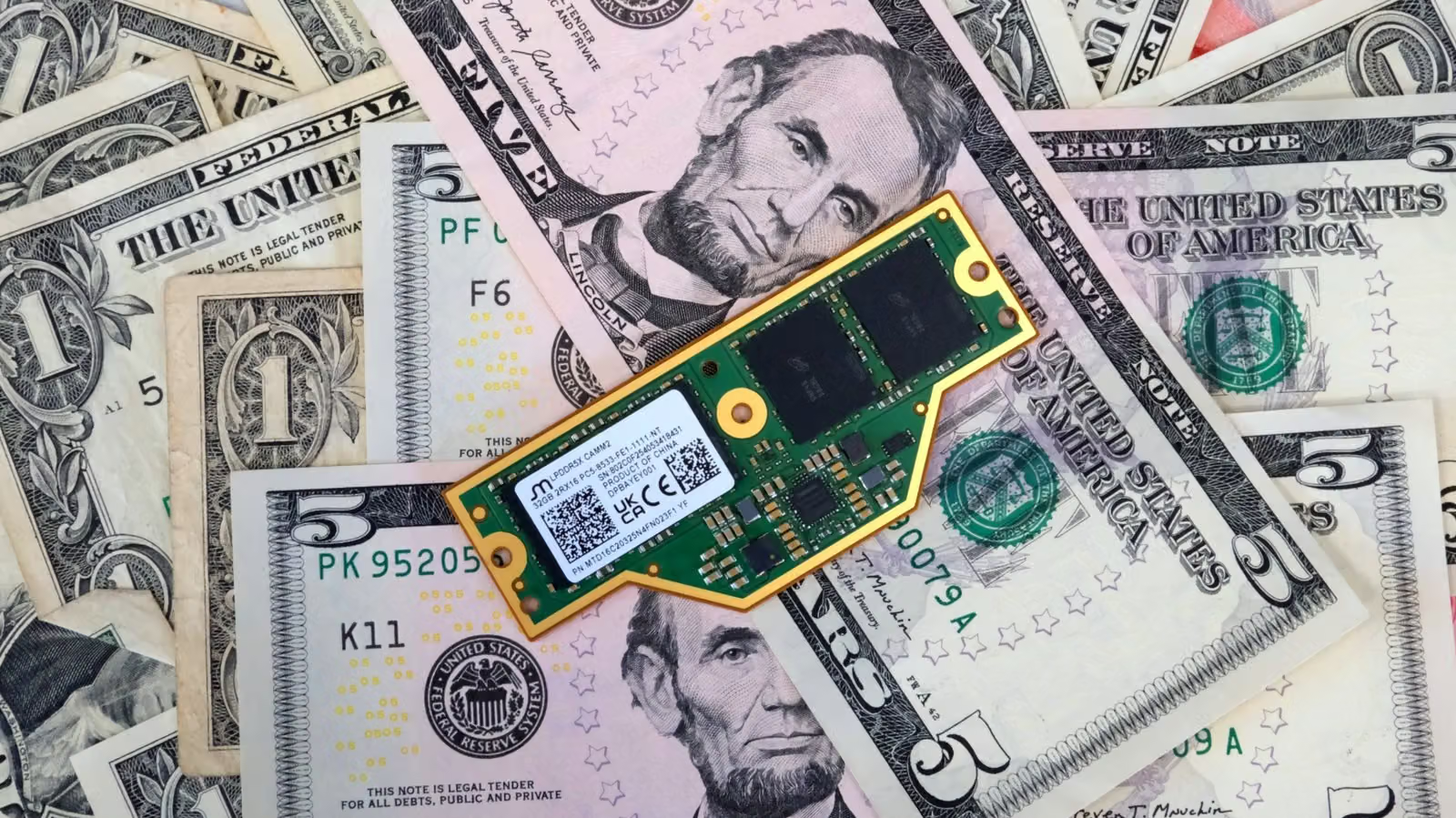
At the end of 2025, Micron did something rarely seen in the RAM industry: it shut down Crucial, the consumer memory brand it had operated for years. Micron EVP Sumit Sadana explained at the time that this was to "improve supply to a larger, faster-growing customer base." In plain terms: the wafers are going to whichever AI customer pays more, and regular consumers are on their own.
This isn't an isolated case for one brand—it's happening across the entire RAM market. According to price tracking from PCPartPicker, a pair of 16GB DDR5-4800 modules cost under $100 at the start of 2025 and now runs past $400. The high-end 32GB DDR5-6000 is even more absurd—once just over $250, it now costs more than $1,200, roughly the price of a MacBook Air.
The problem isn't a shortage of materials—it's that DRAM is competing with HBM (High Bandwidth Memory) used for AI training for the same batch of wafers. Micron CEO Sanjay Mehrotra put it bluntly to investors in 2024: every unit of HBM consumes roughly three times the wafer supply of consumer-grade DDR5. In other words, every extra piece of HBM produced means three fewer pieces of capacity that could have gone into DRAM. And the appetite for HBM orders comes from AI companies like OpenAI, which have received massive investments and are under pressure to scale up compute at any cost.
Just how extreme is the scale? Look at xAI's Colossus data center in Memphis. According to data from infrastructure firm Introl, the facility houses 550,000 NVIDIA GPUs, with hardware alone worth $18 billion, including 520,000 Grace Blackwell 200 units (up to 192GB of memory each) and 30,000 Grace Blackwell 300 units (up to 288GB each). If these servers are all maxed out on memory, the amount of RAM used by a single facility would be equivalent to the combined memory of more than 9.33 million Galaxy S26 phones. Bloomberg reported this past March that there are 831 facilities of comparable scale under construction worldwide. DigiTimes has even claimed that all major manufacturers' 2027 RAM production has already sold out.
The Big Three Are in No Rush to Fix the Problem
Global RAM production is basically split between Samsung, SK Hynix, and Micron. Building a new fab costs billions of dollars and takes years—SK Hynix's two new memory fabs under construction in South Korea represent a total investment of $3.81 billion, and mass production won't start until at least June 2029 at the earliest. But beyond the capacity bottleneck, the more realistic issue is this: none of the three companies has any real incentive to speed up a fix. HBM margins are far higher than regular DRAM, and AI giants are willing to pay sky-high prices to secure supply. Micron reported quarterly revenue of $28.86 billion this June, with a gross margin of 84.9%; SK Hynix posted "record-breaking" revenue in July, with operating profit up 557% year-over-year; Samsung's memory division likewise posted all-time-high revenue and profit. The Wall Street Journal also reported that Micron has directly approached the White House, asking the government to step in and stop customers from switching to other suppliers.
As for when prices might come back down, the outlook is uniformly grim. SK Hynix CEO Kwak Noh-jung told Reuters that things will only get worse in 2027, and the supply shortage could persist beyond 2030. Micron's Mehrotra told investors this June that "the tight situation is expected to continue beyond 2027 (i.e., into 2028)." Deloitte's assessment is that relief likely won't come until at least 2030.
If you're planning to upgrade your computer or phone, there's no clean answer here—just one takeaway: as expensive as prices are right now, they're likely still cheaper than they'll be in the next few years. Buy if you actually need it, but don't stockpile for resale profit—that will only make this price surge burn even longer.