Boyoung Jeong’s The 0 Degree of Looking in Hong Kong ends October 31: light in paintings of a glass swan, windows and carousels
THE HARTZ PROJECT’s The 0 Degree of Looking enters its final week. Five oil paintings from 2023–2026 move from tabletop objects and buildings at night to a diptych, with a closer look at materials, dimensions and visiting details in Wong Chuk Hang.
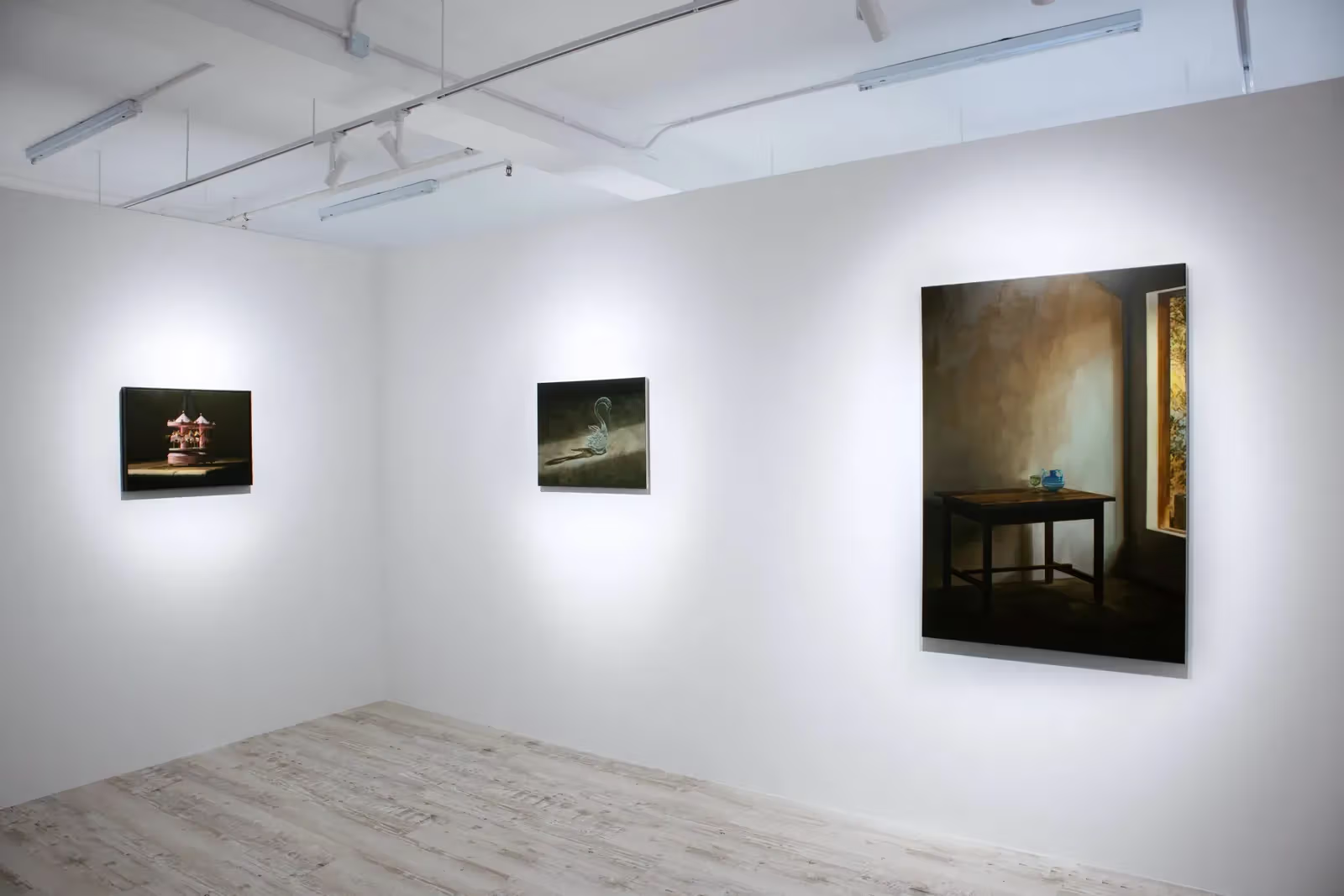
Boyoung Jeong’s solo exhibition The 0 Degree of Looking at THE HARTZ PROJECT in Wong Chuk Hang, Hong Kong, ends on October 31. The Korean artist uses interiors, windows, night scenes and everyday objects to focus attention on how light changes the act of looking. The exhibition includes oils on canvas from 2023, 2025 and 2026, rather than an entirely new group made this year. Begin with tabletops, shadows and the distances within each image, without rushing to supply every scene with a story.
Tables and a transparent swan show how light directs attention
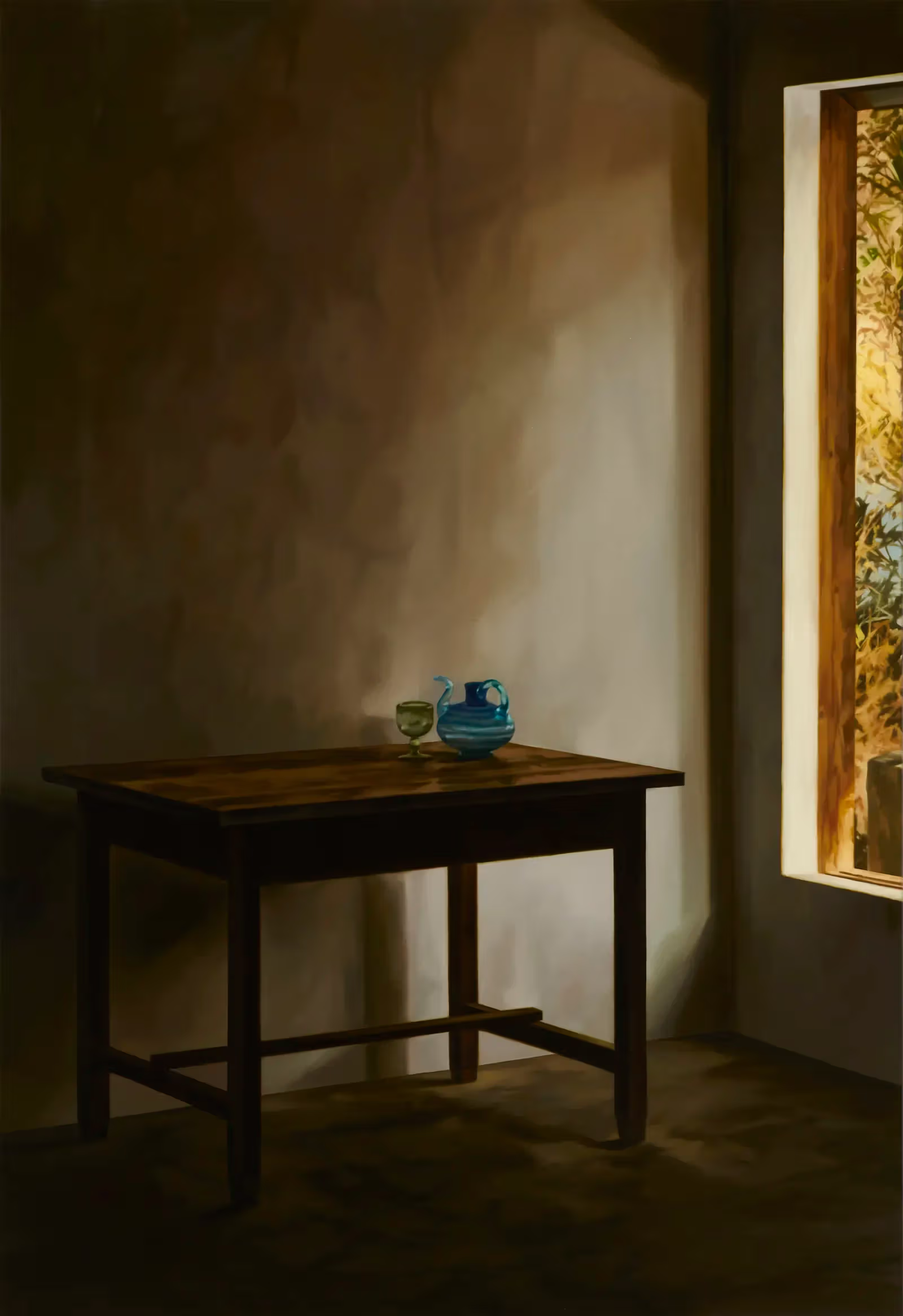
Still Looking (2023) measures 130 × 97 cm and depicts a dark table, a green stemmed glass and a blue pitcher, with a window on the right bringing in light and brightly lit plants. No one appears in the painting, yet the light gives the tabletop a sense of weight. Broad areas of darkness on the wall make the small objects’ colours easier to notice. Start with the window frame’s straight lines, then follow the table legs and shadows. This interior is not evenly illuminated; its distribution of light and dark establishes an order for looking.
Still Looking (2023) connects a green glass and blue pitcher on a table with window light on the right and darkness across the wall.
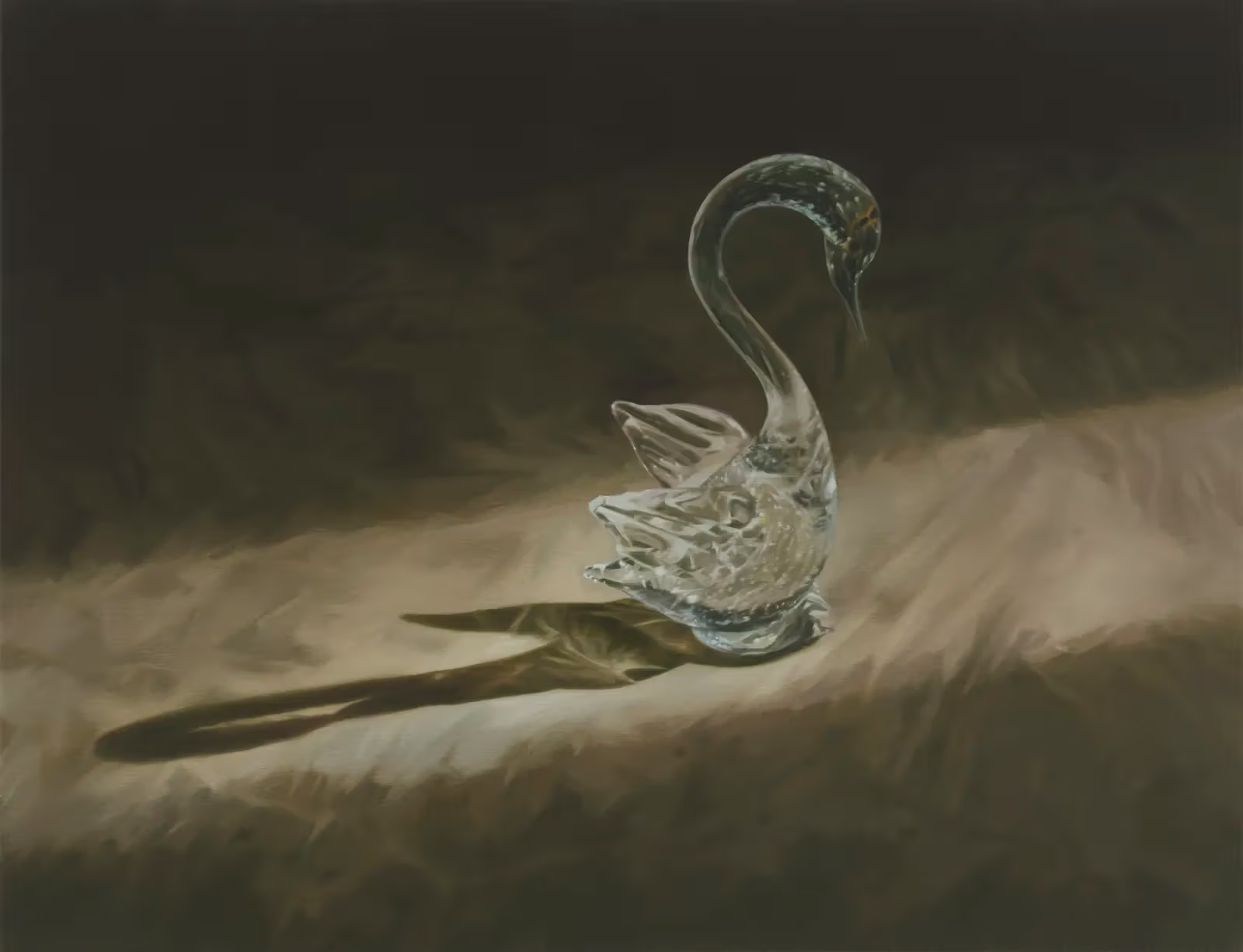
Transparent Shadows (2026) reduces the scale to 50 × 65.2 cm. This oil painting on canvas depicts a transparent swan ornament resting on fabric. The impression of light passing through it, reflections from its facets and an elongated shadow make the object more complex than its outline alone. Look at the ornament together with the shadow toward the lower left: the former is concentrated in a small, three-dimensional shape, while the latter extends outward into another, looser form. The difference between soft fabric texture and sharp reflections gives the painting a tangible sense of touch.
Transparent Shadows (2026), an oil painting on canvas, depicts a transparent swan ornament, fabric and an outward-reaching shadow.
Night scenes and a diptych change the way space is read
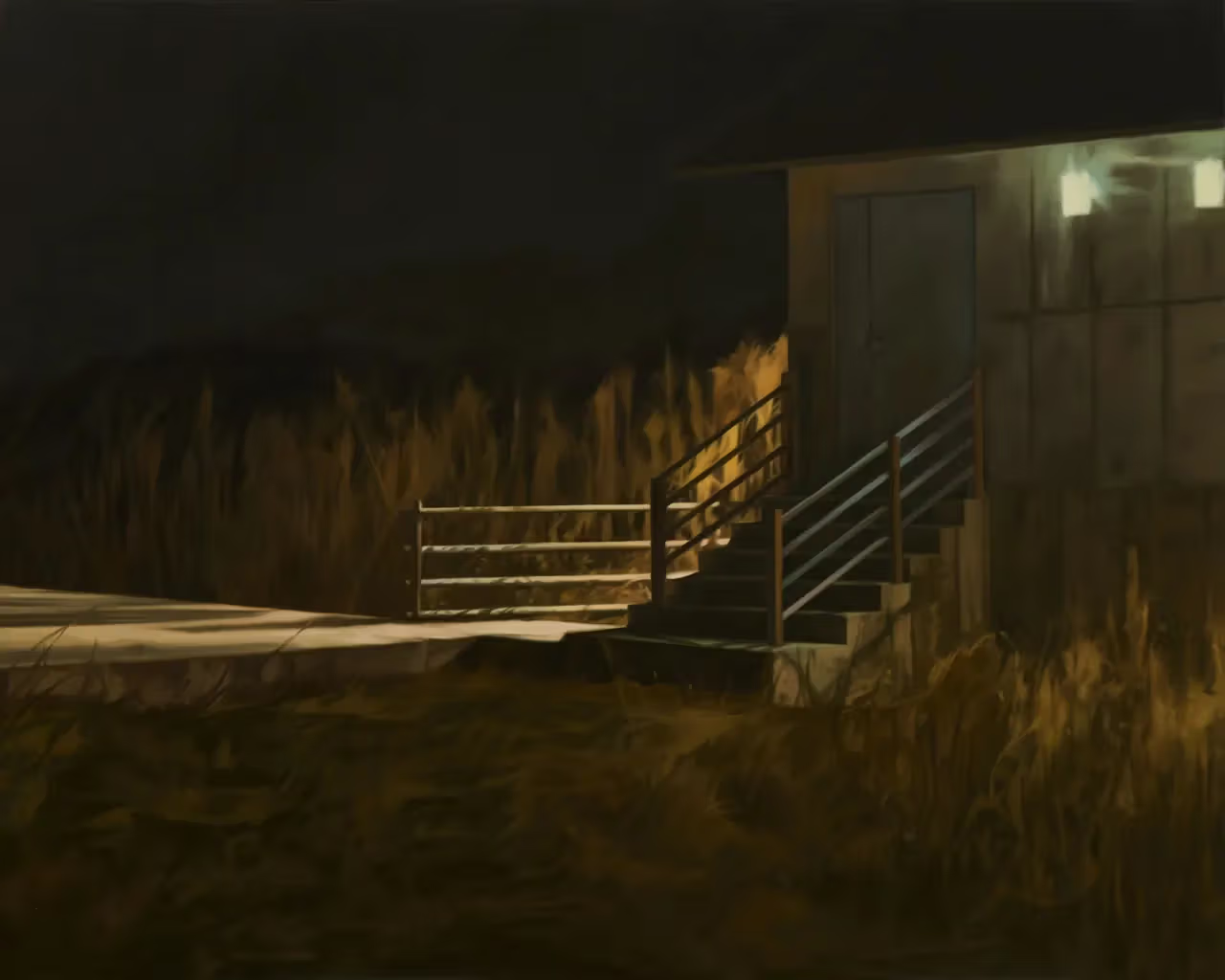
Still Eyes in Motion #2 (2025), also oil on canvas, introduces a building, steps, railings and grasses within a 73 × 91 cm image. The bright ground and railings draw the eye toward the building on the right, while the dark upper area presses down on the space. There is no city landmark that needs identifying. Instead, follow how horizontal and diagonal lines meet and where the light stops. Compared with the preceding interior still lifes, the scene moves outdoors, but light and dark continue to govern how its space is read.
Still Eyes in Motion #2 (2025) creates spatial layers through light and dark between a building, steps, railings and grasses.
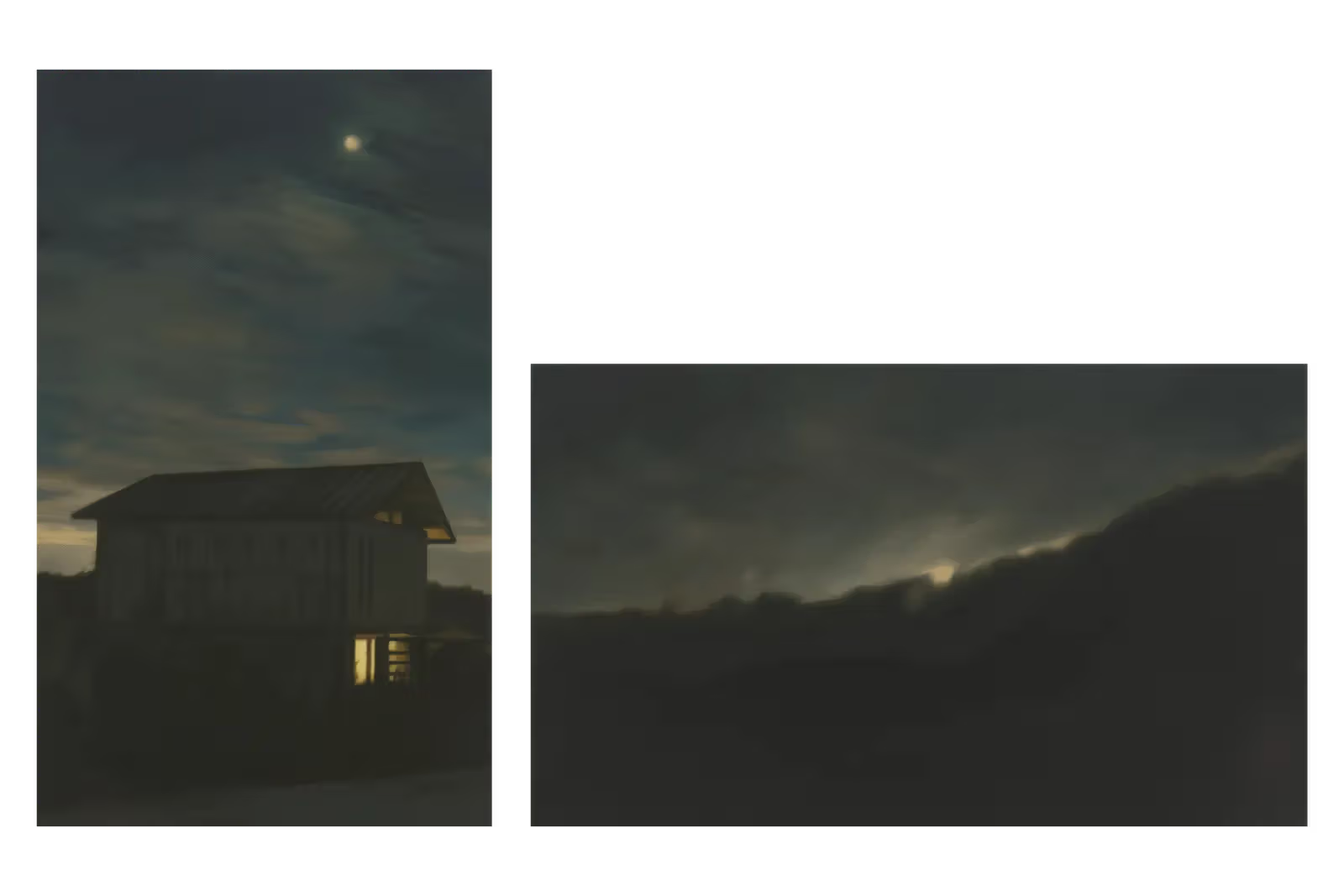
Blue Hour (2025) is a diptych: the left canvas measures 45.5 × 27.3 cm and the right 27.3 × 45.5 cm, both painted in oil. The upright image on the left contains a building and an illuminated window, with a tiny bright point above; the horizontal image on the right extends into clouds and a brighter gap along the horizon. The two orientations need not be assembled into one continuous landscape. Instead, compare how similarly faint light creates different senses of distance in a setting of walls and windows and in an open sky.
Blue Hour (2025) forms a diptych from a vertical image of a building and a horizontal image of sky.
Carousel still life and visiting details in Wong Chuk Hang
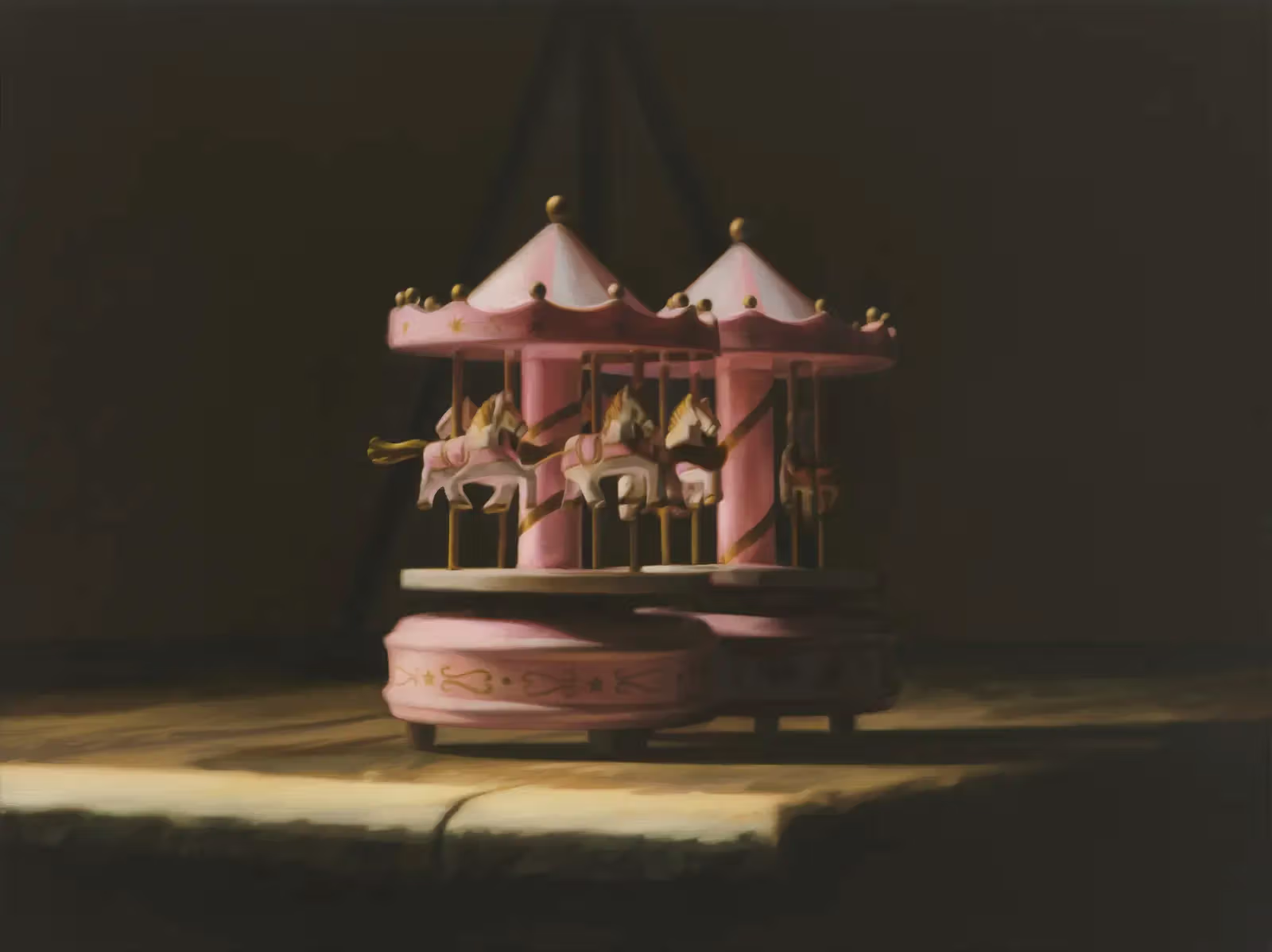
The smaller Being Limited (2026), an oil painting on canvas measuring 45.5 × 60.6 cm, makes two pink carousel-shaped objects its still-life subjects. Their pointed roofs, posts and horses overlap in the light, while the fabric beneath catches their shadows. Seemingly unrelated to a window scene, it similarly uses a few bright areas to bring objects out of darkness. The gallery’s curatorial text draws on Roland Barthes’ concept of neutrality to propose a way of looking less burdened by established narratives. Following these specific details of light and shadow offers a closer approach to the work than rushing to define “stillness.”
Pink carousel-shaped objects in Being Limited (2026) form a still life between a dark background and brightly lit fabric.
The gallery is in Room 2301, M PLACE, 54 Wong Chuk Hang Road, Hong Kong. Its official general opening hours are Tuesday–Saturday, 11:00–19:00, with closures on Sundays, Mondays and public holidays; the telephone number is +852 8490 2954. Before visiting, browse the official exhibition and artwork pages to choose images you would like to compare and plan your visit. The gaps between works also allow small still lifes and larger interiors to establish different rhythms of looking.