Cheung Cheuk Wai at HKU: horses, a dragon and Five Blessings, free until January 10, 2027
HKU’s University Museum and Art Gallery presents calligraphy by Cheung Cheuk Wai. Compare forms, empty space and horizontal or vertical proportions through five official artwork images, with admission, opening hours and November tour details.
Looking at a character as an image brings its weight, direction and empty spaces into focus. Ink Rhymes Through a Millennium: Calligraphy by Cheung Cheuk Wai opened at the University Museum and Art Gallery, The University of Hong Kong, on October 16, 2026, and continues until January 10, 2027. Admission is free, on the first and second floors of the Fung Ping Shan Building. The late Hong Kong calligrapher’s varied scripts and subjects offer an accessible route from repeated comparisons of “horse” and “blessing” to a horizontally extended “dragon”, without requiring viewers to memorise technical vocabulary first.
Horses and Five Blessings: different forms of the same character
The large-seal-script horse work, also called Painting of Eight Horses, dates to 1990 and measures 140 × 22.5 cm. The official image shows eight forms alternating across a long, narrow sheet: some outlines are squarer, while others suggest bent limbs. Smaller inscriptions and red seals below introduce another scale. The interest lies in how the same character retains recognisable clues while changing length and centre of gravity. Finding similarities before differences turns identification into visual comparison.
The 1990 large-seal-script horse work, Painting of Eight Horses, arranges eight forms in a narrow vertical composition.
Five Blessings in Seal Script measures 128 × 16.5 cm and arranges five different small-seal-script forms of the blessing character on gold-flecked red paper. Compared with the horses on yellowish paper, the red background and gold flecks first alter the overall mood; intervals between the five forms give repetition a beat. Begin with spaces within each character, then compare how lines on either side enclose them. Structural variation prevents a repeated blessing from feeling mechanically copied, giving a reason to slow down before a handwritten image.
Five Blessings in Seal Script contrasts five forms of the blessing character with gold-flecked red paper.
A horizontal dragon and the reading pace of regular and cursive scripts
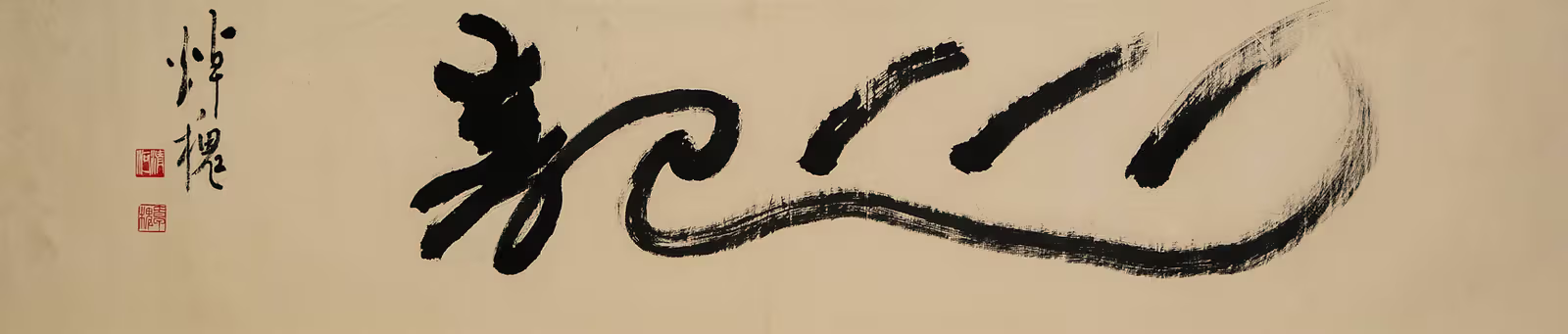
The cursive dragon measures 30 cm high by 140 cm wide, abruptly shifting the format horizontally. Large strokes extend from a denser area on the left towards the right, with pale dry-brush traces breaking through dark ink before the end rises upward. Unlike comparing the eight horses character by character, here one can follow the whole line before returning to its pauses, turns and thinning passages. Meaning remains, but movement across the paper already creates a reading close to looking at an image.
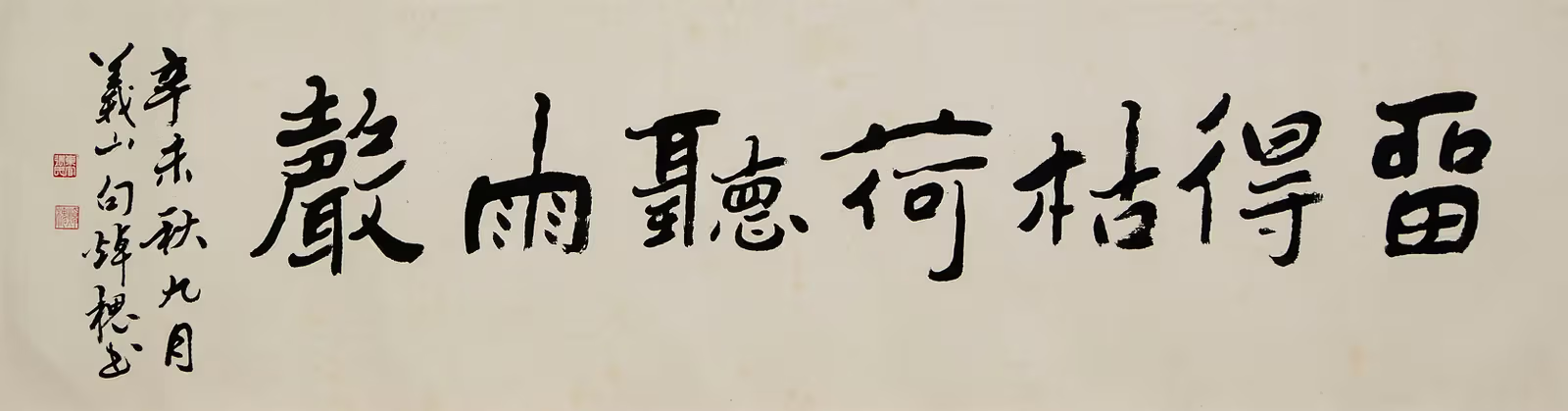
The regular-script verse “留得枯荷聽雨聲”, about leaving withered lotus leaves to hear the rain, is a horizontal work measuring 27 × 101 cm. Seven large characters run right to left beside a smaller inscription. Compare it with the cursive “此中別有天然趣”, about an inherent natural charm, measuring 115.2 × 18 cm: the former gives each character a stable place, while the latter extends a long curve down its vertical format. Rather than immediately choosing a preferred script, compare spacing, paper proportions and stroke widths to see how they affect reading pace, bringing text and composition into view together.
The regular-script horizontal verse “留得枯荷聽雨聲” offers comparisons of stroke widths and character spacing.The cursive verse “此中別有天然趣” extends a long curve along the left side of a vertical format.
Free admission and guided tours: check opening hours first
Cheung Cheuk Wai lived from 1935 to 2022 and founded Yi Geng Shu Xue She in 1989. Students from the society jointly contributed the official online interpretation, placing years of learning alongside the works. Newcomers can use it to verify titles, dimensions and scripts before returning to the images or gallery. The guide also provides original wording and English interpretations, allowing meaning to be checked before observing how a character becomes part of a whole through paper proportions, spacing and brush movement.
The museum is at 90 Bonham Road, Pokfulam, Hong Kong. It opens Tuesday to Saturday, 09:30–18:00, and Sunday, 13:00–18:00, and closes on Mondays and public and university holidays. Official tours last 20–30 minutes, including an English session at 13:00 on November 3; registration follows the date links, with no guaranteed walk-in place. The official exhibition information links to the artwork guide. Choose one horizontal and one vertical work, then use their actual dimensions to imagine two viewing distances.