Giorgio Griffa’s first Asian solo show at Tai Kwun: lines, bare canvas and Campo blu, free until January 30, 2027
MASSIMODECARLO Hong Kong presents four cycles by Griffa, from the 1970s to new work in 2026. Five official artwork and installation photographs explore how folds, unpainted areas and colour fields change the reading of abstract painting.
A painting need not be stretched on a frame, and its creases can remain visible. Italian artist Giorgio Griffa’s first solo exhibition in Asia opened at MASSIMODECARLO Hong Kong on October 16, 2026, and continues until January 30, 2027, with free admission. At Tai Kwun in Central, the selection draws on four of his thirteen cycles, spanning the late 1970s to 2026. Lines of colour, bare fabric and surfaces left unfilled allow the works to be approached through relationships between material and time as well as abstract pattern.
Canvas without stretchers: folds become clues
Born in Turin in 1936, Griffa still lives and works there and began exhibiting in 1968. The approach he developed in the late 1960s includes removing canvas from its stretcher, painting with diluted acrylic on the floor, then attaching its upper edge so the cloth hangs freely. Edges, tension and folds remain part of the viewing experience: the image is not a plane enclosed by a rigid frame, and the fabric itself helps determine the work’s shape.
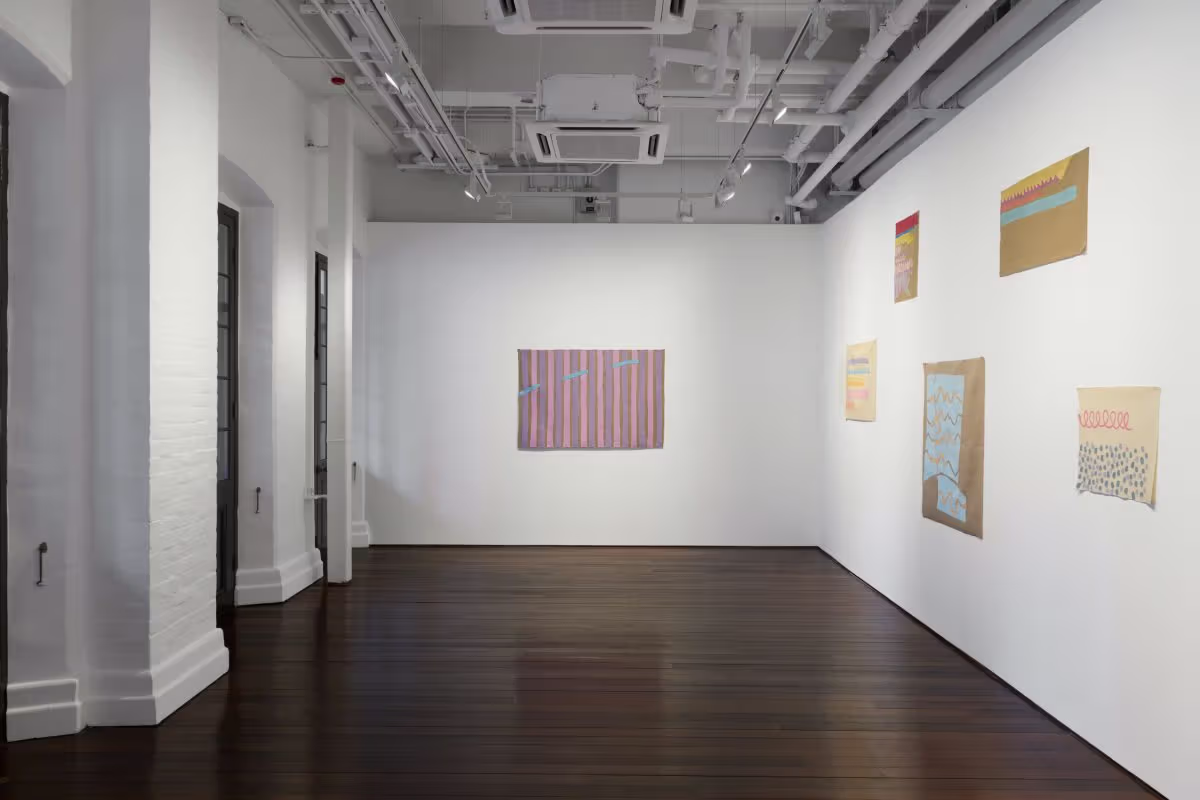
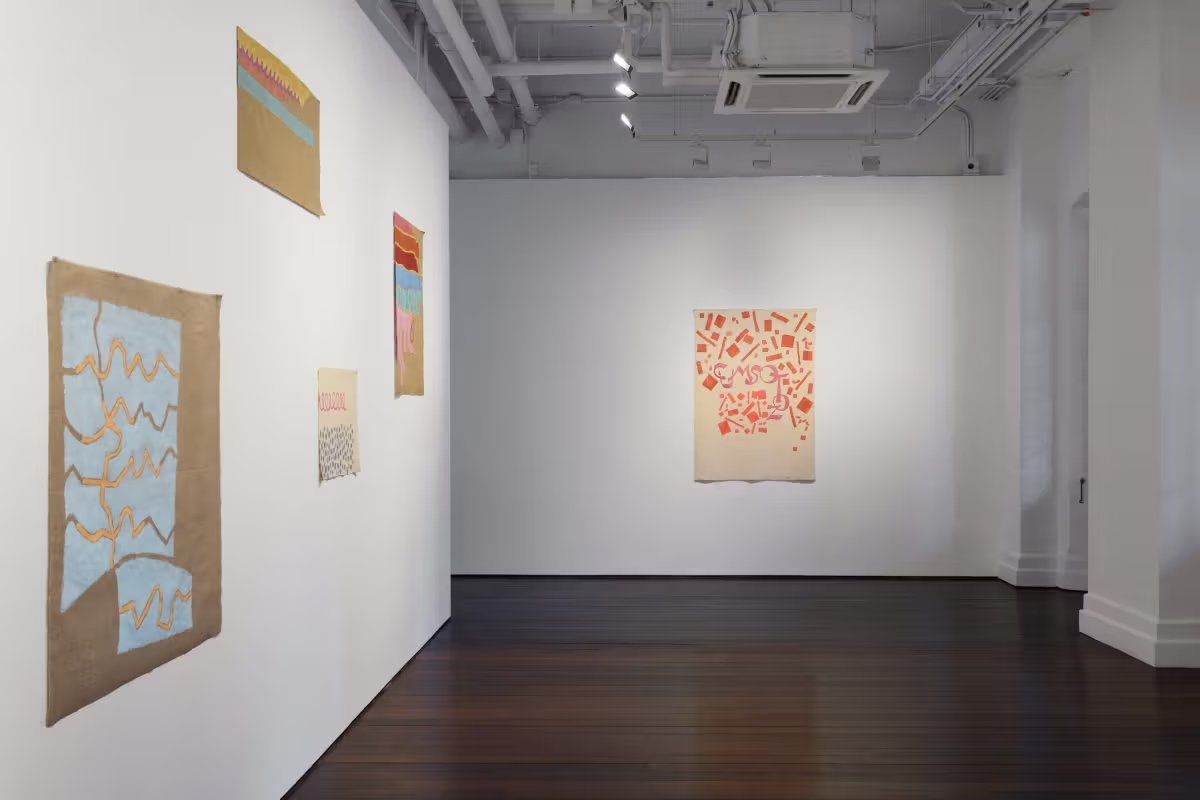
In the official installation photographs, a horizontal work with purple stripes and short blue lines faces several smaller paintings hung at different heights on the right wall. Red, yellow and blue bands, pink curves and dotted marks share the wall with broad areas of brown, unpainted fabric. Unlike a chart in a tidy row, the works vary in dimensions and hanging positions. Step back first to consider the gaps, then approach each piece to compare how similar colours produce different beats through horizontal lines, waves and small dots.
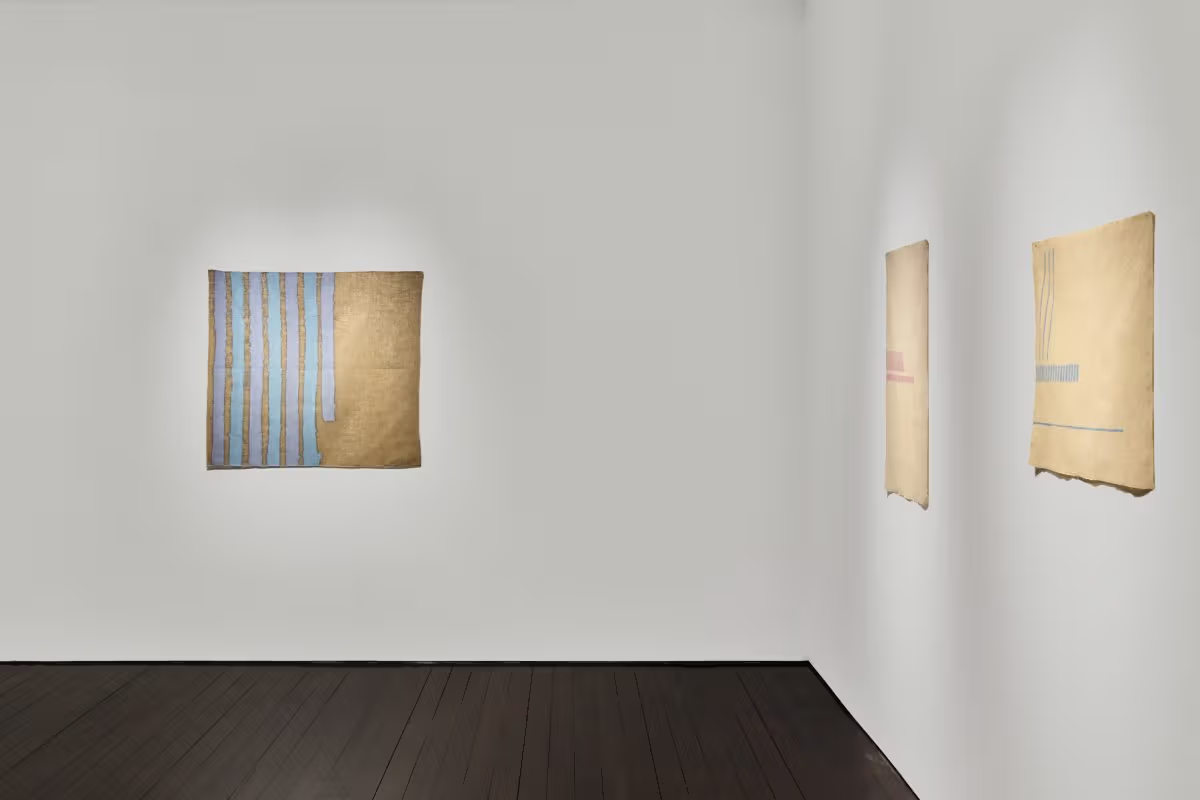
Another corner retains broad unpainted areas around blue vertical bands and smaller line-based works.Four works vary in format and density between white walls and a black door frame.
From Campo blu in 2026 to works of the 1970s–90s
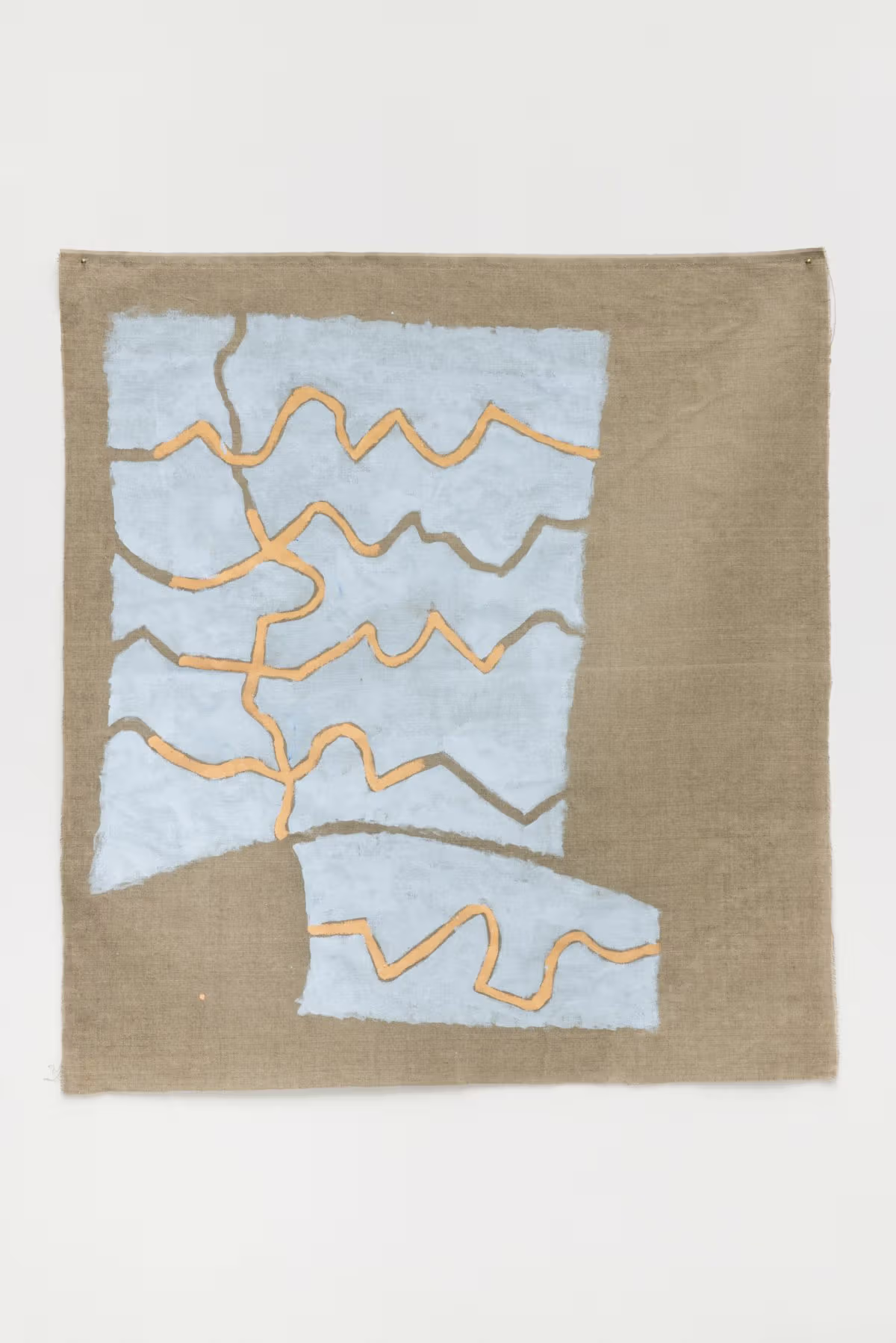
Campo blu from 2026 offers a close-looking example. Its artwork photograph shows pale blue over darker linen, irregular field edges and ochre-yellow curves rising and falling within them, while a broad area on the right retains the fabric’s own colour. Fold lines cross the paint, allowing image and material texture to coexist. There is no need to identify blue immediately as sky or sea: following the field boundaries and then the turning curves already establishes a concrete way of reading it.
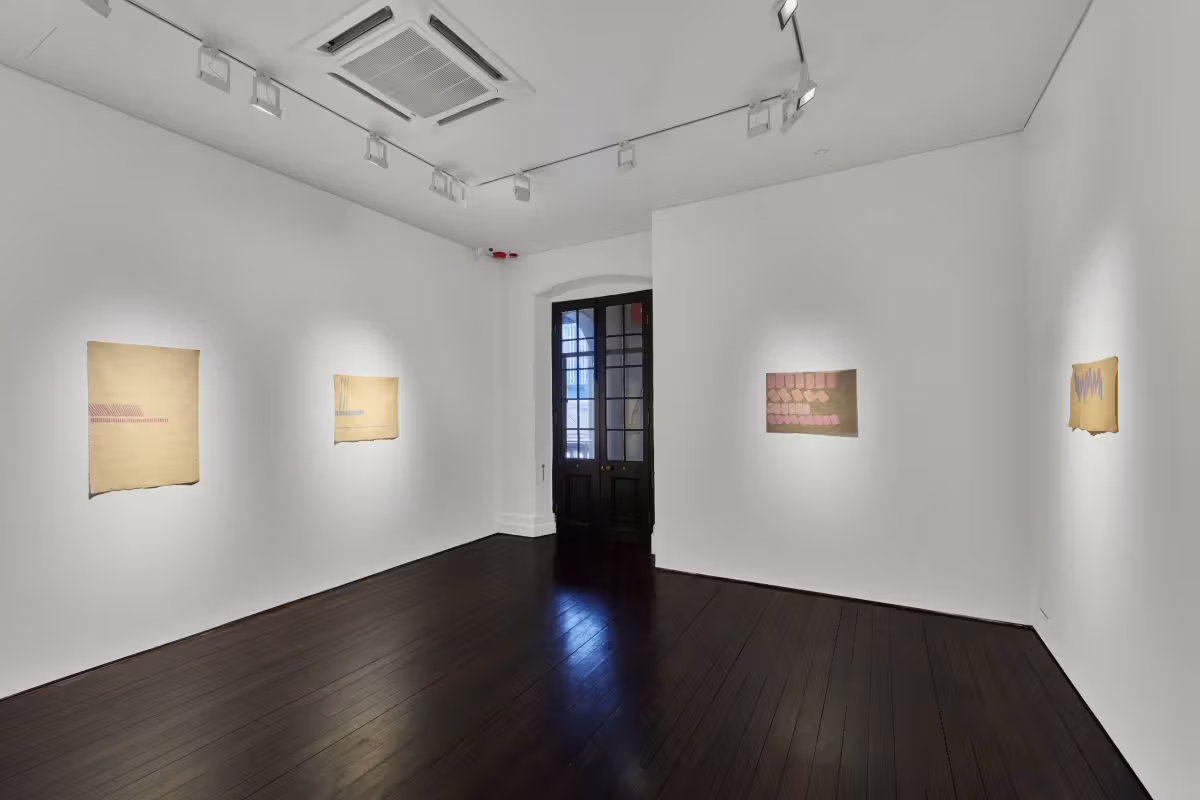
Campo blu (2026) confines pale blue and ochre-yellow curves to part of a darker fabric surface.Blue curves, layered bands and red shapes on different walls carry the gaze around the corner.
Earlier works provide other references. Due segni (1978), Tre segni (1979) and Verticale (1978) place repeated marks on the surface, while Campo giallo (1983) and Campo rosso (1986) introduce larger colour fields. Tre linee con arabesco n. 6 (1991) brings curves between straight lines. These dates are more than a chronological biography: they also establish that not everything on view was made this year, allowing approaches from different decades to be compared repeatedly in one exhibition.
Reading empty space and planning a Tai Kwun visit
The gallery positions the unfinished as an important way into Griffa’s practice, connecting it with his encounters with Daisetz T. Suzuki’s writing and the Tao Te Ching. This is a context for the artist’s thinking rather than a requirement that every viewer apply the same philosophy. A more direct approach is to notice where marks stop, where fabric remains unpainted and why fields do not reach all four edges. Empty space then helps determine where attention advances and pauses, rather than serving only as background.
The gallery is on the second floor of the Barrack Block at Tai Kwun, 10 Hollywood Road, Central, in shops 03-205A, 205B and 206. Regular hours are Monday to Saturday, 10:30–19:00; Sunday is outside regular opening days. Telephone: 2613-8062. Presented with the Italian Cultural Institute in Hong Kong, the exhibition’s October 16 opening tour has already ended, while regular visits continue through the exhibition period. Check the official exhibition and artwork information, select one work built around straight lines and another around colour fields, and arrive with questions about material and proportion.