Molded Minds at Tai Kwun until November 1: four Hong Kong ceramic studios explore faces, animals and glaze
UrbanRoom.Social brings together B Plus Art studio, Ceramic L, Klay and Kay, and TOJI JOJO in a free exhibition at Shop 03-101, Tai Kwun. A face-like vase and a blue-and-black glazed bowl offer two ways to look at form and surface.
Ceramics can hold flowers and food, but a few facial features or contrasting bands of colour can also give an object a distinct character. UrbanRoom.Social’s Molded Minds: Ceramic Exhibition is running at Tai Kwun in Hong Kong from October 10 to November 1, 2026, with free admission. Bringing together four Hong Kong ceramic studios, it moves between imaginative urban animals and contemporary vessels rather than presenting clay through a single style.
Four Hong Kong studios, different approaches to vessels
The participants are B Plus Art studio, Ceramic L, Klay and Kay, and TOJI JOJO. The official poster names Carrie Ho as curator, and the programme information is supplied by UrbanRoom.Social. Their work invites comparison: some objects attract attention through their shapes, while others foreground glazes and finely detailed surfaces. Bringing these approaches together in a compact exhibition makes the broad category of ceramics more specific, returning attention to the different ways individual makers understand an object.
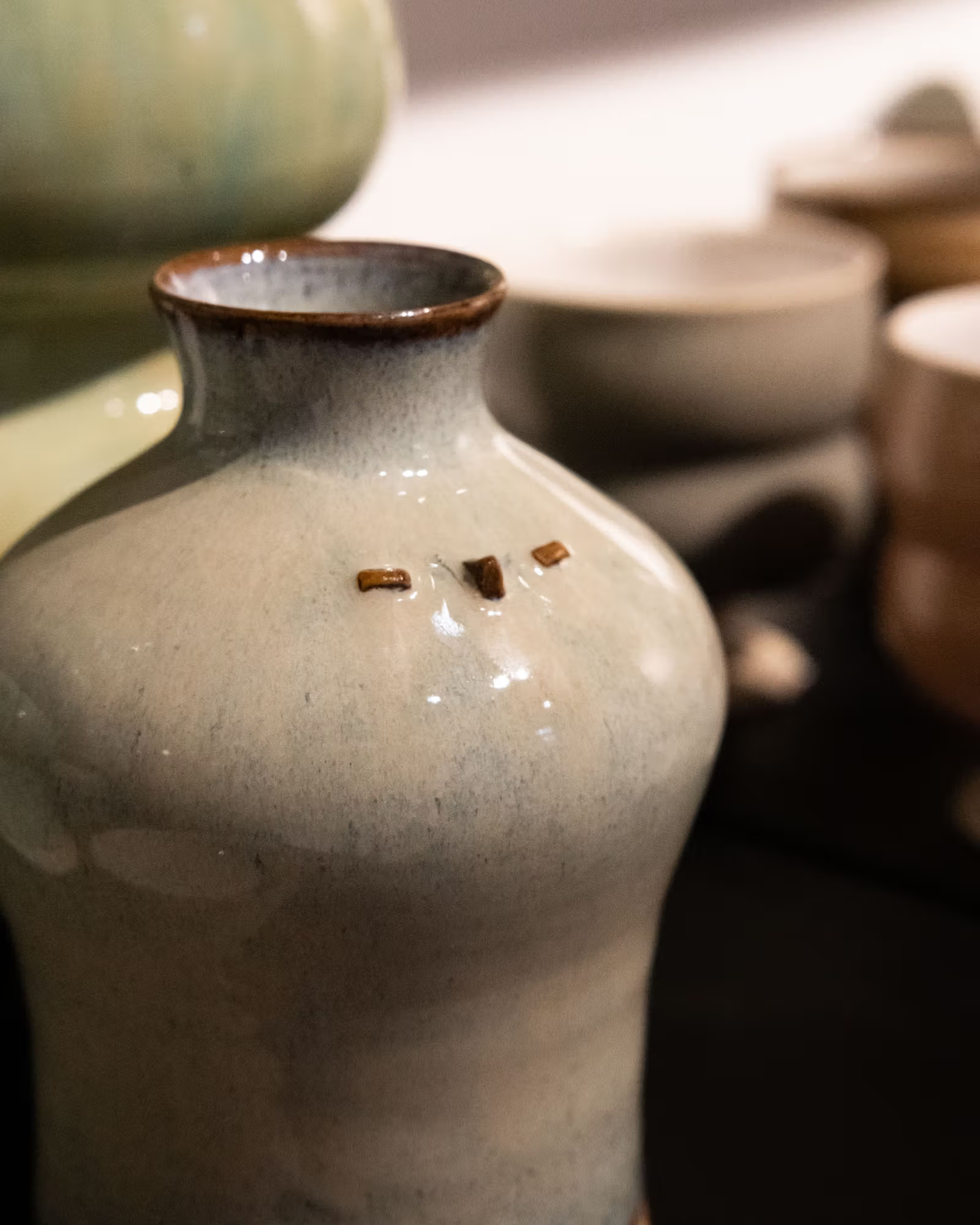
In a close-up published by UrbanRoom.Social, a grey-white vase has a narrow neck above broad, rounded shoulders. Its rim is brown; beneath it, two short eyes and a projecting nose suggest a face. Rather than turning the whole vessel into a realistic head, the design retains most of the vase’s outline and uses only three small elements to indicate an expression. Imagine the vessel without its features, then look again at how those raised details turn a quiet object into a character that seems to look back.
A face-like vase and glazed bowl: form versus surface
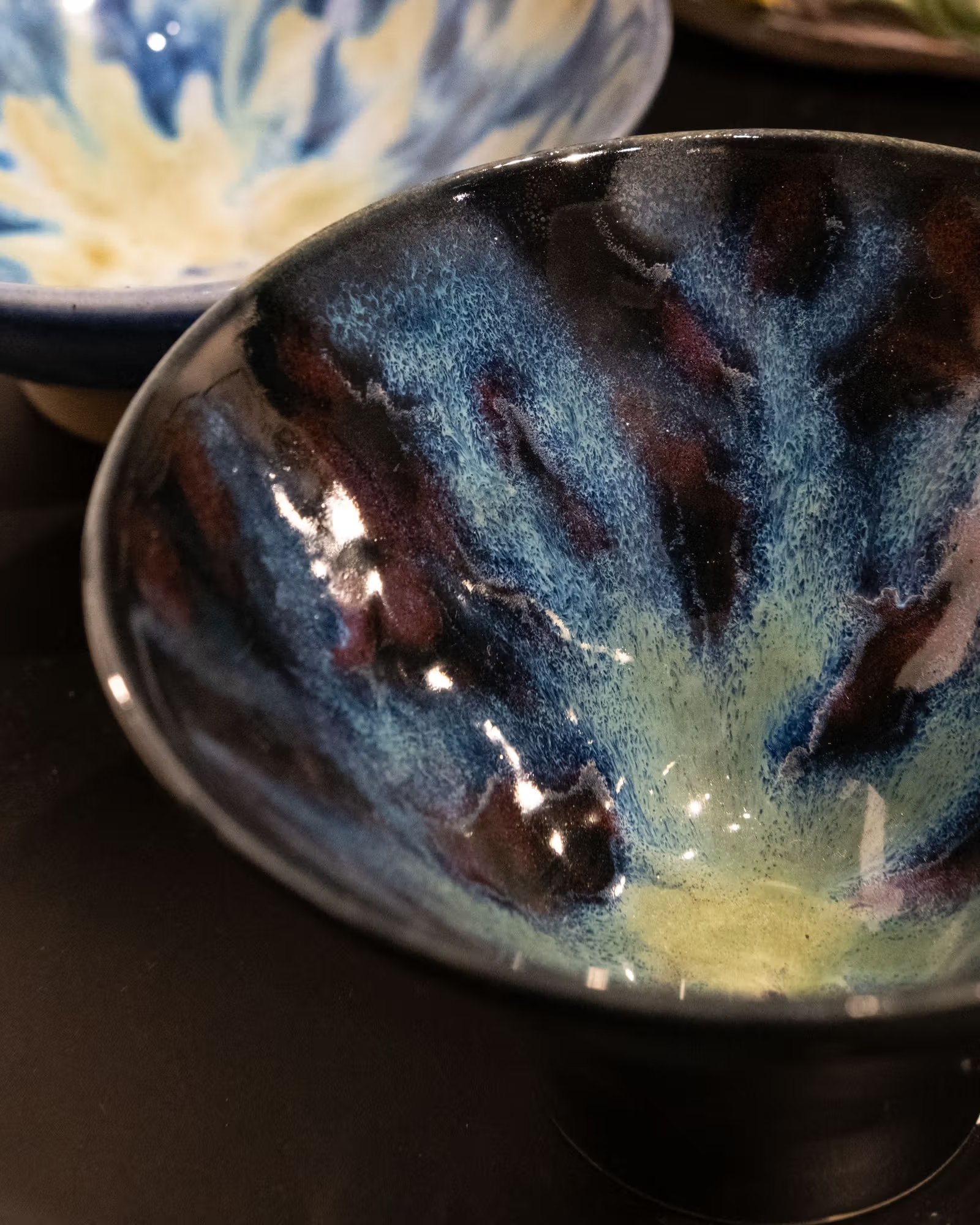
Another official photograph draws attention inside a bowl. Areas of deep black, blue and pale yellow intersect, with dense, fine textures visible in places; white reflections reveal the curved surface. This work invites a different approach from the face-like vase. Instead of seeking a protagonist, the eye can travel along the rim, bands of colour and textures. Shifting attention from shape to surface allows an everyday object to be read almost as an abstract picture.
Blue, black and pale yellow intersect inside a bowl, where sheen and fine textures reward a closer look.
Placed together, the two photographs are most useful for comparing how much expression comes from modelling and how much from glaze, rather than simply counting colours. The vase’s expression depends on small three-dimensional elements and the proportions of its silhouette; the bowl’s focus lies in its internal fields of colour and sheen. The photographs do not individually identify the makers or titles of these two objects, so attention can remain on what is visibly present without arbitrarily assigning them to the four participating studios.
Visiting Tai Kwun: free admission until November 1
The exhibition poster also features animal forms with horns, stars and wave-like patterns, echoing the imaginative urban animals mentioned in Tai Kwun’s programme description. Alongside the restrained vase and the flowing appearance of the glazed bowl, these forms suggest the range within the exhibition. For anyone who encounters ceramics through design shops, the show offers a chance to consider the relationship between shape and surface: rims, shoulders, projections and bands of colour remain worth examining beyond an object’s everyday function.
Molded Minds is at Shop 03-101 on the first floor of Barrack Block 3 at Tai Kwun, Central. Hours are Monday to Saturday, 11:00–19:00, and Sunday, 13:00–19:00. Admission is free until the exhibition ends on November 1; enquiries: 6058 7727. Check the official Tai Kwun exhibition information before visiting. One simple route through the show is enough: first look for expressions created by form, then consider how glaze changes an object’s surface.