What to see in Bangkok’s Blazing: Chetsada Phuwiang explores intimacy through sand, airbrush and fragments of the body
At Nova Contemporary through December 19, orange-red and blue-violet paintings move between figuration and abstraction. The gallery opens Tuesday–Saturday, 11:00–19:00; plan a Sunday visit elsewhere.
A shoulder, a palm or a mouth need not belong to a complete portrait to suggest closeness. Thai artist Chetsada Phuwiang’s Blazing opened at Nova Contemporary in Bangkok on October 24, 2026, and runs through December 19. Enlarged fragments of the body emerge and recede through orange-red, green and violet-blue. The solo presentation at the gallery’s current premises coincides with his participation in Bangkok Art Biennale 2026. The two exhibitions have their own venues and dates; a biennale route is not automatically a route into this show.
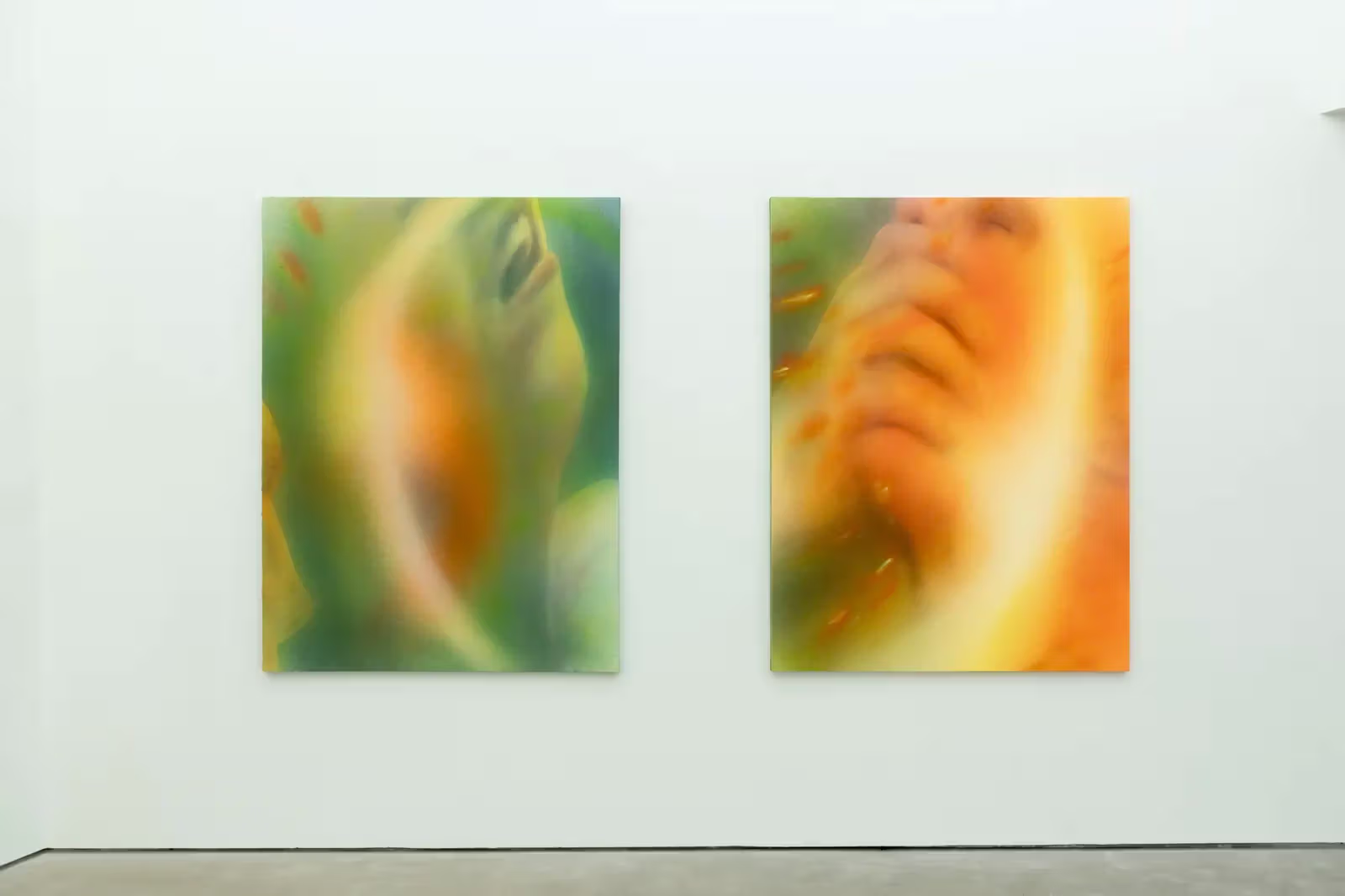
Two paintings of bodily fragments in green and orange hang together on a white wall.
Check the opening days: Sunday is not a gallery visiting day
Nova Contemporary is at 86 Si Phraya Road in Bang Rak, with current opening hours of Tuesday–Saturday, 11:00–19:00. October 25 falls on a Sunday, so anyone planning a Bangkok gallery itinerary today should save this stop for an opening day. Running across two months, the show can be paired with other exhibitions in the area without rushing through every painting at once. Check the gallery’s exhibition page or contact its team for temporary changes.
Born in Suphan Buri in 2001, Phuwiang lives and works between his home province and Bangkok and graduated from Silpakorn University in 2023. He already held a solo exhibition at RATS in Bangkok in 2024, so Blazing should not be described as the first solo show of his career. A continuing focus of his practice is to treat a part of the body as a portrait in its own right, allowing desire, memory and emotion to be communicated without first relying on a recognisable face.
How do sand and airbrush make the body less definite?
The paintings bring sand, oil, acrylic and airbrush into the same process. Grains give the image a physical surface, while sprayed gradients make its contours appear to disperse from view. Try stopping at two distances: take in the overall field of colour, then look at the density of marks and particles. This is not a test with one correct anatomical pose to identify. As recognition shifts between seeing a body part and seeing colour alone, the act of looking becomes part of the work.
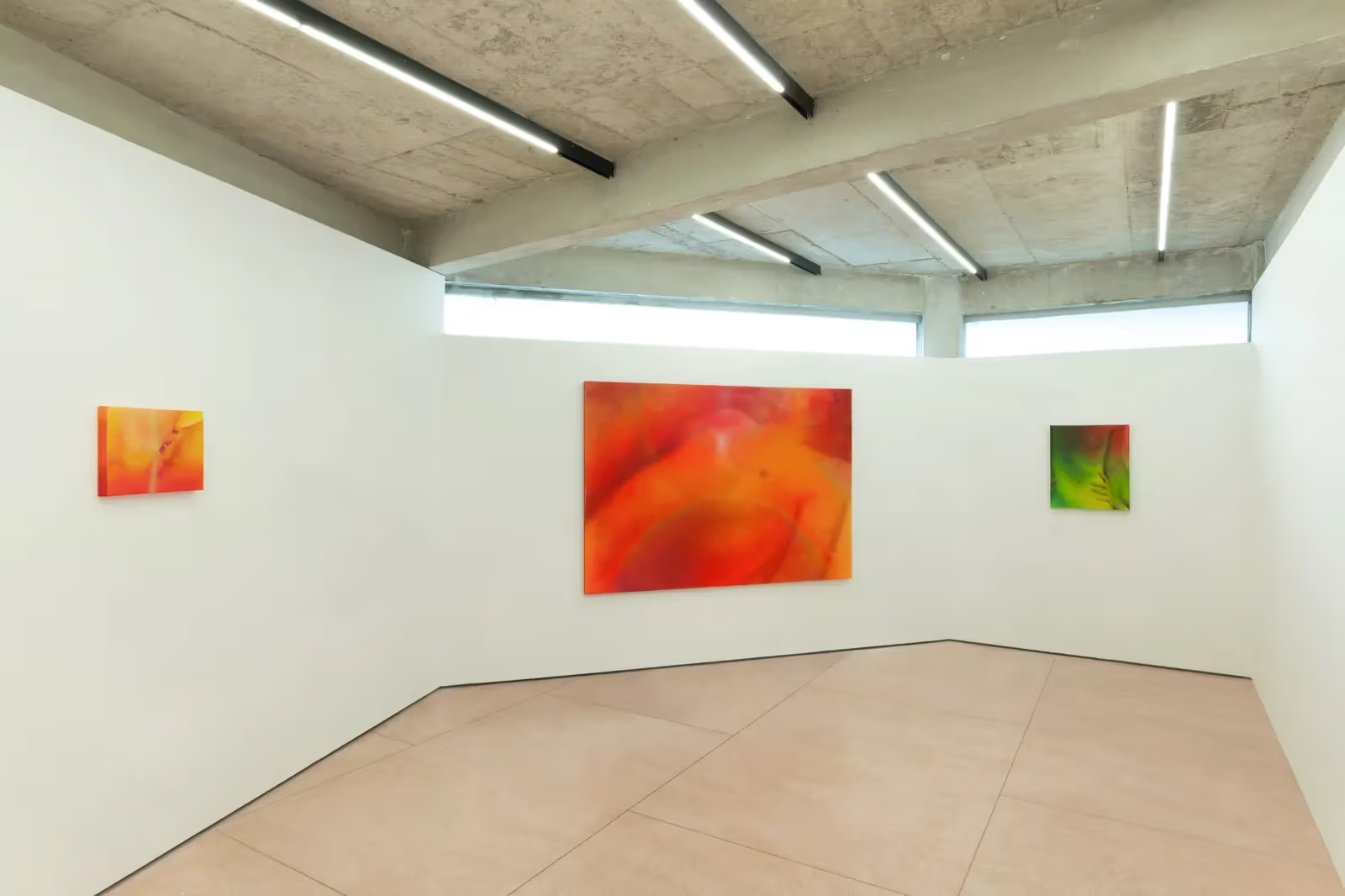
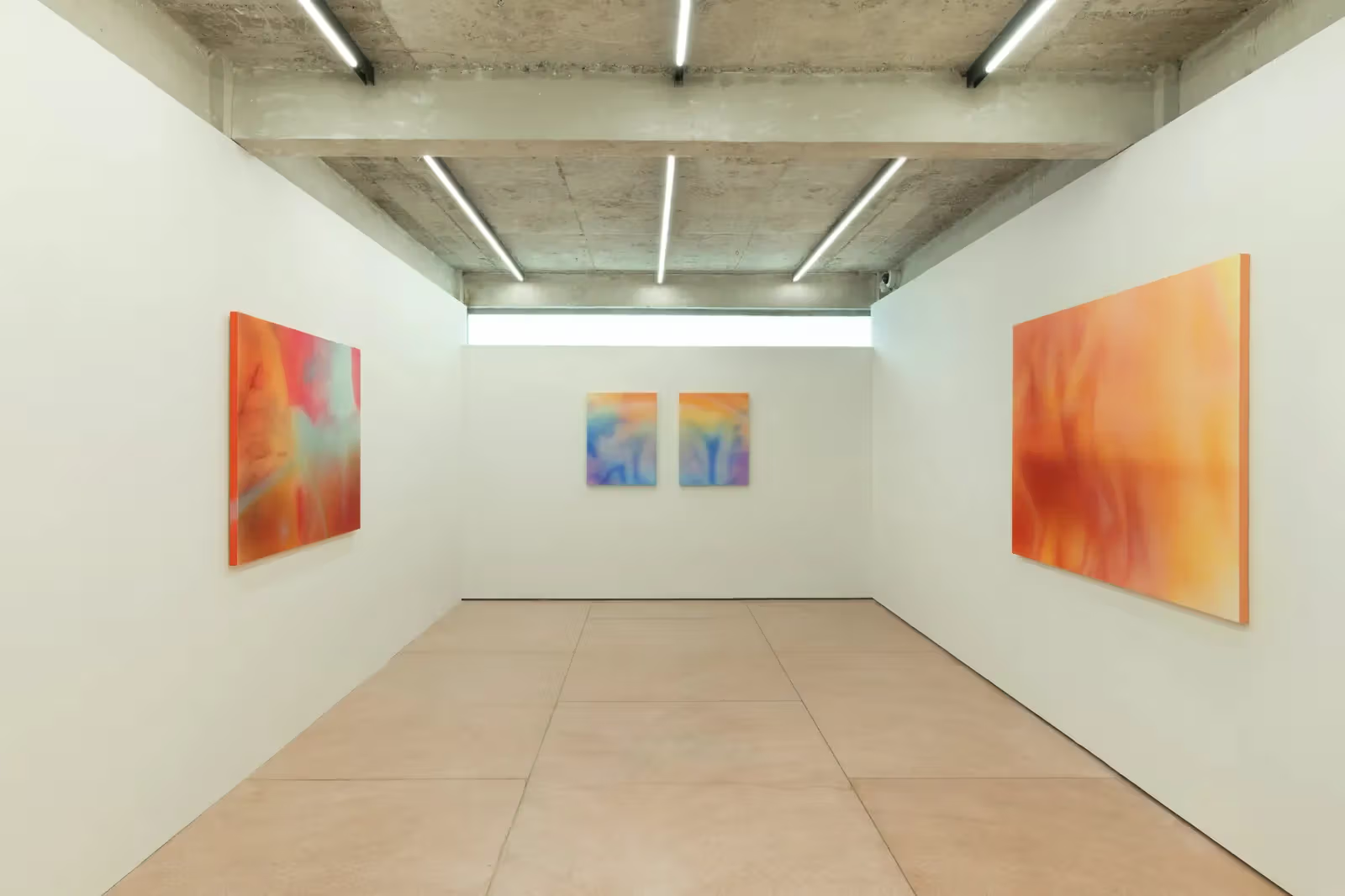
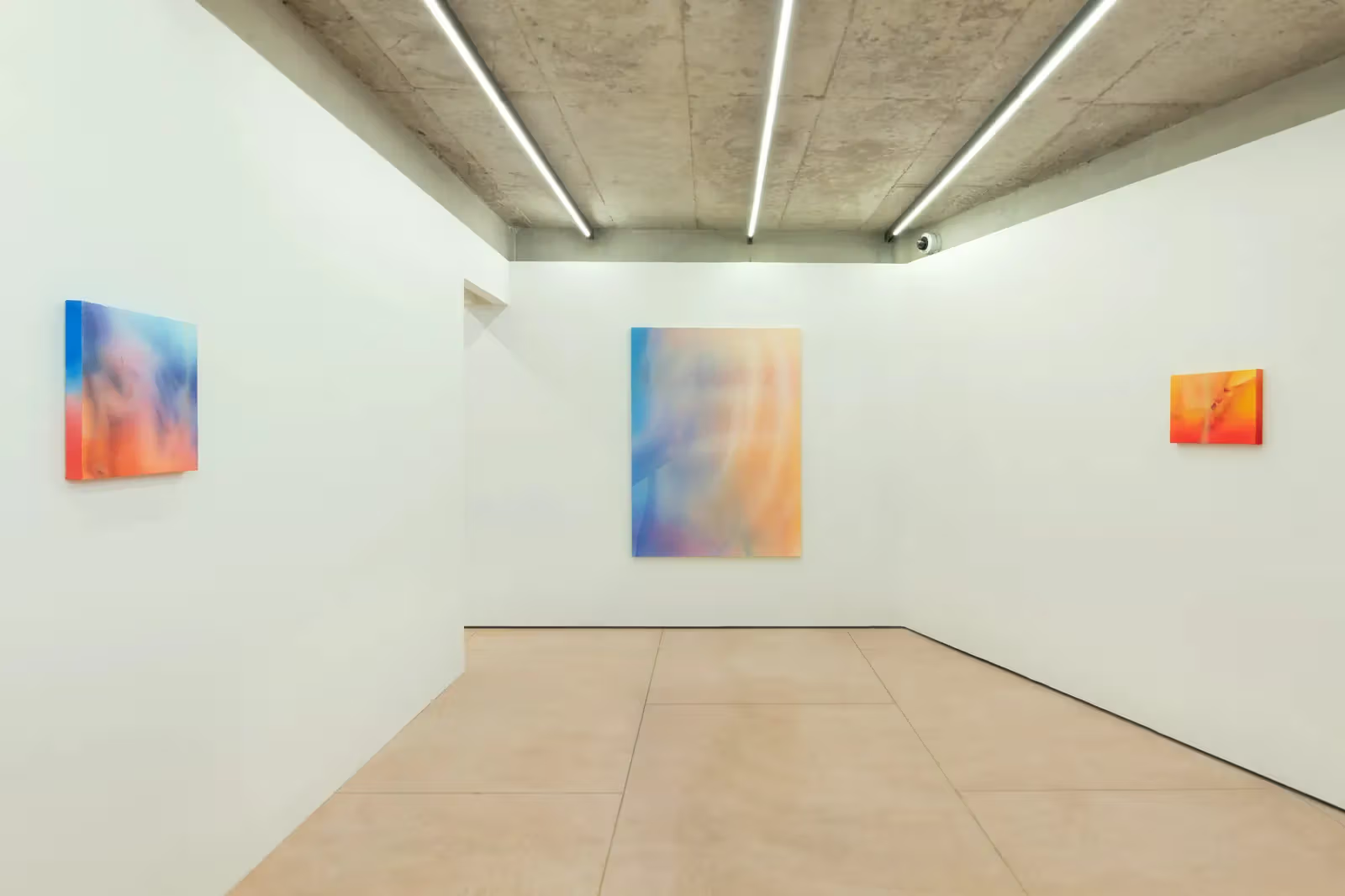
The gallery’s installation photographs suggest another comparison. Large orange-red paintings and smaller green works are spaced across white walls, alongside a pair in blue-violet. Differences in scale and the gaps around them give the paintings different rhythms. Follow how similar colours change from one canvas to another, then compare the clarity of bodily boundaries in warm and cool compositions. That reveals more about the display’s variation than searching every painting for an identical symbol. Begin with the images, then observe colour and spatial distance in the gallery.
Orange-red paintings frame a pair in blue-violet at the far end of the gallery.Works of different sizes meet at a corner, contrasting warm and cool colour fields.
From nightlife’s light to the feeling of being seen
Phuwiang’s practice connects with gay male experience, queer sensuality and intimate relationships, extending into questions of belonging and connection. The artificial colours can suggest recognition and self-consciousness in nightlife: illumination may bring certainty, but also the vulnerability of exposure. With the body cropped into fragments, viewers cannot quickly settle a person’s story through a face. An approaching gesture, the temperature of light or the pause before touch can become more noticeable instead.
Take a concrete question with you: choose one warmer and one cooler work, describe their colours and contours separately, then compare how they alter your sense of distance. The official exhibition text mentions 2026 works including Blazing Exposure I, Moonlit and Sunray; use the labels to confirm individual titles, materials and dates in the gallery. Shifting attention from who a person is to how an image makes closeness felt is a reason to give this exhibition time.