Google Pixel 11 Review: $100 Price Hike, But the Real Highlight Is a Hibiscus Pink
Engadget's review scored it 9.2, but what the editorial team was privately most excited about wasn't the specs—it was the hibiscus pink colorway that leaked early. Priced at $899, the Pixel 11 costs $100 more than its predecessor, with the telephoto lens and AI message suggestions remaining its core strengths.
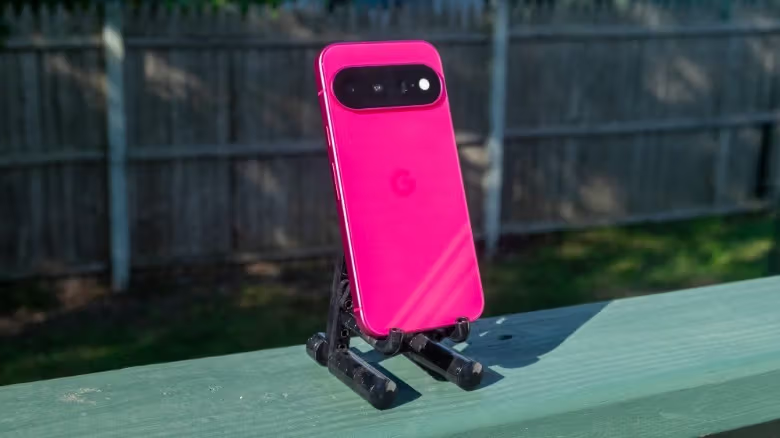
Engadget senior editor Nathan Ingraham mentioned a telling detail in his review: when leaked photos of the Pixel 11 surfaced last month, what got the editorial team buzzing on Slack wasn't any new hardware feature—it was a bold hibiscus magenta colorway. That pretty much sums up where this phone stands this year: the Pixel 11, officially launched by Google last week, is the kind of annual upgrade that basically means "pay more, get a new color."
Priced at $899—$100 more than last year's Pixel 10—the Pixel 11 still earned a solid 9.2 out of 10 in Nathan Ingraham's review published on Engadget on August 19, 2026. He argues it remains one of the best Android phones on the market, though there's almost no compelling reason to upgrade. He's blunt about it: if you're already on a Pixel 10 or any recent flagship, the Pixel 11 won't win you over. But if you're still rocking a Pixel 9 or older, this phone will more than satisfy most buyers.
Display & Design: That Hibiscus Pink Steals the Show More Than the Specs
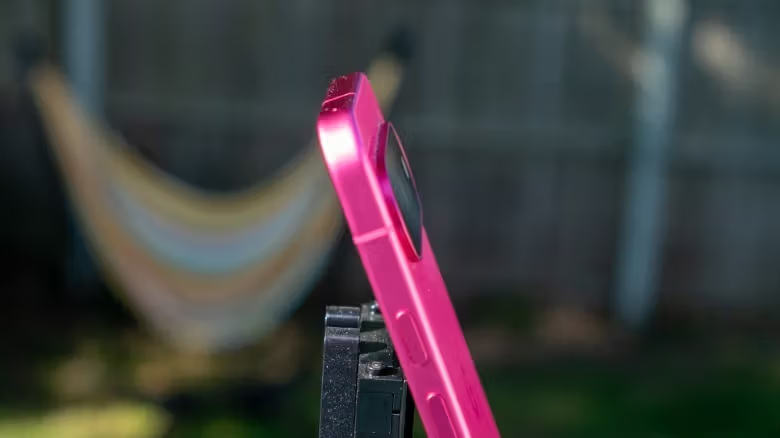
The Pixel 11 keeps the same 6.3-inch Actua display as the Pixel 10, with an identical 60-120Hz variable refresh rate and up to 3,000 nits of peak brightness. The pricier Pixel 11 Pro gets a brighter, higher pixel-density screen that can also drop down to 1Hz, but Nathan Ingraham says the Pixel 11's display more than holds its own at this price point. Both front and back retain glass construction with a metal frame, and the camera bump on the back protrudes slightly less than last year's model, making the phone sit a bit more comfortably in hand. It comes in four colors: Obsidian, Frost, Pistachio, and the standout Hibiscus Pink—Ingraham even wrote that he hopes Apple takes notice of this color.
Triple Camera Array & AI Zoom: Hardware Barely Changed, But the Telephoto Lens Remains the Differentiator
The camera hardware is virtually unchanged: the 13MP f/2.2 ultrawide and the 5x optical zoom 10.8MP f/3.1 telephoto lens are identical to the Pixel 10's; the main camera stays at 48MP but with a larger sensor, and the 10.5MP front camera also remains untouched. The genuine new feature is Super Zoom, now maxing out at 30x, up from the Pixel 10's 20x—Google says this is achieved through multi-frame stacking and HDR+ processing to fill in detail, rather than the generative AI frame-filling used in the Pixel 11 Pro's 120x Pro Zoom. In Nathan Ingraham's hands-on testing, 30x zoom shots still showed a noticeable lack of detail when pulled up on a laptop screen, though the results were comparable to what the pricier iPhone 17 Pro produces at the same 30x zoom. He emphasized that the 5x telephoto lens is really the Pixel 11's true differentiator—the base iPhone 17 has no telephoto lens at all, and the Galaxy S26 only manages 3x optical zoom.
On the software side, a new feature called Camera Looks lets users customize and switch between multiple filter presets, adjusting contrast, highlights, shadows, and color temperature—the settings are remembered and applied automatically to future shots. Another highlight is Magic Capture, which simultaneously records a short video and multiple photos when activated, then automatically applies edits. Google says this is designed to catch fast-moving moments, like blowing out birthday candles. Nathan Ingraham admits his day-to-day life is "too uneventful" to really put this feature through its paces, but his colleague Sam Rutherford, testing the Pixel 11 Pro Fold, said: "Magic Capture really shines for things like sports or dancing—the P11PF automatically holds onto the best dynamic poses, so you don't have to stress about nailing the shutter timing. I just wish the video processing time were a bit shorter."
AI Features: Rambler Fixes Your Verbal Slip-Ups, Proactive Intelligence Links Messages and Calendar
Rambler is a voice input tool that corrects what you're saying in real time as you speak—Nathan Ingraham gives an example: say "I need to buy tortellini, no wait, I mean tortillas," and the final transcribed text will simply show "tortillas." Since the system waits until you finish speaking before processing, the correction isn't shown instantly, but he found the accuracy held up consistently in testing. More useful is Proactive Intelligence, a renamed and expanded version of last year's Magic Cue feature, which surfaces contextual Gemini suggestions within Google Messages conversations. For example, when a friend asks in a group chat whether Wednesday or Thursday works better for dinner, the system immediately pops up a calendar suggestion card. He also tried typing "want to grab tacos in Somerville this weekend," and the system instantly suggested searching nearby restaurants—tapping it brought up a Gemini search preview without ever leaving the conversation. Nathan Ingraham thinks that compared to Apple's similar Siri AI features this year, Google's integration is more polished at this stage.
At the core is the new Tensor G6 chip, which Google says features an upgraded image signal processor and a tensor processing unit that's 50% faster than last year's G5, powering the on-device Gemini Nano model. RAM stays at 12GB, unchanged from the Pixel 10, while storage now starts at 256GB with a 512GB option—meaning the base model's storage effectively doubled alongside the price hike. In everyday use, Nathan Ingraham describes the Pixel 11 as running smoothly, easily handling daily demands. He hasn't yet finished Engadget's standardized battery test, but based on personal use, he says the battery rarely drops below 50% most days—one weekend it even lasted from 8am Saturday to 7pm Sunday before needing a charge, with battery saver only kicking in once it dipped below 20%.
The pros listed by Engadget include strong performance and battery life, increased base storage, some genuinely useful AI features, and a triple-camera setup that still outclasses the base iPhone and similarly priced Android rivals. The cons: it costs $100 more than the Pixel 10 and shows little meaningful change from last year.