Myonghi Kang’s What Remains to Be Seen in Hong Kong runs through November 15: five 2026 oils, from Wollabong to La source
Villepin presents Myonghi Kang’s sustained looking through recent oils and works on paper. Compare the colour and scale of Hibiscus, Pivoine and La source, with dates, public hours and private-tour information for Hollywood Road.
Myonghi Kang’s solo exhibition What Remains to Be Seen at Villepin in Hong Kong continues through November 15, bringing together recent paintings and works on paper. Born in Daegu, South Korea, in 1947 and now living and working in Jeju, Kang has long divided her time between Korea and France. Flowers, mountains and water enter her paintings through repeated observation. The exhibition invites attention beyond identifying natural scenery, towards how colour, distance and memory coexist on one canvas.
From 97 centimetres to three metres: restoring distance to landscape
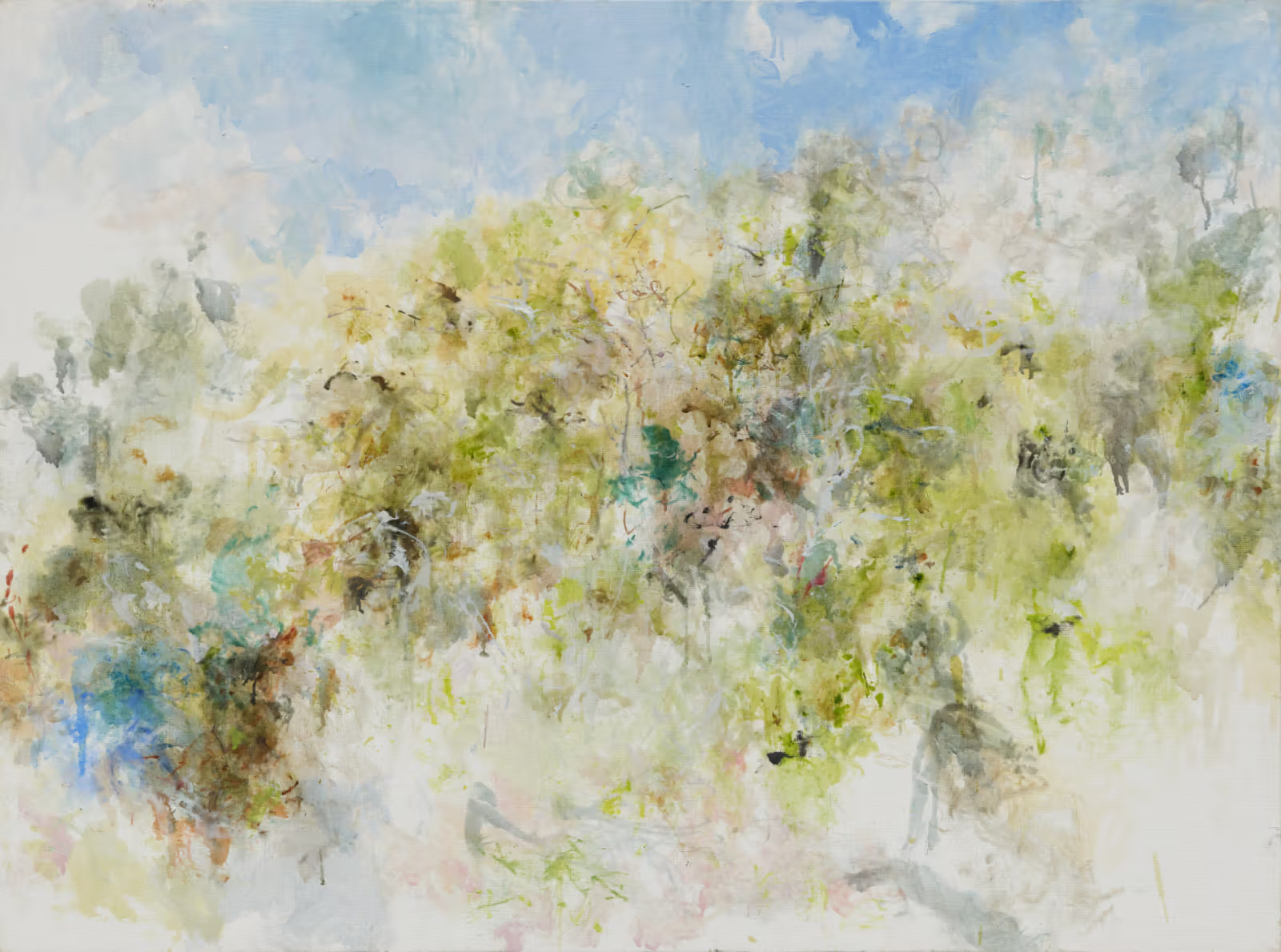
The five works featured by the gallery are all dated 2026, but a date does not imply rapid completion. Wollabong measures 97 × 130 cm. Pale blue, light green and small orange marks spread across a largely luminous ground. From farther away, the landscape feels continuous; closer up, brushstrokes branch apart. Instead of enclosing a mountain within a clear outline, the painting lets the eye move between different densities. A pale area can suggest both air and a gap seen through trees.
Myonghi Kang, Wollabong (2026), oil on canvas, 97 × 130 cm.
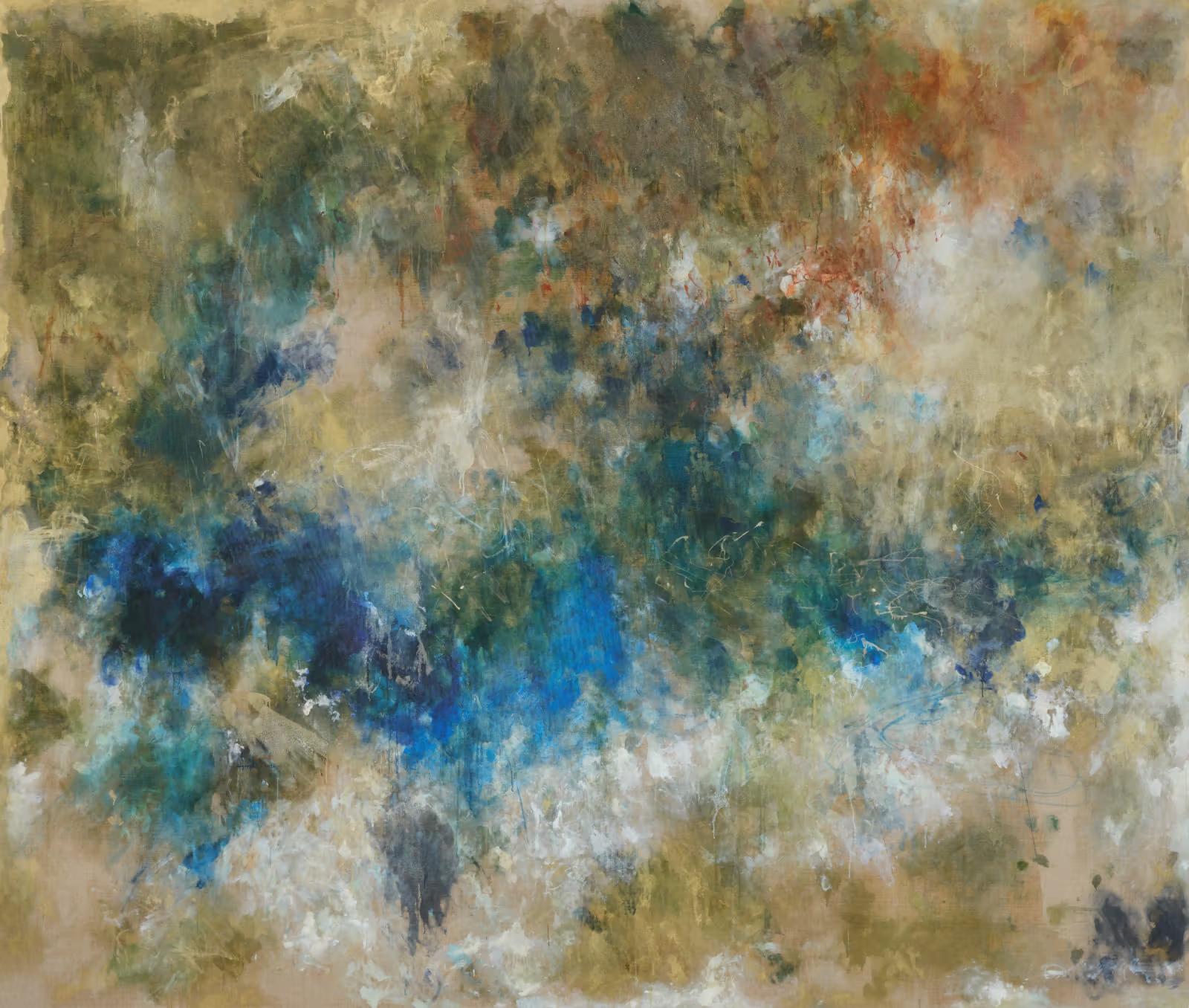
By comparison, La source measures 288 × 340 cm, extending more than three metres horizontally. Blue and deep-green areas gather more densely, while off-white, brown and fine lines weave between them. The work is inspired by Jeju’s Andeok Valley, but there is no need to immediately assign every mark to a rock or water surface. Start by comparing how blue spreads outwards and how dark areas and pale spaces push against one another. Seen alongside smaller works, the large canvas makes viewing distance part of understanding the image.
Hibiscus, peonies and bamboo: comparing five oil paintings
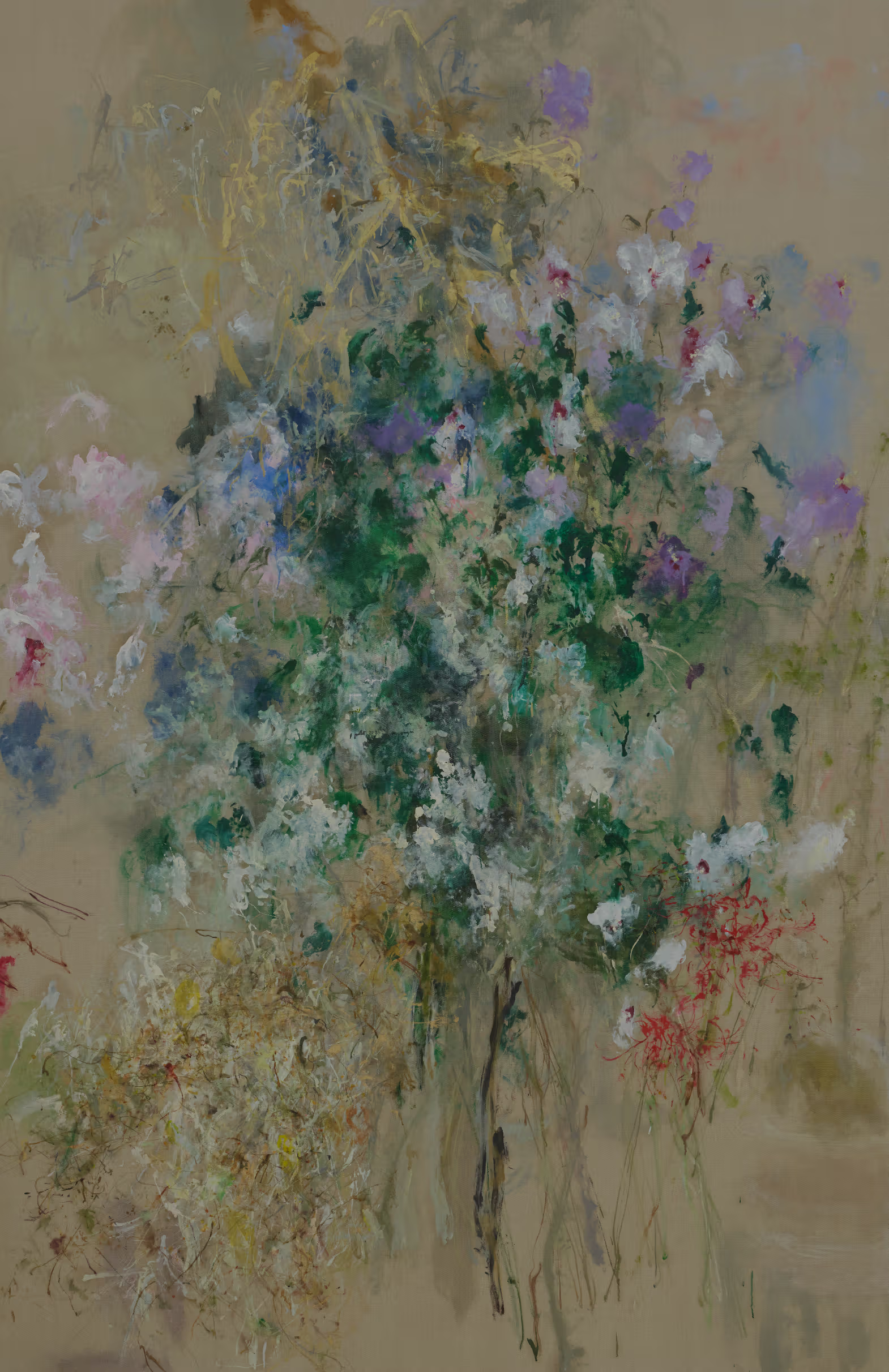
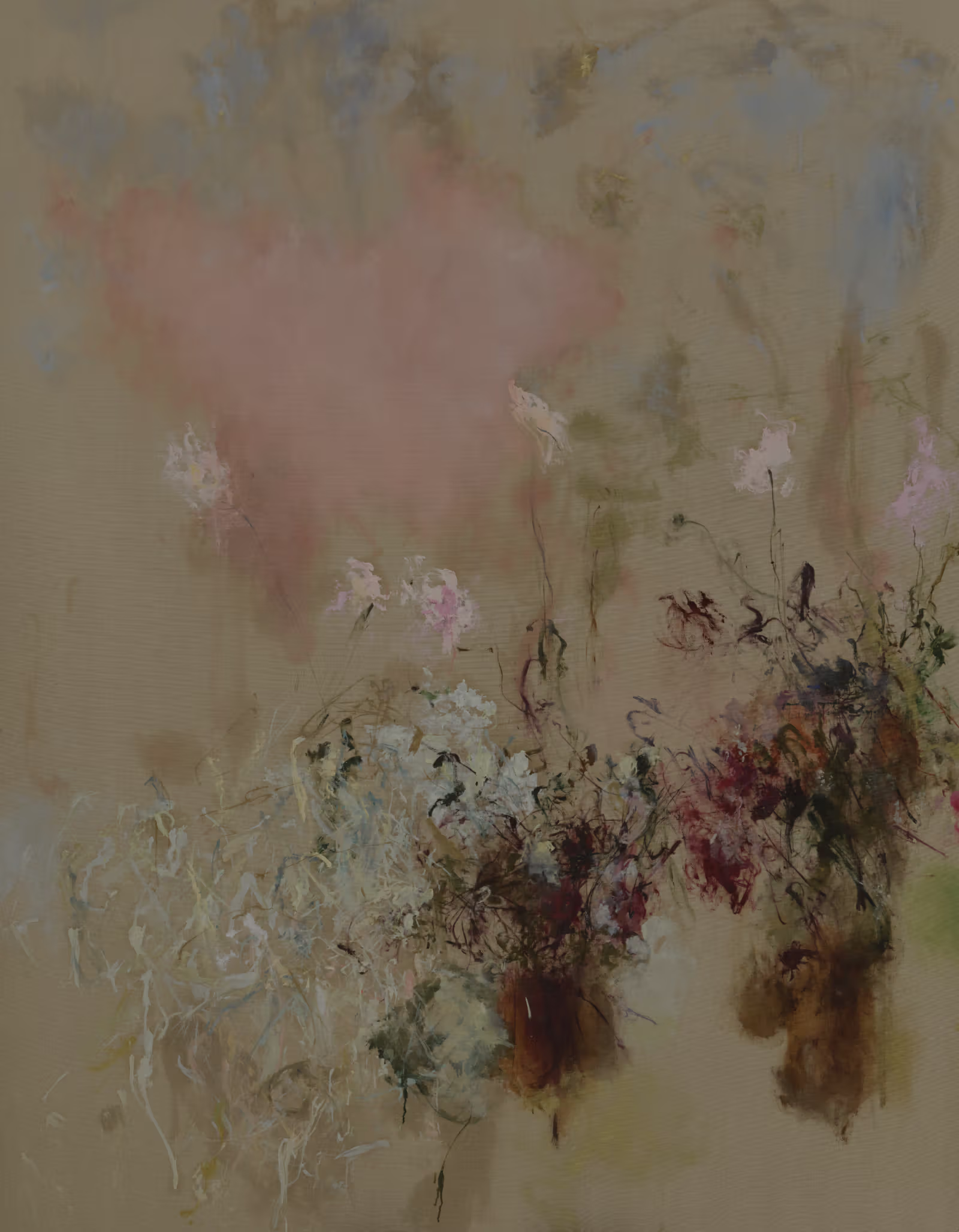
The vertical Hibiscus measures 300 × 195 cm. Deep-green, blue-violet and white marks gather towards the centre, with red lines appearing to emerge from the ground. Pivoine measures 250 × 195 cm, with a more open upper section and flower-like forms and dark lines concentrated below. Both concern flowers, yet their centres of gravity differ: the former develops an upward-reaching density, while the latter places open space in tension with flowers lower down. The proportion between flowers and surrounding space deserves attention alongside any question of resemblance.
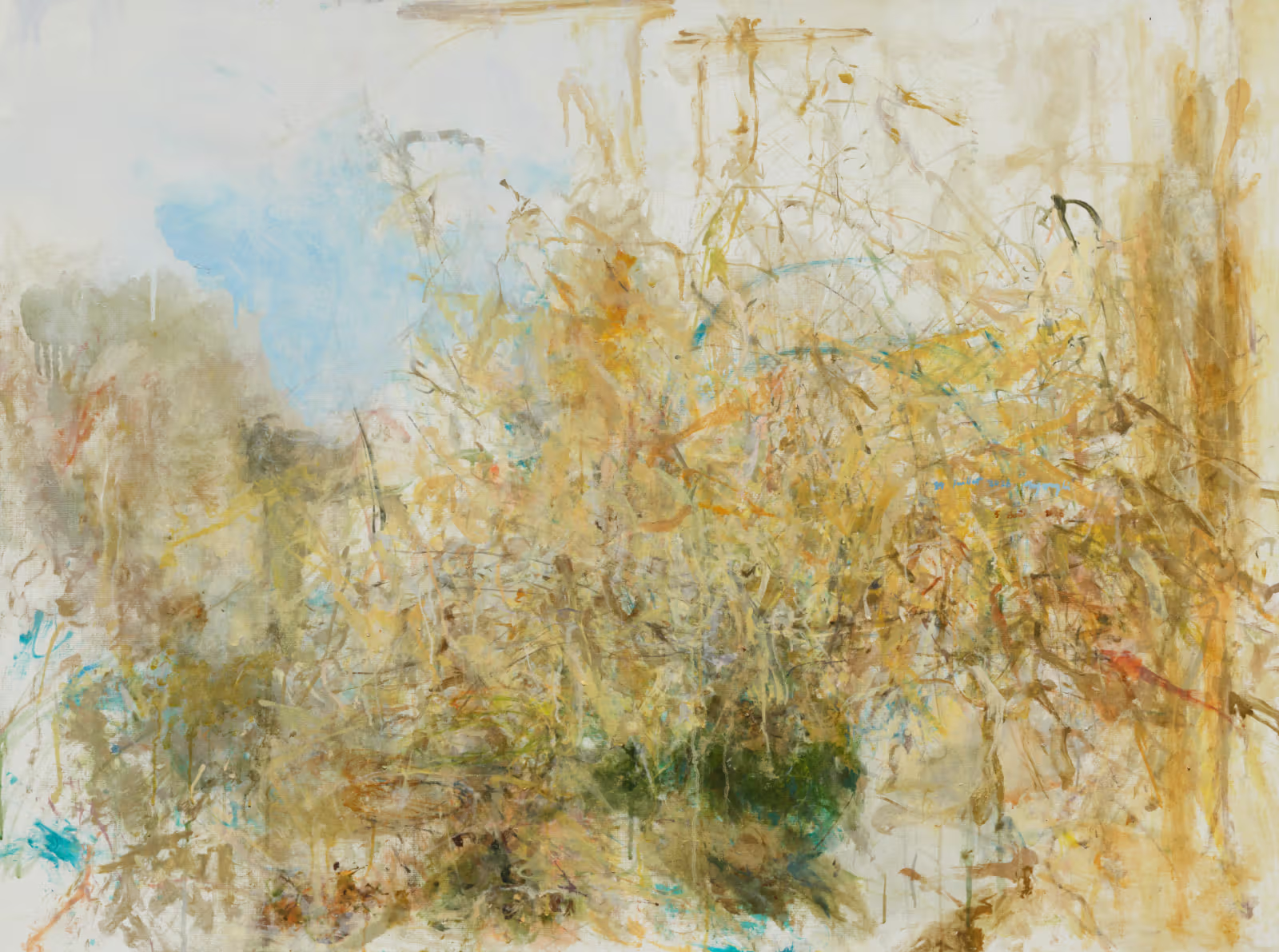
Myonghi Kang, Bambous aux fruits du gardénia séché (2026), oil on canvas, 97 × 131 cm.
Bambous aux fruits du gardénia séché measures 97 × 131 cm. Yellow-brown branch-like lines and dark-green areas meet a pale-blue section at the upper left, with fine lines continually changing direction across the canvas. Compared with the two vertical flower paintings, it returns the eye to a dispersed horizontal rhythm. Kang does not rely on one fixed viewpoint: nearby plants, distant landscape and colours encountered before can coexist through successive marks. Similar palettes therefore produce different balances and breathing spaces across these works.
Myonghi Kang, Hibiscus (2026), oil on canvas, 300 × 195 cm.Myonghi Kang, Pivoine (2026), oil on canvas, 250 × 195 cm.
Pastel, ink and time: exhibition dates and public hours
Curated by Arthur de Villepin, the exhibition also includes recent works on paper made at the Villa Medici in Rome, using pastel and ink. Kang would rise early to observe the first light, returning to the same place to continue drawing. The gallery’s account of her process describes paintings set aside for months or years before further work; even a signature need not mark a final endpoint. A 2026 date can therefore be read as a record of the work, without compressing all its looking and revision into one moment.
The exhibition runs from September 29 to November 15, 2026, at 53–55 Hollywood Road, Central, Hong Kong. Official public hours are Tuesday–Thursday, 14:00–19:00; Friday, 11:00–19:00; and Saturday–Sunday, 11:00–18:00, closed Mondays. For private tours, contact info@villepinart.com or telephone +852 3709 0913. Before visiting, choose works with contrasting scales or colours on the official exhibition page, then approach the paintings with a comparison in mind.