ChatGPT for Teens Goes Live — Its Promise to Alert Parents Within an Hour Has Child Safety Experts Skeptical
OpenAI has rolled out an age-tiered version of ChatGPT, ChatGPT for Teens, promising that human reviewers will flag and notify parents of high-risk conversations within an hour. But organizations like Common Sense Media and Fairplay say the company's track record and current systems make that promise hard to trust.
"If we predict you're under 18, or you tell us yourself, this becomes your default experience." That's how Lauren Jonas, OpenAI's head of teen and family initiatives, describes how ChatGPT for Teens works: there's no separate account to sign up for — the system automatically detects a user's age and switches the interface accordingly. The age-tiered version launched this Tuesday, the result of a project OpenAI began building last September in the wake of the death of 16-year-old Adam Raine, whose parents filed a lawsuit alleging ChatGPT played a role in encouraging his suicide.
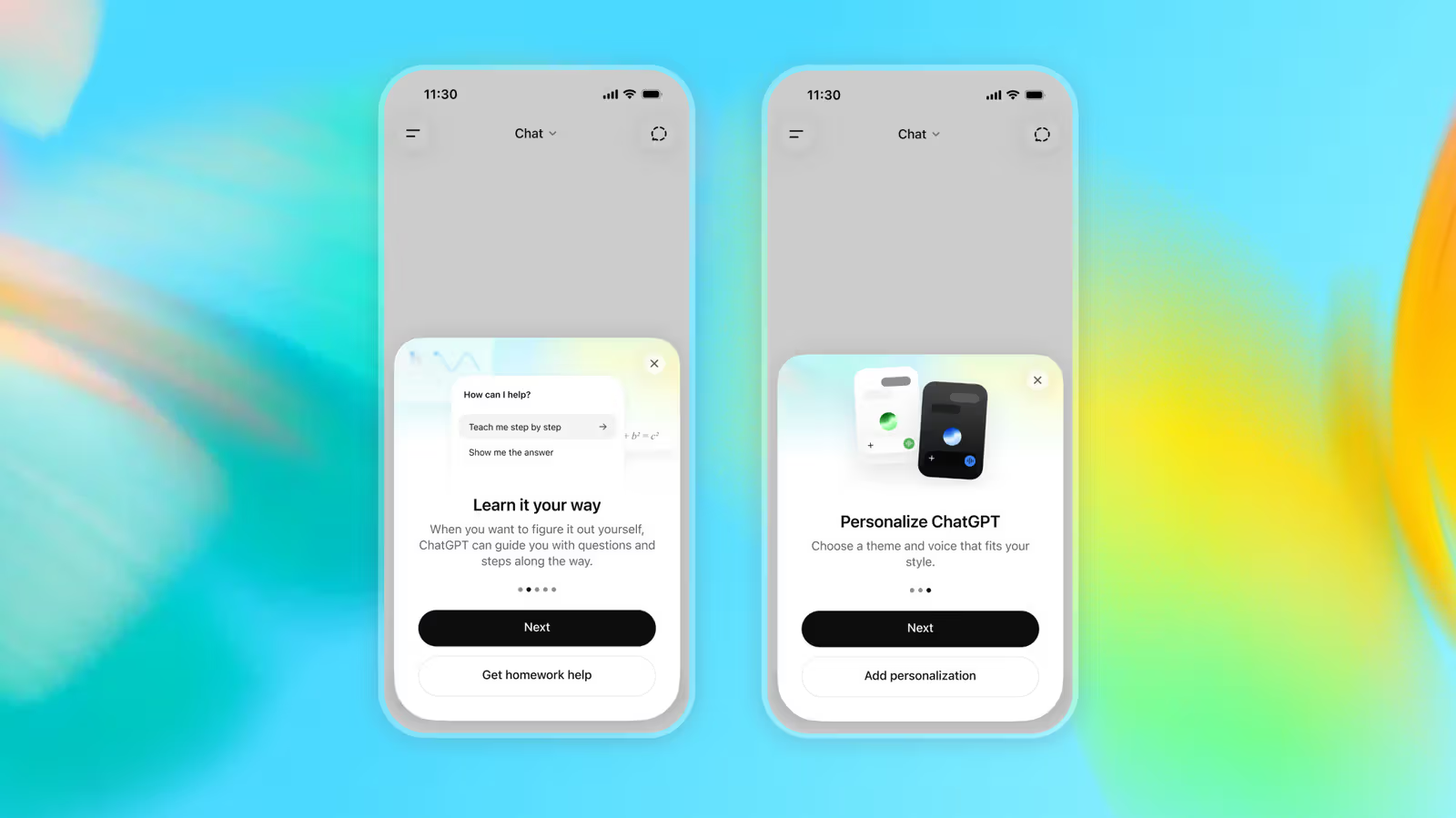
A Pew Research Center survey from early last year found that roughly a quarter of American teens are already using ChatGPT for schoolwork. In other words, this was never a question of whether to let teens use it — they already were. That's why ChatGPT for Teens leans heavily on educational features like Study Mode and data visualization tools as its main selling points, while adding a new mechanism: if the system detects that a child is discussing an eating disorder alongside signs of self-harm risk, it will notify the parent linked to that account. OpenAI also released updated model guidelines for users under 18, stating that "ChatGPT should not use romantic language, encourage emotional dependency, or imply that it has feelings or consciousness."
The one-hour notification promise doesn't hold up against past track record
Jonas told Engadget that all flagged content first goes through review by full-time OpenAI staff, with a target of notifying parents within an hour. In a follow-up interview with CNN, she reiterated explicitly that the company has enough staff to make this happen. But that's exactly the part experts find hardest to accept.
Robbie Torney, who oversees AI and digital assessments at Common Sense Media, points out that OpenAI has never disclosed the error rate of its automated classification system — including both false negatives and false positives. He notes that when OpenAI planned to roll out adult-oriented erotic content last year before ultimately scrapping it, one reason cited was that the age-prediction technology at the time couldn't reliably catch enough teen users. Fairplay's executive director Josh Golin is even more blunt: "This is another case of automated decision-making at work, and the question remains the same — should we trust the classifier that flags content and hands it off for human review?" He wants OpenAI to release concrete numbers: how many conversations get flagged daily, how many people are reviewing them, and how much time on average is spent reviewing each conversation. "It's hard to imagine they've hired enough staff to genuinely and carefully review every conversation that might be a problem."
This skepticism isn't unfounded. Last November, Common Sense Media actually tested OpenAI's parental notification system by sending ChatGPT messages that explicitly mentioned suicide and self-harm. The resulting parent-side alerts arrived anywhere from 24 hours to over 48 hours later. "Sometimes we never received a notification at all, even though the messages were that explicit," Torney said. He adds that November was a while ago, and OpenAI may have improved since then — but getting this truly right requires more resources and a much larger human review team, and interpreting these conversations demands cultural context: American teens, Dutch teens, and Singaporean teens express distress differently, and the right response — whether to suggest talking to a parent, calling the police, or referring to a crisis hotline — isn't the same in every case.
The eating disorder alert is well-intentioned, but its design flaws are the same old problem
All three experts interviewed agree that OpenAI is right to take eating disorders seriously. Ellen Fitzsimmons-Craft, associate professor of psychiatry at Washington University in St. Louis, points to a 2023 meta-analysis finding that 22% of children and adolescents screened positive for disordered eating tendencies, yet fewer than 20% of them had ever received targeted treatment. She notes that one of the most effective approaches to treating eating disorders in teens involves family participation, with therapists guiding parents on how to help their child restore healthy weight. "Of course this doesn't work for every family — especially when a parent might themselves be part of the problem — but it's the best approach we currently have."
Golin doesn't take issue with the approach itself, but questions how it was rolled out. "A feature like this should be tested on a small scale first — not just to check whether the flagging is accurate, but whether it's actually helpful for teens." He believes the announcement "feels more like a PR response than something that reflects real thought about what kind of support teens actually need."
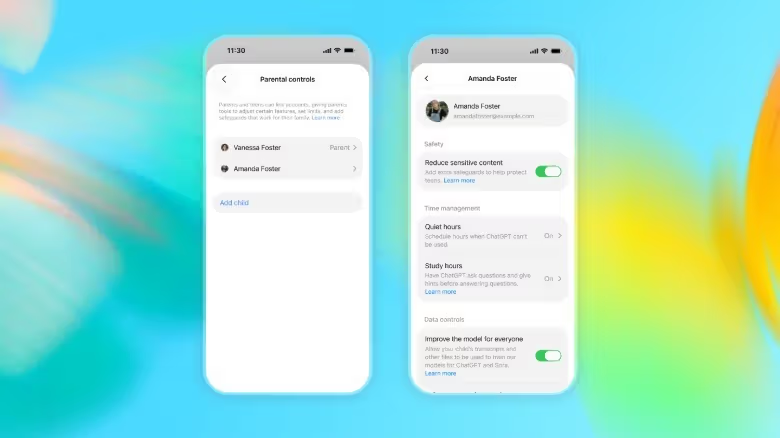
All three also independently pointed to the same structural problem: the entire system depends on parents and kids actively linking their accounts. "The vast majority of parents never actually use these parental control tools, partly because the tools are deliberately designed to be hard to find and hard to use," Golin said. A recent report from the Cybersafety Research Center tested 86 safety features across Instagram, Snapchat, TikTok, and YouTube, and found that 51 of them — nearly 60% — either didn't work as advertised or were difficult to operate. Fairplay's report from last year similarly found that many of Instagram's teen account safety settings require parents to click through several layers of menus just to locate them. "What actually works is safe-by-default, safe-by-design — setting things to the most protective option from the start, then letting parents loosen restrictions if needed, instead of putting the burden on parents to configure everything themselves," Golin said.
OpenAI hasn't clarified what happens when a teen without a linked parental account is flagged for a high-risk conversation. In a statement to Engadget, the company said: "Currently, we only send alerts for accounts that have parental controls enabled. Our goal is to help connect users with real-world support resources, and we'll continue testing and strengthening these safeguards together with experts, families, and teens."
If you or someone you know is struggling with an eating disorder, the ANAD Eating Disorder Helpline is available Monday through Friday, 9 a.m. to 9 p.m. Central Time, at 1-888-375-7767.