Pixel 11 Pro Review: When AI Starts Deciding What's Worth Capturing
Engadget reviews the Pixel 11 Pro, focusing on Rambler voice input, Magic Capture, and 120x Pro Zoom. The hardware is solid, but some AI photography features raise the question: "Is this really the photo I wanted?"
A heron perched on a branch by the Delaware River, its feathers preened to an unnatural perfection, its face wearing what almost looks like a smile for the camera—except that smile is unsettling. After Engadget reviewer Cherlynn Low captured this shot with the Pixel 11 Pro's 120x Pro Zoom, her friends' first reaction upon seeing it was "that's AI, right?"—and the photo's metadata confirmed the suspicion.
That's exactly the interesting tension behind the Pixel 11 Pro's 9-out-of-10 score in this review: Google has poured enormous effort into how AI can help you "edit" life's various moments, but where the line for "help" actually falls is something even the reviewer is still trying to figure out.
There's not much suspense on the hardware side. The Pixel 11 Pro sticks with a 6.3-inch Super Actua display, now with a re-integrated 1Hz to 120Hz refresh rate, brightness boosted by about 300 nits over the previous generation, and a coating claimed to be twice as scratch-resistant. The device weighs 7.2 ounces, roughly 0.1 ounce lighter than its predecessor, while battery capacity dipped slightly from 4,870mAh to 4,850mAh. The processor gets upgraded to Tensor G6, but RAM drops from 16GB to 12GB, the 128GB entry-level option has been cut entirely, and the price is $100 higher than last year's model. The reviewer suspects the spec cuts may be tied to supply shortages, though no noticeable performance issues have surfaced in use so far. The biggest visual change is on the camera module, where a single piece of glass replaces the old crescent-shaped metal visor, joined by a new ring-shaped fill light called HiLight.
Rambler Voice Input: An Experiment in Writing With Your Mouth
The reviewer actually dictated part of this review using Google's new AI voice input feature, Rambler, and found it genuinely useful—she hates typing more than a few characters on a phone screen and normally prefers sending voice messages over text to friends anyway. This feature lands as one of the rare cases in the review where "AI actually fits how I already use my phone."
Instant Night Sight Is Fast Enough, But 120x Zoom Goes Too Far
Instant Night Sight is one of the few features in this review to earn unreserved praise. Thanks to a larger sensor and the Tensor G6, fewer frames are needed for capture, shortening exposure time accordingly. In the reviewer's low-light tests, the Pixel 11 Pro consistently finished night shots faster than the iPhone 17 Pro Max, and in slightly better lighting, it wrapped up in under two seconds.
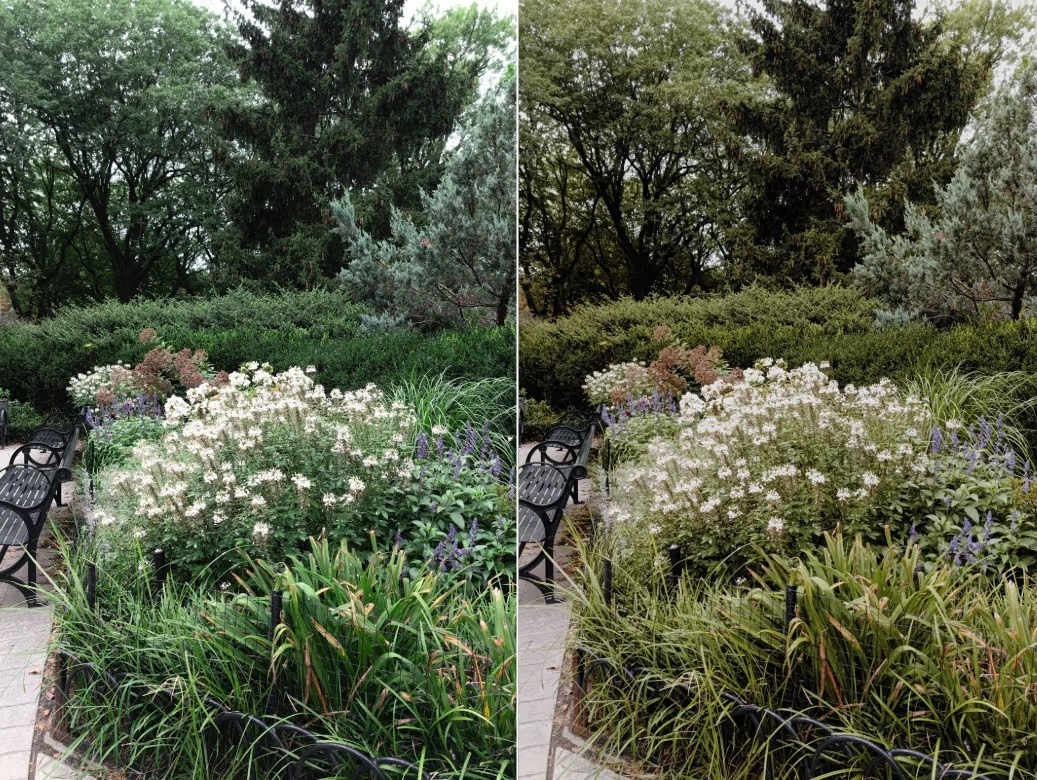
By contrast, expanding Pro Zoom from 100x to 120x—with AI generating the extra detail—earns a much more guarded response. When shooting stationary subjects like buildings or art installations, the results look clean, but pointing it at living wildlife produces images that feel unsettling. She also flags a more practical annoyance: handheld stability is tough at such extreme magnification, and the viewfinder automatically locks onto whatever it decides is the "subject," forcing you to fight the system to get back to what you actually meant to shoot. If your subject is a skittish deer or a dancer moving fast on stage, you might not even manage to get the shot at all.
Magic Capture's Logic Favors Big Movements
Magic Capture lets you record up to two minutes of video of a scene, and the system automatically picks out a handful of "worth keeping" still frames, while preserving the full video so you can screenshot from it yourself later. The reviewer tested it with a 43-second video of herself doing box jumps, and the system selected six photos: arms spread standing atop the box, a side fall, a side plank leg raise, mid-pushup, and a Mario-pose moment. She concludes the system's logic leans toward capturing moments with "big, distinctive movement that stands out from the rest," but may miss subtler expressions or gestures—like a bored kid rolling their eyes. She also tested it on a neighborhood squirrel, where a roughly 30-second clip yielded three photos, none of which turned out well.
By comparison, the Camera Looks filter feature is described by the reviewer as being "at the level of Apple's early Photographic Styles"—the four always-on filters and six one-time-use filters don't differ much from each other, and unlike iPhone filters, they don't dramatically shift background tone or contrast. It's one of the rare areas where Google trails behind Apple.
Pro Stable Video falls into the category of "it works, but should you actually use it?" Enabling it requires turning on Video Boost and shooting exclusively with the main camera; after recording, the phone uploads the footage to the cloud, where stabilization and brightness optimization are completed a few hours later. In testing, the reviewer found the footage noticeably steadier, though side-to-side shake wasn't fully eliminated—and the scenarios she'd actually want to use it for, like biking or waterskiing, are exactly the moments when you shouldn't be distracted holding up your phone to film in the first place.
The Pixel 11 Pro also adds Circle to Search integrated directly into the camera interface, Live Translate support for media content, tap-to-share in Quick Share, and proactive suggestion cards from Gemini during conversations. The materials provided don't include Taiwan release date or pricing information.