TIDEZINE.

Sony Music and UMG Accuse Suno's v6 Model of Being a Facelift, Not a Fix — Still Trained on Old Infringing Data

In a new lawsuit, Sony Music and Universal Music Group allege that Suno's v6 model, marketed as trained on licensed content, actually smuggled in outputs from its previously unauthorized models through "user interaction" data — with damages sought as high as $9 billion.

Jordan Lin, Deputy Editor
Sony Music and UMG Accuse Suno's v6 Model of Being a Facelift, Not a Fix — Still Trained on Old Infringing Data

Suno's v6 model was supposed to be an image makeover: it's the company's first release since signing licensing deals with Warner Music Group and BMG, with official messaging emphasizing that training material came from "partner-licensed content." But Sony Music Entertainment and Universal Music Group (UMG) see it differently — according to a lawsuit reported by Variety and obtained by Music Business Worldwide, the two record labels claim in their new suit that v6 is actually continuing to feed on unauthorized old data through a roundabout route.

The dispute hinges on a line Suno itself has publicly admitted: that v6's training data, besides licensed content, also includes "user interactions with the service." Sony Music and UMG interpret this as meaning these interactions are actually outputs and preference signals from earlier model versions — models that were trained using unauthorized copies of the two companies' recordings. In other words, even though v6 appears on the surface to use clean training material, the "taste memory" left behind by the old models may have leaked into the new generation of the product.

Following this logic, the two companies allege Suno has infringed the copyrights of at least 60,202 recordings, which under U.S. copyright law could result in damages of up to $9 billion. According to Music Business Worldwide, Suno could also face additional penalties of up to $2,500 each time it bypassed YouTube's anti-download technology to scrape songs.


Sony Music and UMG Accuse Suno's v6 Model of Being a Facelift, Not a Fix — Still Trained on Old Infringing Data

Responding to the allegations, Suno told Engadget that "these claims are fundamentally wrong, both factually and legally," reiterating that "Suno exists to help more people create new music." The company said it has spent the past two years working toward this goal, and that v6, developed in partnership with WMG, BMG, and Believe, "was trained using content licensed from our partners, interactions from our community (including creations and preference signals), and the learnings our team has accumulated." Suno added that it hopes AI and the music industry can mutually elevate each other going forward, creating new product experiences for artists, fans, and the wider music community.

This lawsuit follows earlier suits filed against Suno by Sony Music, UMG, and WMG, as well as a July 2026 data leak involving Suno — which revealed that the AI company had scraped large volumes of songs and lyrics from platforms like YouTube Music, Deezer, and Genius to train its earlier models. Suno has previously defended this kind of scraping as falling under fair use.

One notable move worth flagging: alongside the launch of v6, Suno also discontinued support for its older models. This at least suggests the company is well aware that a product marketed as trained on licensed material holds up better in the public eye than its past practices. But if the judge accepts the two labels' interpretation of how the training actually worked, this new packaging may not be enough to hold up.

Related

EU Unveils "EU Kids Act": Social Media Banned for Under-13s, Self-Registered Accounts Only Allowed at 15
Tech

EU Unveils "EU Kids Act": Social Media Banned for Under-13s, Self-Registered Accounts Only Allowed at 15

The European Commission has proposed the EU Kids Act, which would ban social media use for children under 13, require parental supervision for those aged 13 to 14, and only allow self-registered accounts starting at age 15. The proposal also calls for platforms to remove addictive design features like infinite scroll and recommendation algorithms.

GMO Launches Humanoid Robot Ambulance to Rescue Broken-Down Robots on Tokyo Streets
Tech

GMO Launches Humanoid Robot Ambulance to Rescue Broken-Down Robots on Tokyo Streets

GMO AI & Robotics Trading has rolled out Japan's first "humanoid robot ambulance" in Tokyo, stocked with parts, tools, and a spare robot on board. Broken units get swapped out on the spot, while the malfunctioning robots are shipped back to Humanoid Lab in Shibuya for repairs.

Sony Unveils Dual Headset Lineup Pulse and Pulse Edge, Magnet Count Draws the Line Between Models
Tech

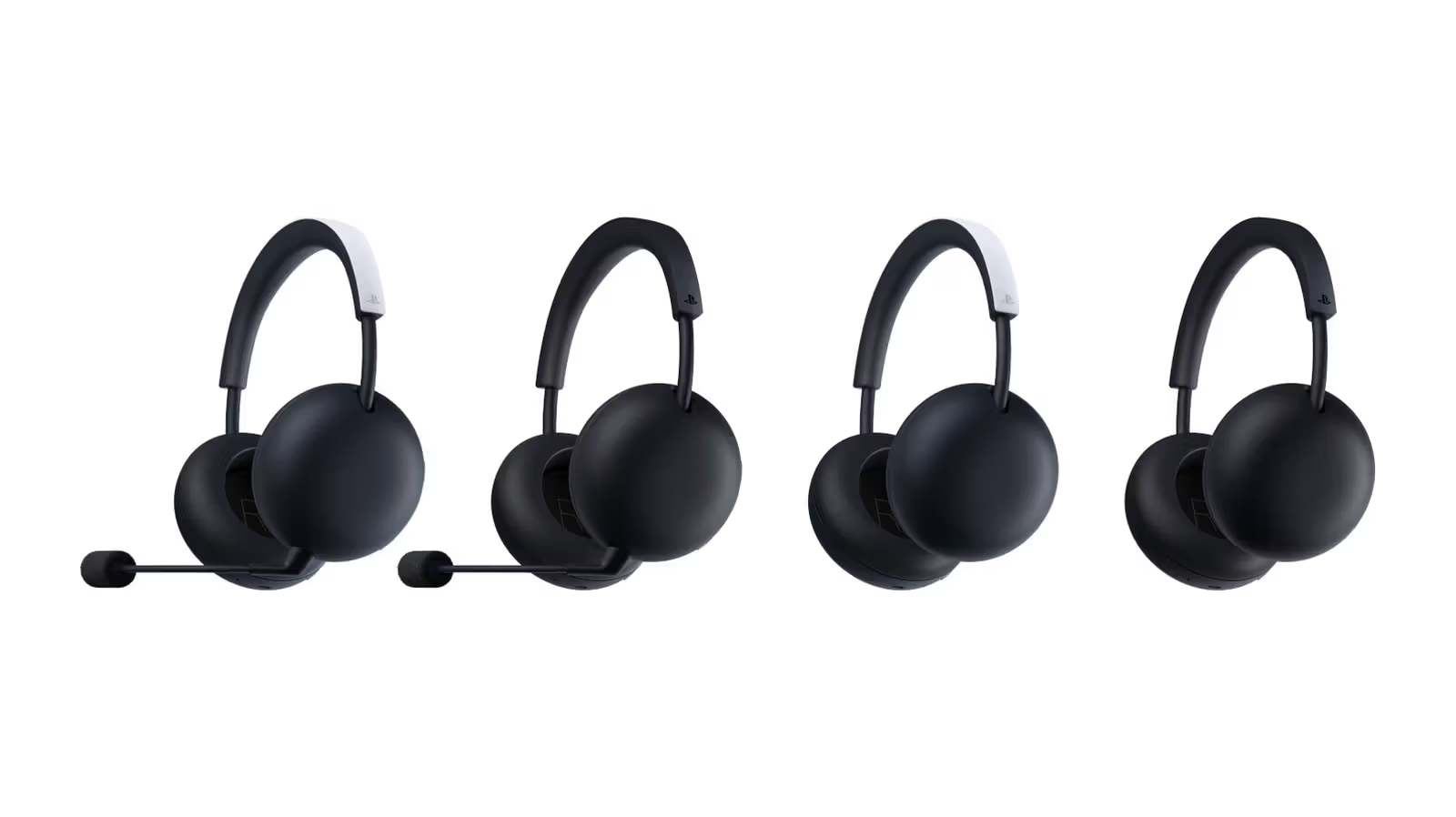
Sony Unveils Dual Headset Lineup Pulse and Pulse Edge, Magnet Count Draws the Line Between Models

Sony has announced two planar magnetic wireless headsets, the PlayStation Pulse and Pulse Edge, with the main difference coming down to magnet count and noise-cancelling setup. Both support PS Link and Bluetooth dual connectivity, though pricing and release dates have yet to be announced.

Boox Palma 3 Switches to Aluminum Body, Yet Costs $60 Less Than Predecessor
Tech

Boox Palma 3 Switches to Aluminum Body, Yet Costs $60 Less Than Predecessor

Boox just dropped three new E Ink devices at once, and the standout is its pocket-sized e-reader Palma 3, which upgrades from a plastic shell to an anodized aluminum body—yet drops the price from $380 to $320, all while adding support for the InkSense Plus stylus.

Musk's X and xAI Drop Antitrust Suit Against Apple, But OpenAI Still in the Crosshairs
Tech

Musk's X and xAI Drop Antitrust Suit Against Apple, But OpenAI Still in the Crosshairs

X Corp and xAI have withdrawn their antitrust lawsuit against Apple in a Texas federal court, with neither the reason for the dismissal nor whether a settlement was reached disclosed. OpenAI, a co-defendant in the same case, was not included in the dismissal, and the plaintiffs still plan to pursue the claims against it.

Valve Steam Frame Priced from $1,059, Bundles Remastered "Half-Life: Alyx"
Tech

Valve Steam Frame Priced from $1,059, Bundles Remastered "Half-Life: Alyx"

Valve has announced pricing for its new Steam Frame VR headset, starting at $1,059 for the 256GB version and $1,299 for the 1TB version. Every purchase comes with a remastered version of "Half-Life: Alyx" built with foveated rendering tech, capable of running standalone on the headset.