Calligrapher Tu Chung-gao dies: Taiwan’s Culture Ministry to seek presidential commendation
Taiwan’s Ministry of Culture announced Tu Chung-gao’s death on October 29 and said it would request a presidential commendation. His legacy spans calligraphy, research into Chinese writing, textbooks and decades of teaching.
Calligrapher Tu Chung-gao has died, Taiwan’s Ministry of Culture announced October 29. Its release commemorated him at 78 and said it would request a presidential commendation for an artist whose work crossed creative practice, scholarship and education. Culture Minister Li Yuan expressed condolences and recognised his contribution to calligraphy’s development and transmission in Taiwan. The proposed request is a next step, not an announcement that a commendation has already been issued. Looking back, his brushwork appears connected to reading, teaching and sustained change rather than separated from daily work.
From Changhua and teacher training
Born in Pitou, Changhua County, in 1948, Tu entered Taiwan Provincial Taichung Normal School, the predecessor of today’s National Taichung University of Education, in 1964. After graduation he taught at Jiuzhuang Elementary School in Taipei’s Nangang District, then pursued further study in Chinese at National Taiwan Normal University. That path from teacher training to classical learning gives his career the weight of both classroom and desk. A list of prizes alone cannot describe it.
He continued returning to education. In 1987 he began postgraduate art studies at the University of Tsukuba in Japan, receiving a master’s degree in 1990. A doctorate in literature from National Taiwan Normal University followed in 2001. Art and writing met across those stages. A retrospective published by NTNU in 2017 recorded his emphasis on understanding what one writes before expressing ideas through the brush. This is historical testimony from his lifetime, not a new interview conducted for this report.
Teaching and research beyond the brush
His teaching extended to National Taiwan Normal University, National Taiwan University of Arts and Taipei National University of the Arts. He also helped review and compile senior-high-school calligraphy textbooks. The ministry lists publications including Shudao Jifa 123, Shuowen Zhuanwen E’xing Shili and Hanzi Yange zhi Yanjiu, alongside participation in a volume on calligraphy in a series of Taiwanese art classics. Their subjects suggest another way to approach his work: beyond the line lie questions of technique, character forms and the history of writing.
In its account of his practice, the ministry described his command of seal, clerical, regular, running and cursive scripts, together with encouragement of experimentation. Tradition and change need not be treated as opposite poles: knowledge of several scripts and a search for personal expression can belong to the same long practice. His honours included the National Award for Arts, Chung Shan Literary and Art Award, recognition in the provincial art exhibition with permanent exemption from judging, and the Wu San-lien calligraphy award. He received the Order of Brilliant Star, Second Class, in 2016. Awards record achievements; teaching and books provide paths others can continue.
Reading and brushwork in three photographs
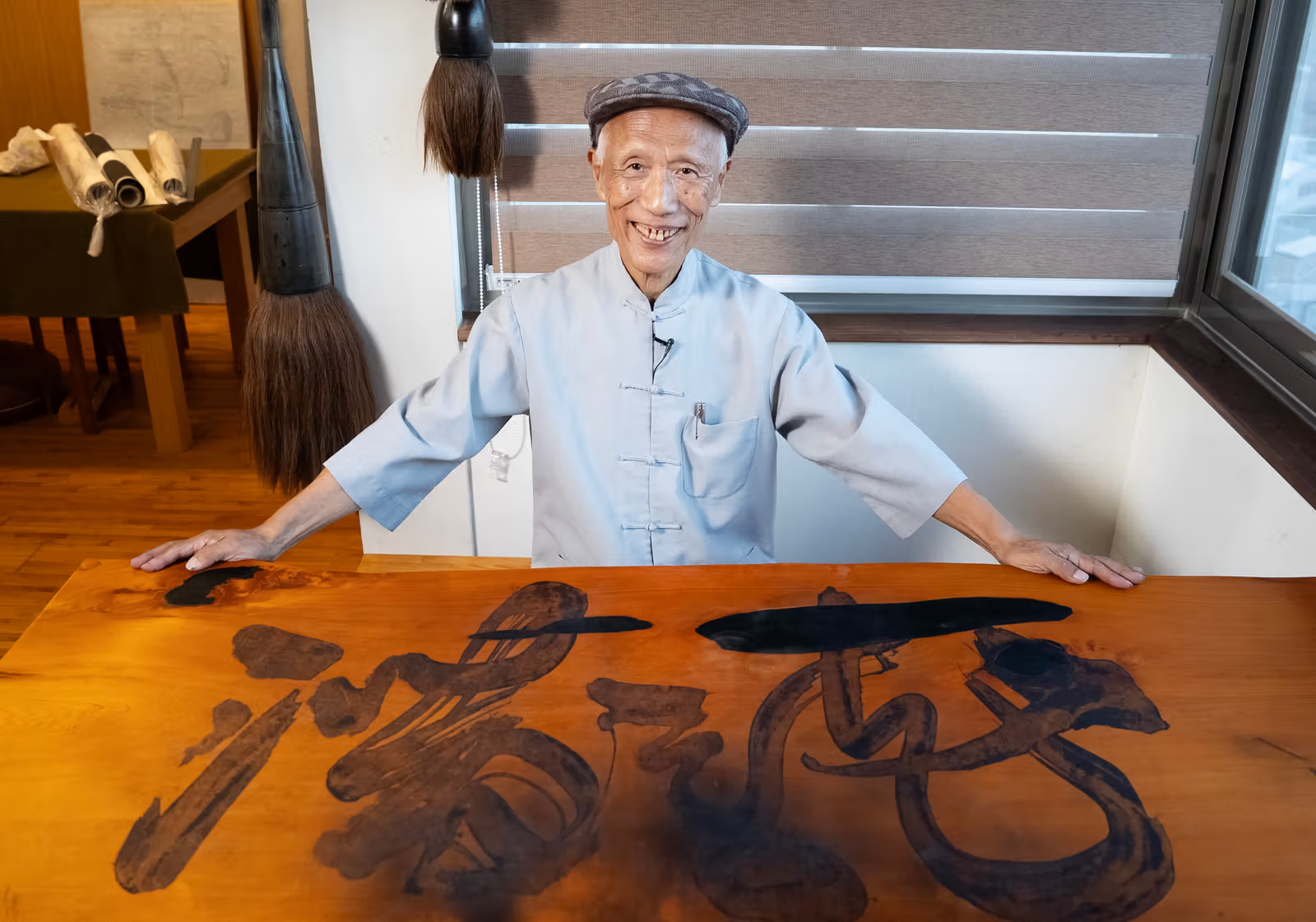
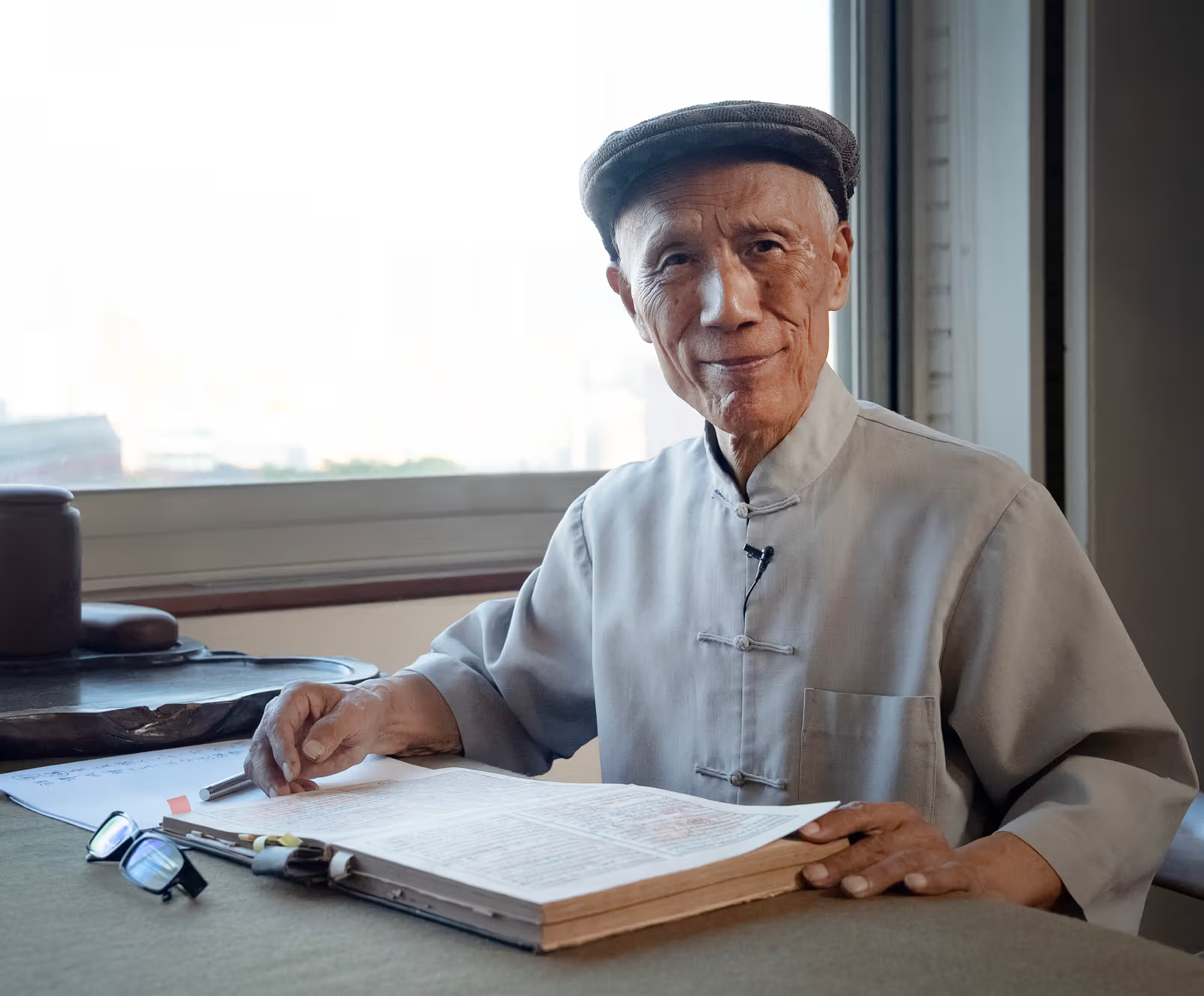
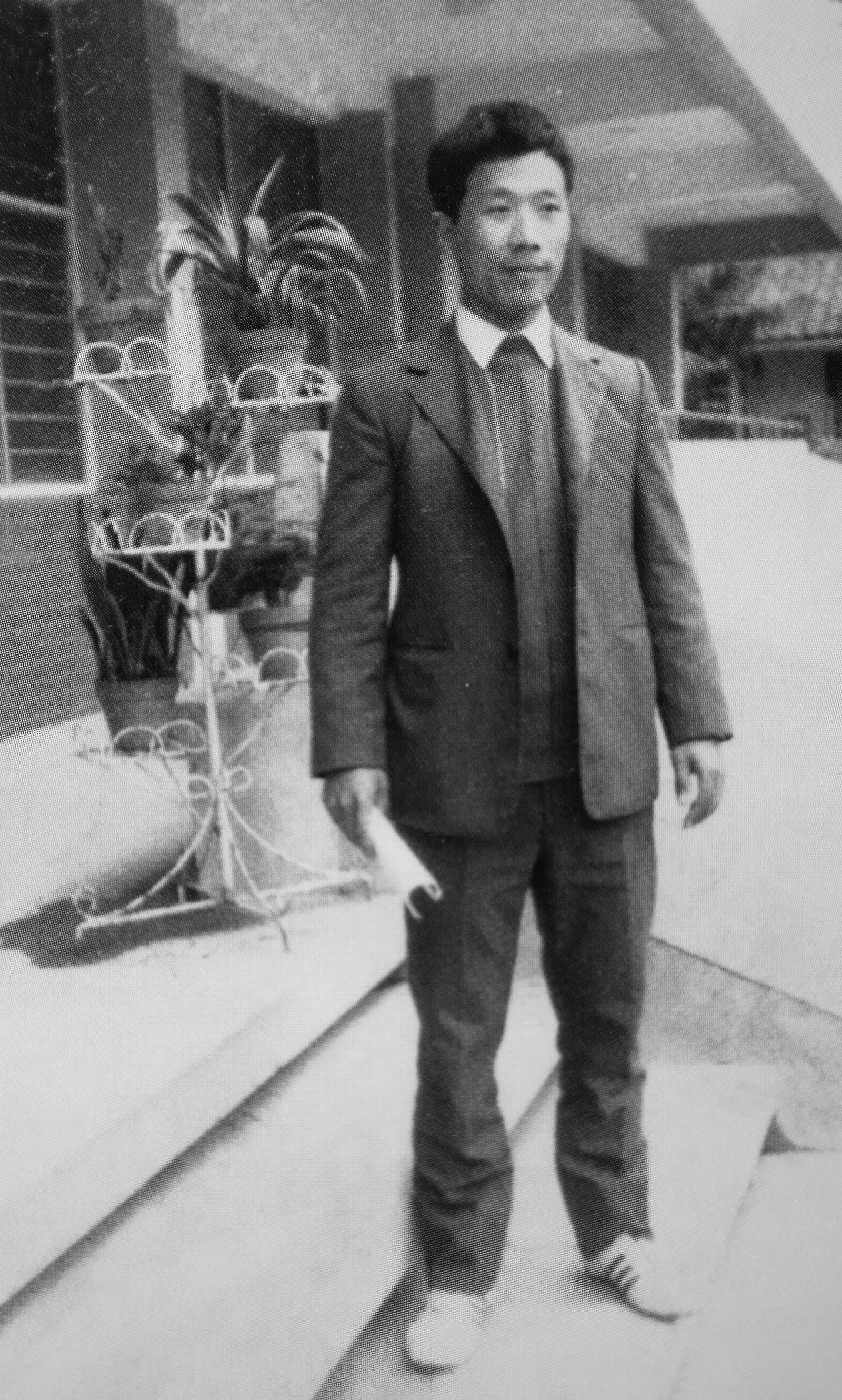
The photographs supplied with the release give that history an everyday scale. One shows Tu in a cap and pale-blue clothing behind a wooden table marked with large ink characters, with oversized brushes hanging nearby. Another places him at a window-side desk with open pages and glasses set aside. An earlier black-and-white portrait shows him in a suit. They connect the person with brushwork and reading. The release does not identify each photograph’s year or name the writing on the table, so these images should not be assigned to a particular exhibition or representative work.
Tu at a window-side desk with open pages and glasses set aside.An earlier black-and-white portrait supplied with the ministry’s release; its year is unspecified.
The ministry’s selection of works includes a running-cursive screen of five poems by Zhao Oubei, sayings of Dongshan Liangjie, Caigentan and Cheng · Xian · Pu. It notes holdings at institutions including the National Taiwan Museum of Fine Arts and Taoyuan Museum of Fine Arts. Remembrance can therefore extend beyond the news through works, scholarship and educational records. The announcement does not give dates for a memorial exhibition, public farewell or display of works. Any such arrangements should be confirmed through later family or institutional announcements.