Chiu Wei-Hsiang’s Toil and Soil in Hong Kong: land, care and nocturnal memory in colour
At gdm Hong Kong through October 31, Toil and Soil connects Chiu Wei-Hsiang’s family home in Taoyuan with daytime care work and nighttime painting, through portraits and everyday objects.
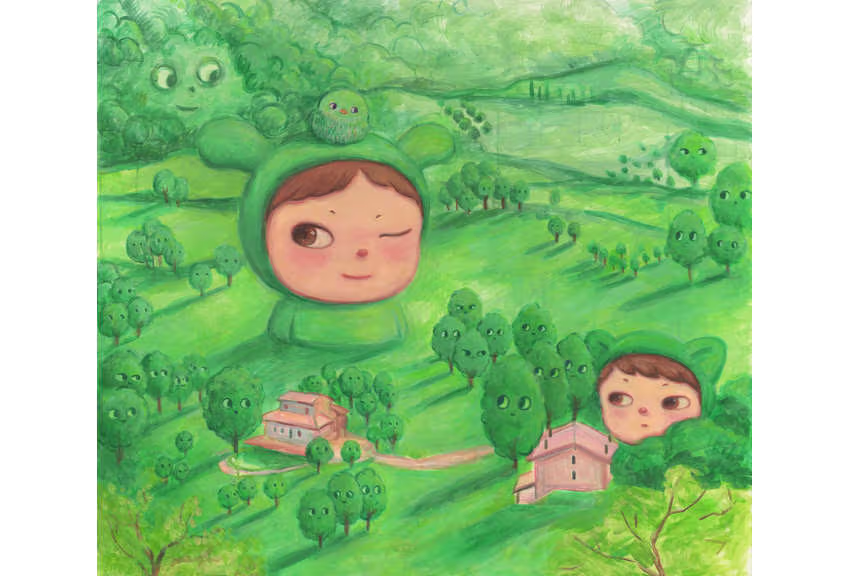
Chiu Wei-Hsiang’s Toil and Soil at gdm in Central, Hong Kong, closes on October 31. Animals, fruit and vegetables, flowers and distorted faces appear in vivid colour, with brushwork that resists a perfectly smooth finish. Born in Dayuan, Taoyuan in 1997, the artist brings the demolition of his family home, the family’s market business and his work in a care institution into painting. The idea of cultivation connects with land, but also with repeatedly making images at night after a day’s work.
From Dayuan, Taoyuan to a home held in memory
Chiu graduated from the Department of Painting and Calligraphy Arts at National Taiwan University of Arts in 2020 and now lives in Taipei. His childhood was bound to rural life, family and the market; his old home was later expropriated and demolished for the Aerotropolis project. The House (2023) and Root (2024) were staged at the ancestral home site. This history matters beyond repainting a lost building: a life once held together by addresses, landscapes and family relationships becomes memory that can be seen, but never wholly restored.
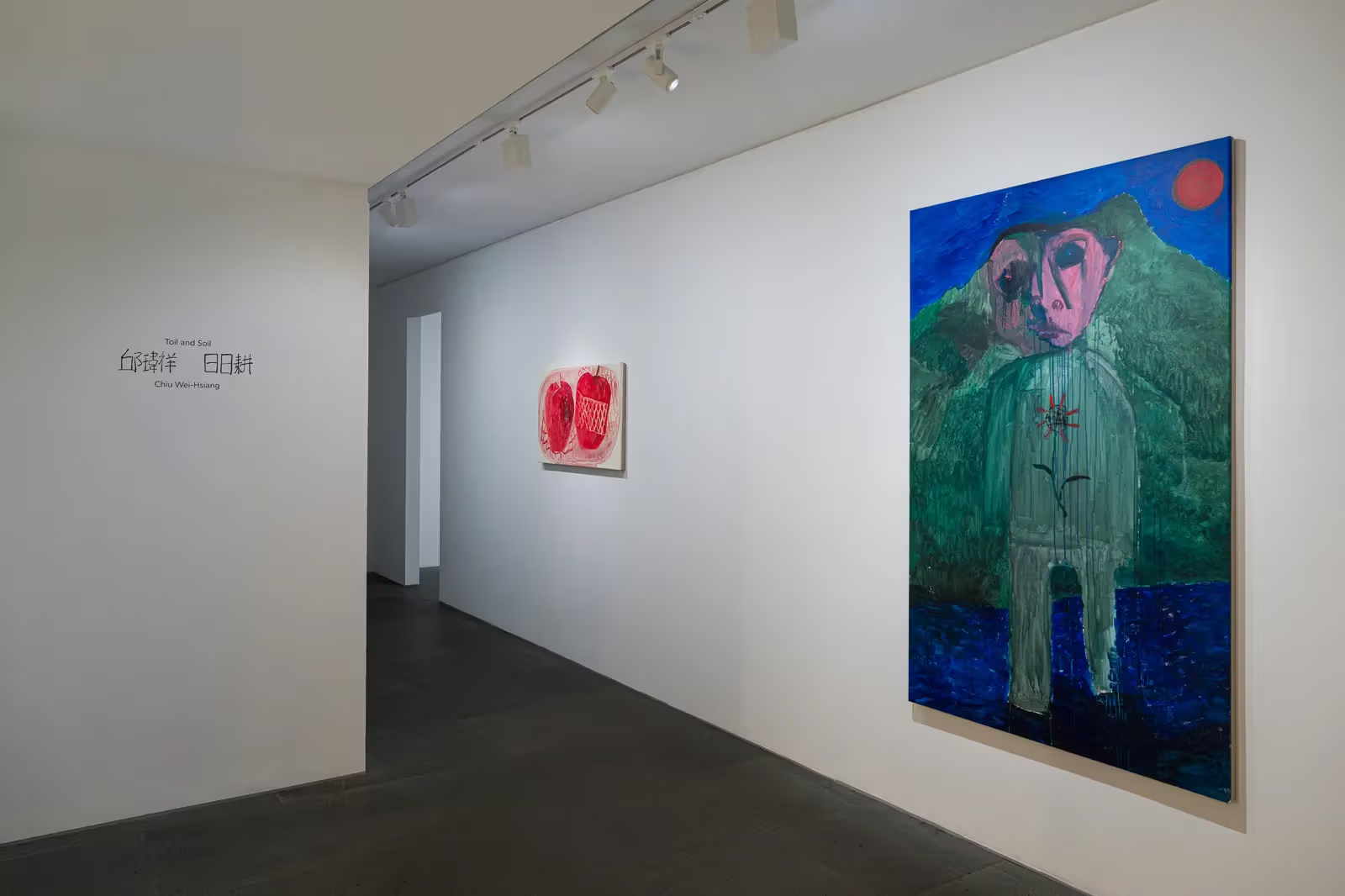
It helps to set aside the usual test of whether something looks accurate. Chiu paints directly from images in his mind rather than relying on reference photographs or preliminary sketches, so blurred contours and distorted proportions need not be treated as errors awaiting correction. Memory already omits, enlarges and displaces. Strong pinks, greens, blues and reds retain those deviations on the surface, allowing everyday things to carry tension and intimacy as well as recognisable shapes.
Different rhythms in large paintings and small sequences
In installation photographs, a large vertical work surrounds a pink face with a blue and green background; an elongated body and a flower at the chest create unsettled proportions. A sequence of smaller works places people, plants and objects alongside one another at comparable scales. Start by following how one colour changes between images, then compare the pace of reading a single large painting with a succession of small ones. Attention shifts from “what is this?” towards “how is it remembered?”
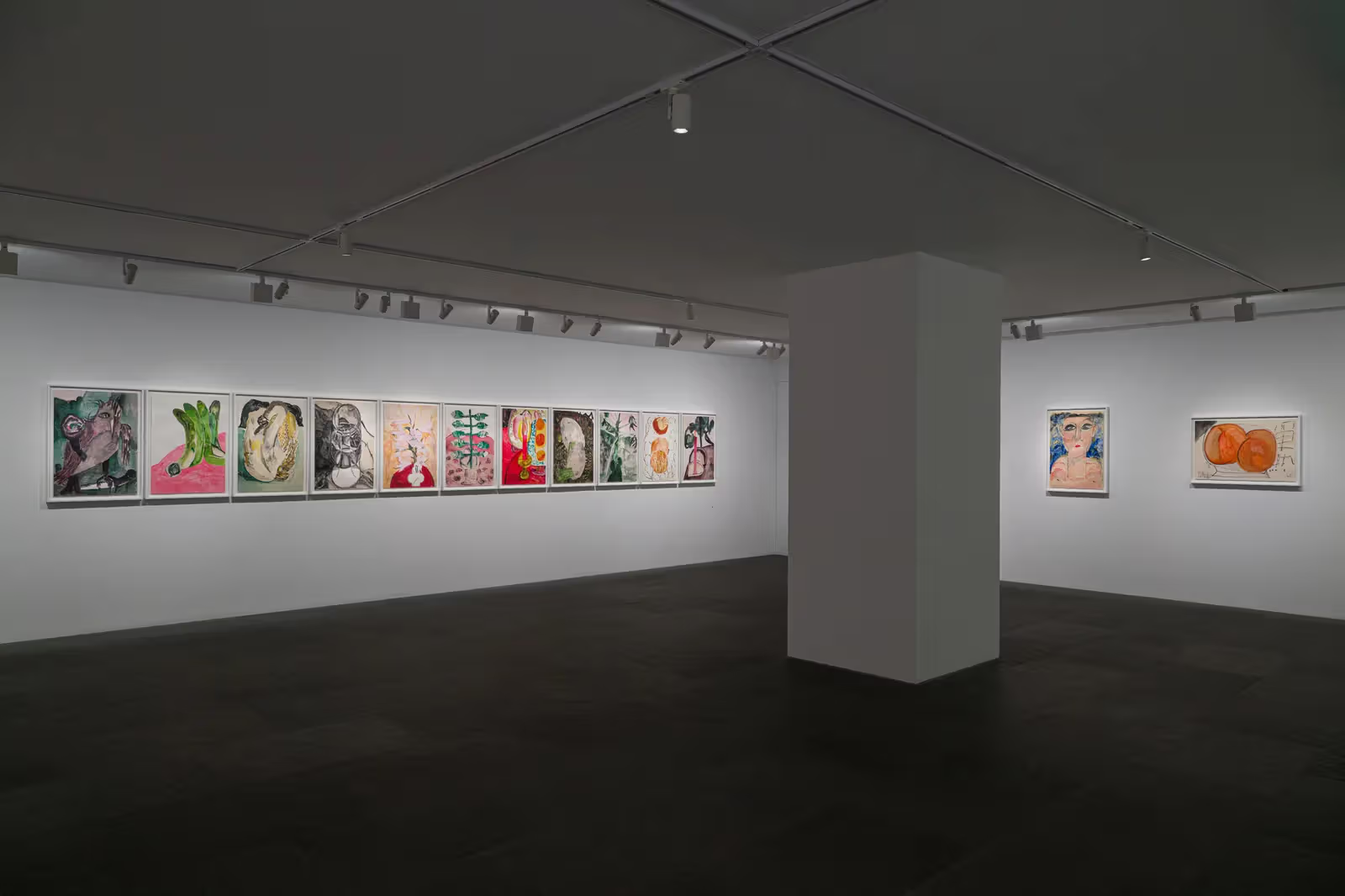
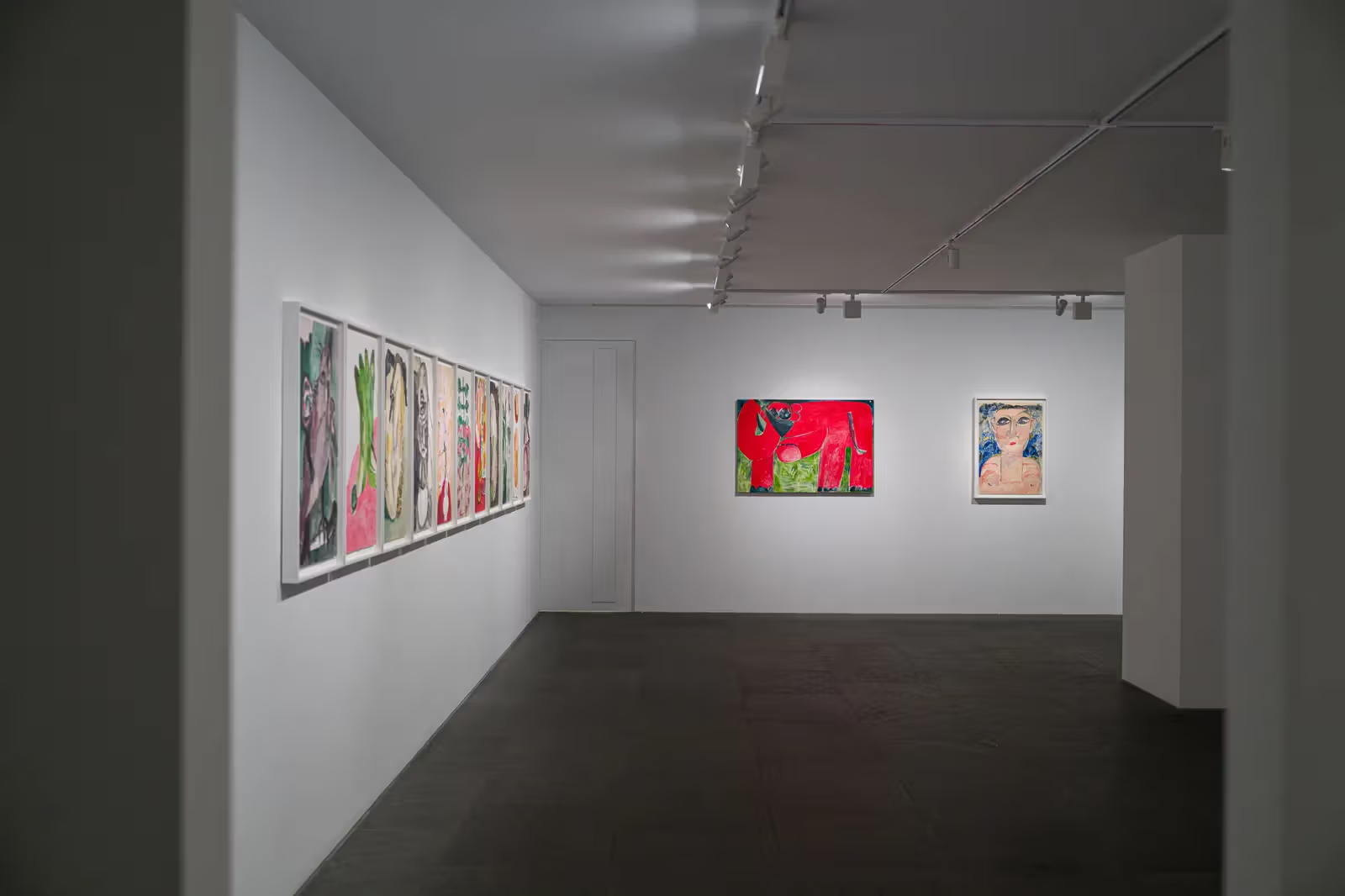
Small paintings of people, plants and everyday objects are placed side by side along a wall.A sequence on the long wall offers a different viewing distance from the portraits and animal painting at the end.
Daytime care work is another reality inseparable from the practice. Chiu manages a nursing institution full-time and paints at night, facing ageing and the end of life in his everyday work. The gallery’s interpretation considers how care labour can be obscured by systems and efficiency, and how images preserve individual complexity. This is not a matter of reducing people receiving care to one symbol; it asks viewers to consider the stories a face or household object can hold beyond a functional category.
After care work, images continue into the night
For viewers used to polished digital imagery, the unrefined lines and colour in Toil and Soil reward attention. Rough shapes, paint drips and uneven brushwork reveal an image built through repeated gestures rather than automatic production. Between the sequence across a long exhibition wall and a separately hung portrait, move closer and step back. Notice what becomes legible first at each distance: a person, a block of colour or an apparently ordinary object.
Toil and Soil runs from September 10 to October 31, 2026 at room 108, 1/F, Ruttonjee Centre, 11 Duddell Street, Central, Hong Kong. The gallery opens Tuesday to Saturday, 10am–7pm. Enquiries: +852 2525 0529; further details are on the gdm exhibition page. Before the show closes, leave time for the pauses between lines and figures, and for how a young artist holds a place for himself within everyday labour.