TIDEZINE.

Claude's Memory Is Now Editable: Anthropic Lets Users Rewrite What the Chatbot Remembers Long-Term

Anthropic is rolling out more granular memory controls for Claude, letting users edit or delete what the chatbot remembers by topic, with the option to include or exclude sensitive information.

Claude's Memory Is Now Editable: Anthropic Lets Users Rewrite What the Chatbot Remembers Long-Term

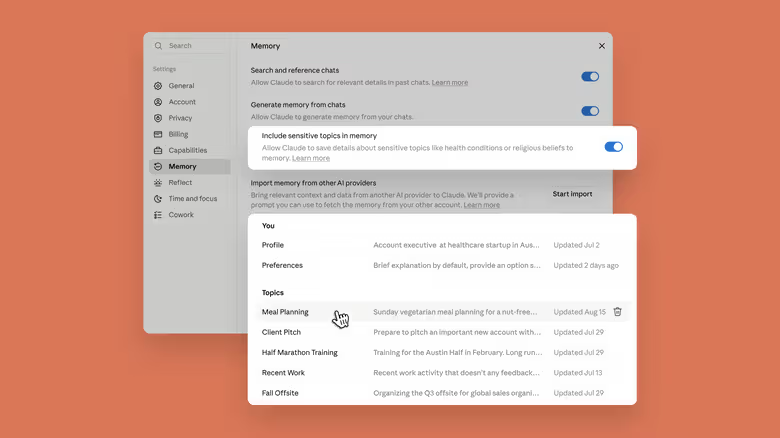
Claude gained the ability to remember across conversations starting summer 2025, sparing users from having to re-explain context every time they chat. The feature is on by default for all accounts, including free users. After a recent update, this memory now also carries over between Claude Cowork sessions. What's really worth noting is the new set of controls Anthropic has been rolling out over the past few weeks — users can now edit specific topics that Claude remembers, instead of only being able to wipe the whole thing at once.

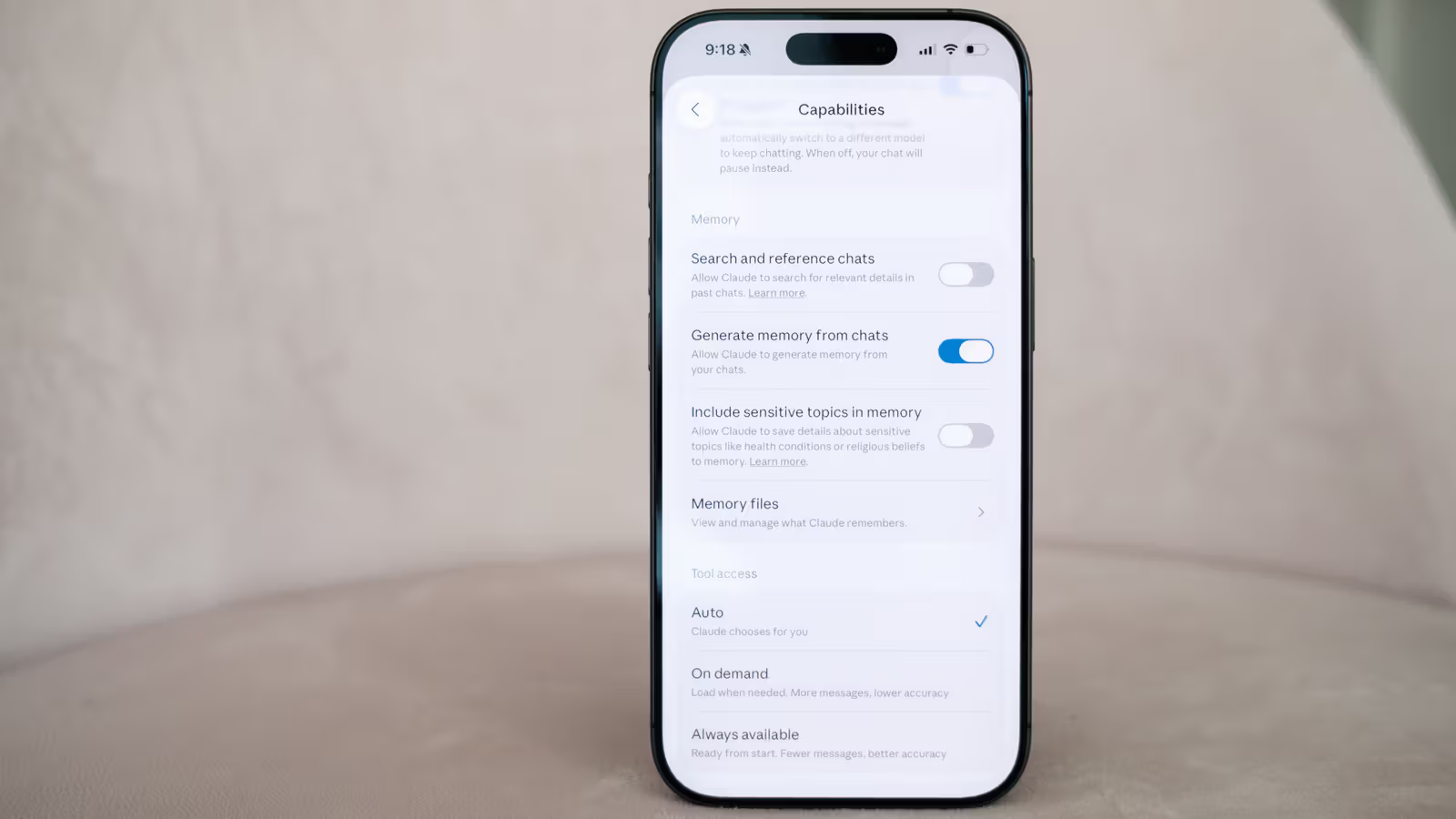
On the web version at claude.ai, it's not complicated: go to Settings from the profile menu, click Memory, scroll down to the Topics section, and you'll see edit and delete icons next to each memory topic. Click the edit icon to type instructions in the prompt bar telling Claude how to modify that memory, or click delete to remove the topic entirely. The mobile path is slightly different — go to Settings from the profile icon, find Capabilities under the App category, then scroll down to Memory files to pick a topic to edit or delete using the trash icon.
Claude 的記憶可以編輯了:Anthropic 開放使用者改寫聊天機器人的長期印象

This update also adds a new option called Include sensitive topics in memory. By default, Claude won't store memories related to health, race, religious beliefs, political views, or gender identity. Only after a user actively turns on this option will Claude start recording this kind of sensitive information — and it'll show a prompt every time it generates a related memory. Anthropic notes that users on older versions or the mobile app won't see this prompt, and in that case Claude won't save the sensitive topic at all. Regardless of whether this option is turned on, Claude will never remember things like government-issued ID numbers, and the feature won't retroactively save memories from past conversations.


If you'd rather stop Claude from accumulating any more memories, you can turn off Generate memory from chats, which brings up two options: Pause memory and Reset memory. Anthropic warns that once Reset memory is executed, there's no undoing it — "after you re-enable this feature, you'll be starting from scratch, and Claude won't retain any previous memories."

Memory in Projects is kept separate

Claude 的記憶可以編輯了:Anthropic 開放使用者改寫聊天機器人的長期印象

Anthropic keeps Claude's memory within Projects walled off separately, to avoid cluttering the context window with information unrelated to the current task. Users can shape what Claude remembers for a specific project by adding comments, documents, or connecting GitHub info through the panel on the right side of the interface. At the end of each day, Claude generates a summary of the work completed, which can also be edited directly within this same interface.

If you accidentally give Claude an instruction outside of a Project, you can click the three-dot icon in the top right and select Add to project to file that conversation under the correct project. If you want a piece of information to be remembered by Claude across all tools and conversations — including every Project — you'll need to add it to the Profile section within the Memory menu instead.

There's also a ghost icon in the top right of the interface — clicking it switches on Incognito mode, temporarily preventing Claude from writing anything to memory. As Anthropic puts it: "Private conversations won't be saved, won't be added to memory, and won't be used to train the model." Back in March, Anthropic also added an import tool that lets users bring over chat histories from other chatbots into Claude, accessible via Start import in the Memory menu.

Related

No Account Hack, No Leaked Password: The Truth Behind Mysteriously Drained Claude Usage
Tech

No Account Hack, No Leaked Password: The Truth Behind Mysteriously Drained Claude Usage

Anthropic sent an email to affected users last week, force-logging them out of their accounts, deleting saved credit cards, and issuing refunds. The cause: info-stealing malware on users' computers that hijacked their Claude login sessions.

Memphis Data Center Hiccup Knocks Grok Offline for Over 3 Hours—SpaceXAI Apologizes to "Compute Partners"
Tech

Memphis Data Center Hiccup Knocks Grok Offline for Over 3 Hours—SpaceXAI Apologizes to "Compute Partners"

SpaceXAI's data center in Memphis suffered a "model outage" on September 3, taking Grok down for more than three hours. The company also issued an apology to unnamed "compute partners." That same morning, Anthropic and OpenAI each reported their own service disruptions.

Boox Go 6 Gen II Review: The E-Reader That Runs Google Play, but the Battery Only Lasts Eight Days
Tech

Boox Go 6 Gen II Review: The E-Reader That Runs Google Play, but the Battery Only Lasts Eight Days

The $200 Boox Go 6 (Gen II) runs Android, letting you install any reading app and use a stylus, but its battery life falls well short of Kindle and Kobo—and it's still stuck on Android 11, which has already lost security updates.

Android's Scam Detection Is Expanding to Samsung Devices, Starting With the Galaxy S26
Tech

Android's Scam Detection Is Expanding to Samsung Devices, Starting With the Galaxy S26

Google's AI-powered call scam detection has so far been limited to Pixel devices, but the company has now confirmed it's expanding to the Samsung Galaxy S26. Beyond that, updates, two-factor authentication, Find Hub, and anti-theft locks are all easy-to-overlook pieces of Android's security toolkit.

Honor Robot Phone Hands-On: The Wild Experiment of Squeezing a Gimbal Into a 9.6mm Body
Tech

Honor Robot Phone Hands-On: The Wild Experiment of Squeezing a Gimbal Into a 9.6mm Body

Honor built its own 2.6-gram gimbal motor and tucked it inside a phone's back cover to drive three-axis stabilization for a 200MP main camera. This limited-run experimental device, launched only in China, feels somewhere between a regular phone and a dedicated gimbal camera in real-world use.

NVIDIA PAIR: Turning That Idle PC at Home into a Free AI Compute Pool
Tech

NVIDIA PAIR: Turning That Idle PC at Home into a Free AI Compute Pool

NVIDIA unveiled PAIR, a free open-source tool, at IFA 2026. It distributes AI compute workloads to idle computers on your local network, so your main machine doesn't have to shoulder the entire GPU load alone.