Kim Duck-Yong at Soluna Hong Kong: wood grain, mother-of-pearl and sea light until November 28
Soluna Fine Art presents its third solo exhibition with Kim Duck-Yong. Four installation photographs trace the connections between wooden windows, seascapes, stacked books and the memory of everyday objects.
A seascape need not appear on canvas: it can emerge between wood and the lustre of shell. Korean artist Kim Duck-Yong’s Where Grain Becomes Light opened at Soluna Fine Art in Hong Kong on October 15, 2026, and continues until November 28. His third solo exhibition with the gallery centres on wood, mother-of-pearl and other mixed media. Windows, the sea, books and vessels provide ways into the materials.
Begin with the installation: windows, sea and books
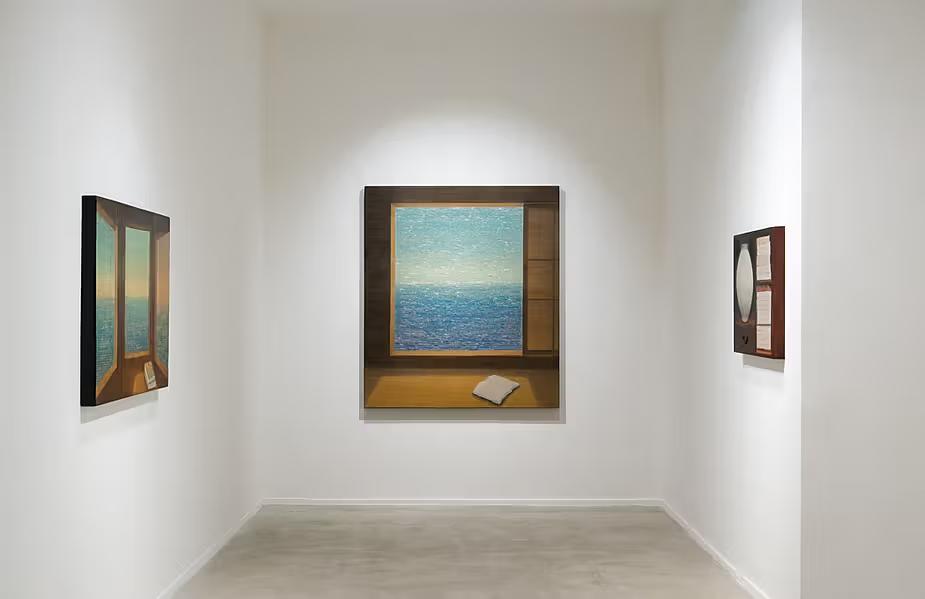
In the gallery’s installation photographs, a wooden-window seascape hangs at the centre of a white wall, with an open book near the lower edge of the composition. Brown framing retains the solidity of wood, while the view moves from pale blue towards a deeper sea. Works on either side continue the window and white-vessel motifs. Seen across the three walls, a window is both a structure within the picture and a limit on how much landscape the viewer can see: some passages suggest looking outside, while others hold attention on objects indoors.
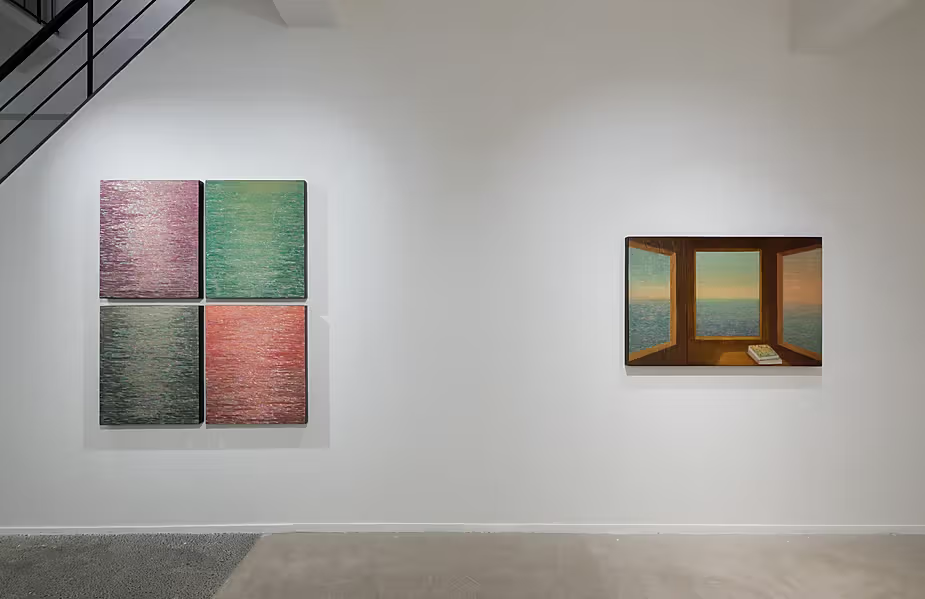
Another photograph places four pink, green, dark-grey and coral-coloured surfaces beside a figurative window scene. Without a window frame as a cue, horizontal glints become the visual focus; in the seascape, similar small highlights resemble water. These offer two useful ways of looking in the gallery: identify the subject first, then step back to consider how the material organises the surface. A photograph records one lighting angle and cannot replace observing reflections as your viewpoint moves.
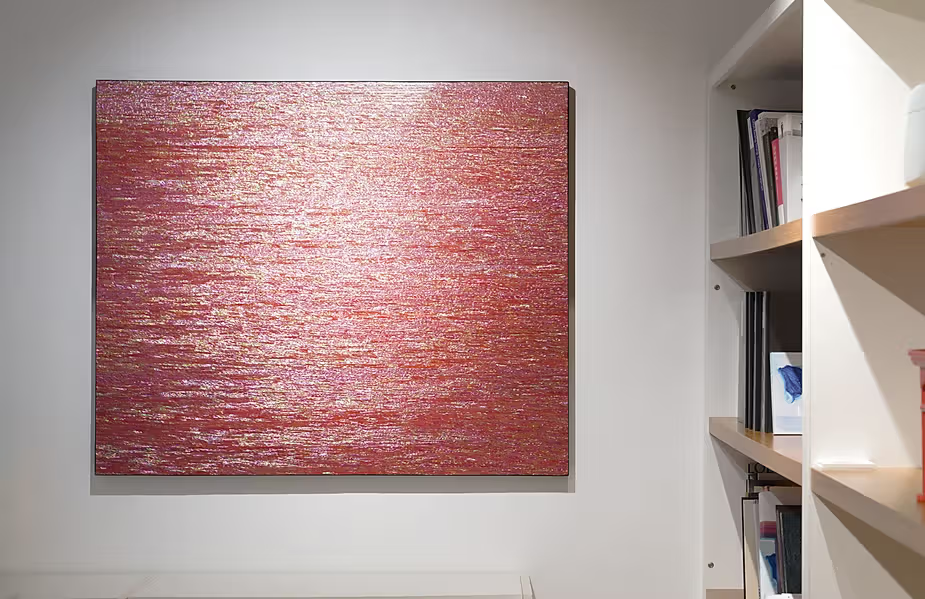
Four shimmering fields of colour are shown alongside a window seascape, inviting comparison between surface texture and figurative composition.Horizontal glints across a reddish work produce varying light and dark areas under the gallery lighting.
Mother-of-pearl and wood make time visible
The exhibition lists Borrowed Scenery – Light and Grain as a 2026 work in mother-of-pearl and mixed media on wood, measuring 160 × 140 cm. The Time of Light, made in 2025, measures 80 × 120 cm. Dates, proportions and materials offer more precise clues than simply calling the works shimmering. Relating those dimensions to the body suggests a more encompassing window-like field in the former and a broader horizontal view in the latter, before returning to how their frames and inner spaces are arranged.
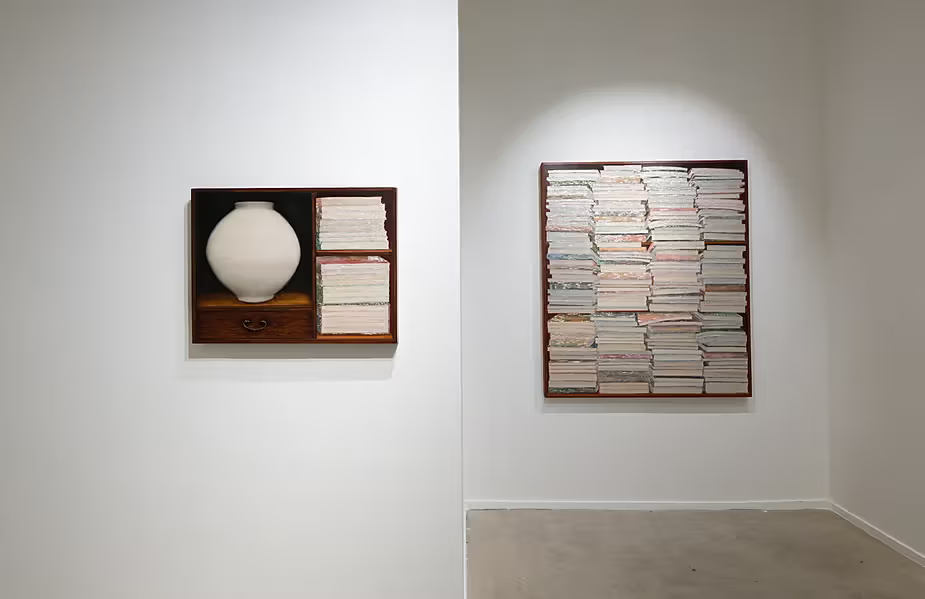
Kim was born in Suncheon, South Korea, in 1961 and holds a BFA and MFA in painting from Seoul National University. The gallery connects his materials, memory and inheritance through the Korean idea of Jasaengjimi, or naturally arising beauty; this is a curatorial reading. A white vessel and stacks of books elsewhere in the installation offer a more immediate entry point. Their familiar outlines and rows of spines are reconstructed through wood tones and luminous surfaces, giving ordinary objects a presence as both images and materials.
Vessels and stacked books are arranged in different ways, connecting everyday objects with the exhibition’s concern for memory.
Visiting Sheung Wan: open Tuesday to Saturday
For a visit, begin with an overall view, look closely at the texture of one work, and then compare its colours with another wall. Seascapes, fields of colour and books need not follow one narrative. Their treatment of sheen, frames and repeated lines already supplies a clear route through the exhibition. Anyone interested in interiors can also consider how the white walls, the edges of wooden panels and the windows within the works connect the actual gallery to the depicted spaces.
Soluna Fine Art is at G/F, 52 Sai Street, Sheung Wan. Regular hours are Tuesday to Saturday, 10:00–18:00; it closes on public holidays, and Sunday is outside its regular opening days. The exhibition runs until November 28. Check the official exhibition and visiting information before planning a trip. One simple focus is enough: let wood grain and reflected light, so often treated as background, become the subjects of attention.