Samsung and POLI.design Give 14 OLED Screens Different Frames
Italian artists reinterpret phones, audio and appliances at Seoul Design Week. Pink tubes, silver facets and woven textures show how a screen’s physical edge can join its imagery.
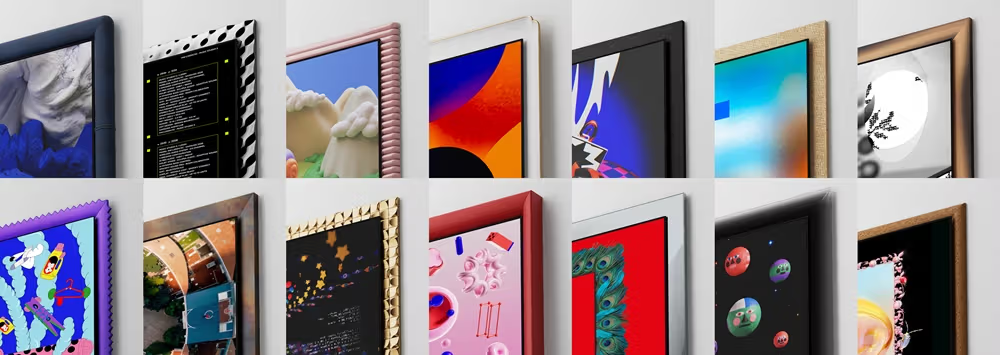
Can the same television remain the same object after its frame changes? Samsung and Italian design education institution POLI.design paired works by 14 Italian artist teams with custom frames on 14 OLED televisions for Design is an Act of Love at Seoul Design Week. Photographs released by the brand on October 21 offer a comparison of screens, imagery and physical boundaries.
Start from products without making conventional product advertisements
The works draw on mobile devices, appliances and televisions, including Galaxy Z Fold8, Music Studio 5 and Bespoke AI Family Hub. Samsung says the artists began with product forms and characteristics, added personal experience and used AI to develop ideas and explore expression, while grounding each work in its maker’s perspective and creativity. That account of process does not establish that every image came from one model or that the depicted capabilities belong to the products themselves.
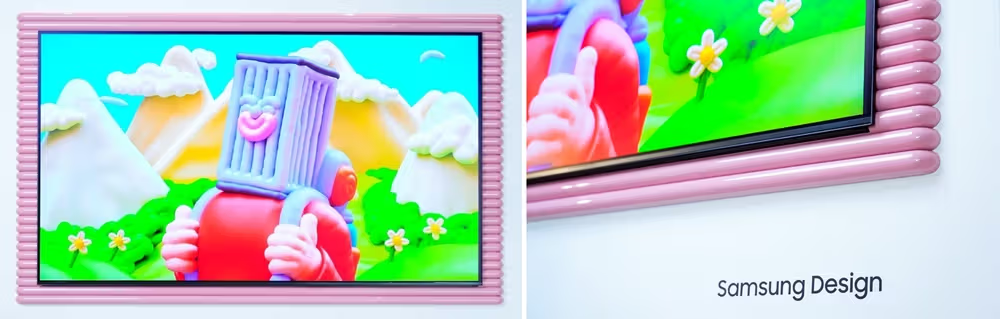
The air-purifier work makes the differences tangible. Tommy Tokyo, whose practice spans virtual reality, animation and digital media, translates the Infinite AI air purifier’s clean-air concept into a brightly coloured narrative. Official photographs show a smiling purple machine-like character among mountains, clouds and flowers, framed by pink rounded tubular forms. The character and soft border continue into each other, bringing a technological object into a toy-like setting.
Tommy Tokyo’s air-purifier-inspired work meets a pink rounded tubular frame.
On-screen space meets off-screen material
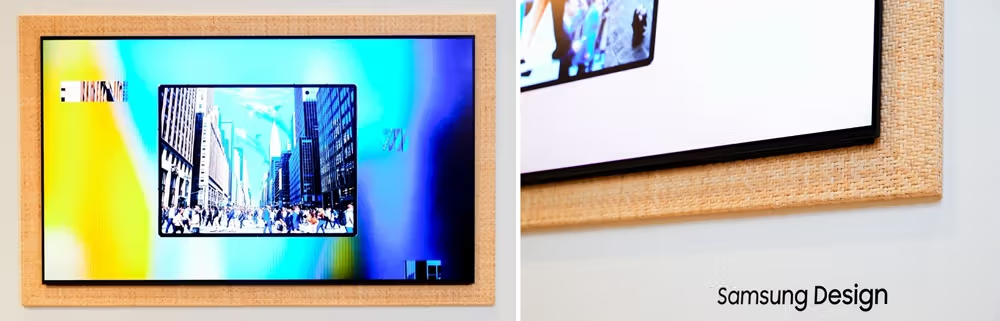
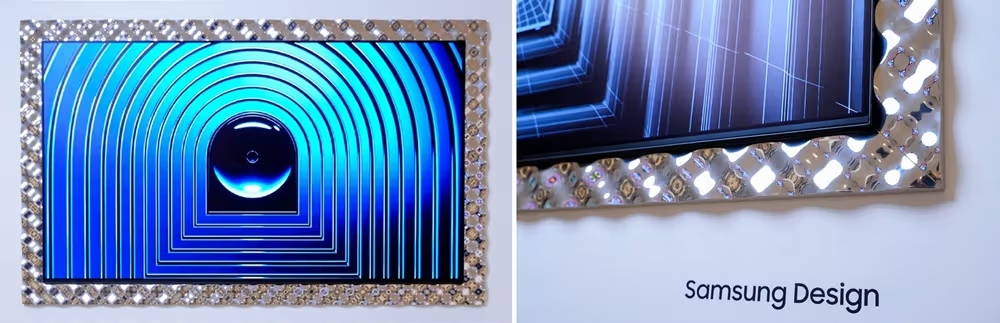
The Music Studio 5-inspired work goes another way: layered blue arches recede towards a dark circle, while the surrounding frame is densely covered in reflective silver facets. Lines establish depth within the image and gloss creates rhythm at its physical edge. The Fold8-related work places a city street within a horizontal image surrounded by blue and yellow areas, paired with a light brown woven-texture frame. Urban imagery meets a surface associated with domestic materials.
The Galaxy Z Fold8-inspired work pairs urban imagery with a woven-texture frame.The Music Studio 5-related work contrasts blue arches with a silver faceted frame.
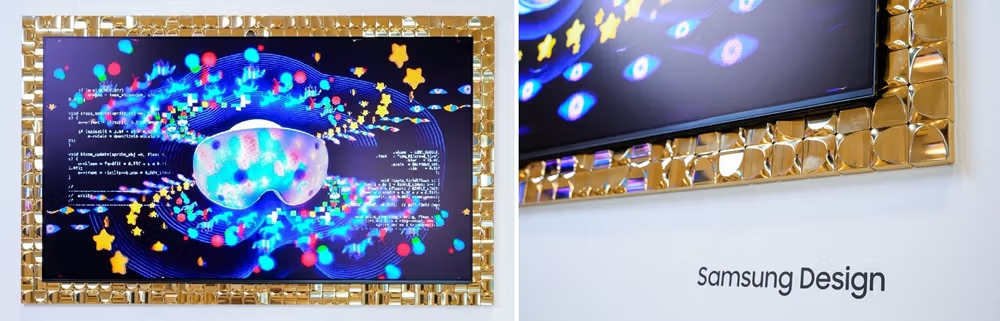
The Galaxy XR-related work offers another combination. Official images show colourful particles, eye shapes and lettering above a dark ground, with a gold frame of square divisions and reflective curved surfaces. Together, these four examples clarify the custom frame’s role. Rather than uniformly concealing hardware, it participates in the composition. Thickness, corners and surface texture all change the perceived distance between an image and the surrounding white wall.
Official comparison of the 14 artworks and their different custom frames.The Galaxy XR-related work combines colourful digital imagery with a reflective gold frame.
Fourteen frames do not mean fourteen new retail TVs
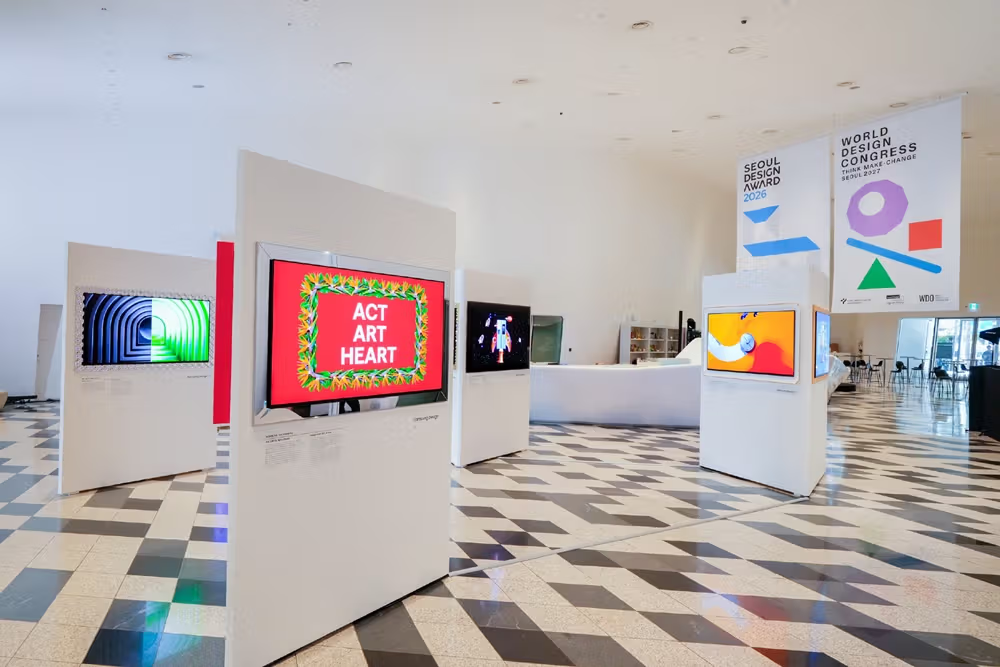
Samsung says the frames were made specifically for the exhibition to complement each artwork’s colours and mood. The OLED’s Float Layer Design makes the screen seem to float above a metal plate. The display therefore compares two things: how one screen model accommodates different makers, and how physical framing extends an image. Freestanding white partitions and multidirectional placement in the photographs also break away from a single continuous row along a wall.
The exhibition continues September’s Design Miami Seoul theme with different collaborators and works. Its announced run was October 15–25 at the DDP Lounge, Art Hall 1F, Seoul. The published images reveal the exhibition’s design details; retail prices and sales arrangements for these exhibition frames have not been announced. For anyone considering screens within domestic space, the useful lesson is how surrounding material can give one rectangular interface quite different expressions.