Dan Archer’s free Hong Kong Street Comix exhibition ends October 28: taxis, rituals and hand-drawn rhythms
Comix Home Base on the Hong Kong Arts Centre’s second floor opens free daily from 08:00 to 23:00. Four exhibition-preview comics show how Dan Archer turns observation, dialogue and panels into Hong Kong stories.
A story about Hong Kong’s streets need not begin with a wide-angle photograph. British comics creator Dan Archer brings on-the-spot sketches, people’s speech and sequential panels into Comix from the Streets of Hong Kong, a solo exhibition in the Hong Kong Arts Centre’s Comix Pulse series. Open since October 15, 2026, it ends on October 28 and is free to enter. At Comix Home Base on the Arts Centre’s second floor, 2 Harbour Road, Wan Chai, markets, martial-arts spaces and festivals reveal how a city can be understood line by line.
How does on-the-spot sketching become sequential storytelling?
Most of the comics and sketchbooks were made through direct observation rather than from photographs. The difference goes beyond using pen and paper: drawing people on location requires choosing which pose, sound or object to keep while movement continues. The exhibition also traces the process from sketches to finished comics. Comparing what survives from an initial drawing into a panel sequence reveals how a moment is organised into a narrative with a before and after.
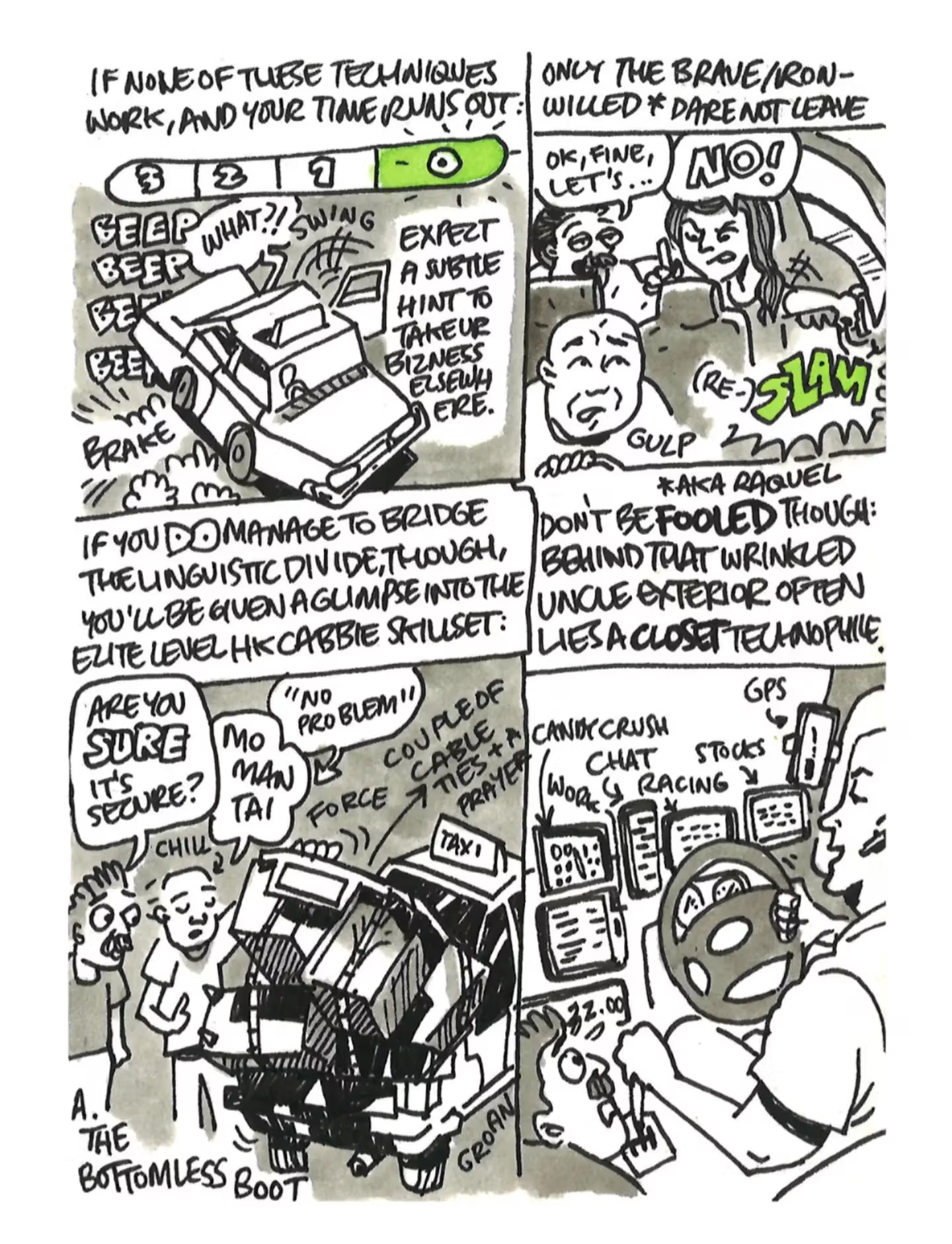
The artist’s public exhibition-preview taxi comic makes that rhythm easy to recognise. Doors, a boot, facial expressions and multiple phones beside a steering wheel occupy panels of different sizes, with small green highlights punctuating black-and-white imagery. Humour lies in the pauses between panels as well as in dialogue. This is the creator’s comic treatment of urban transport experiences: its storytelling is worth examining without treating it as a description of every driver or passenger.
A taxi comic arranges doors, a boot and phone screens into a sequence of urban jokes.
Gatherings beside a festival and the movement of hands take the lead
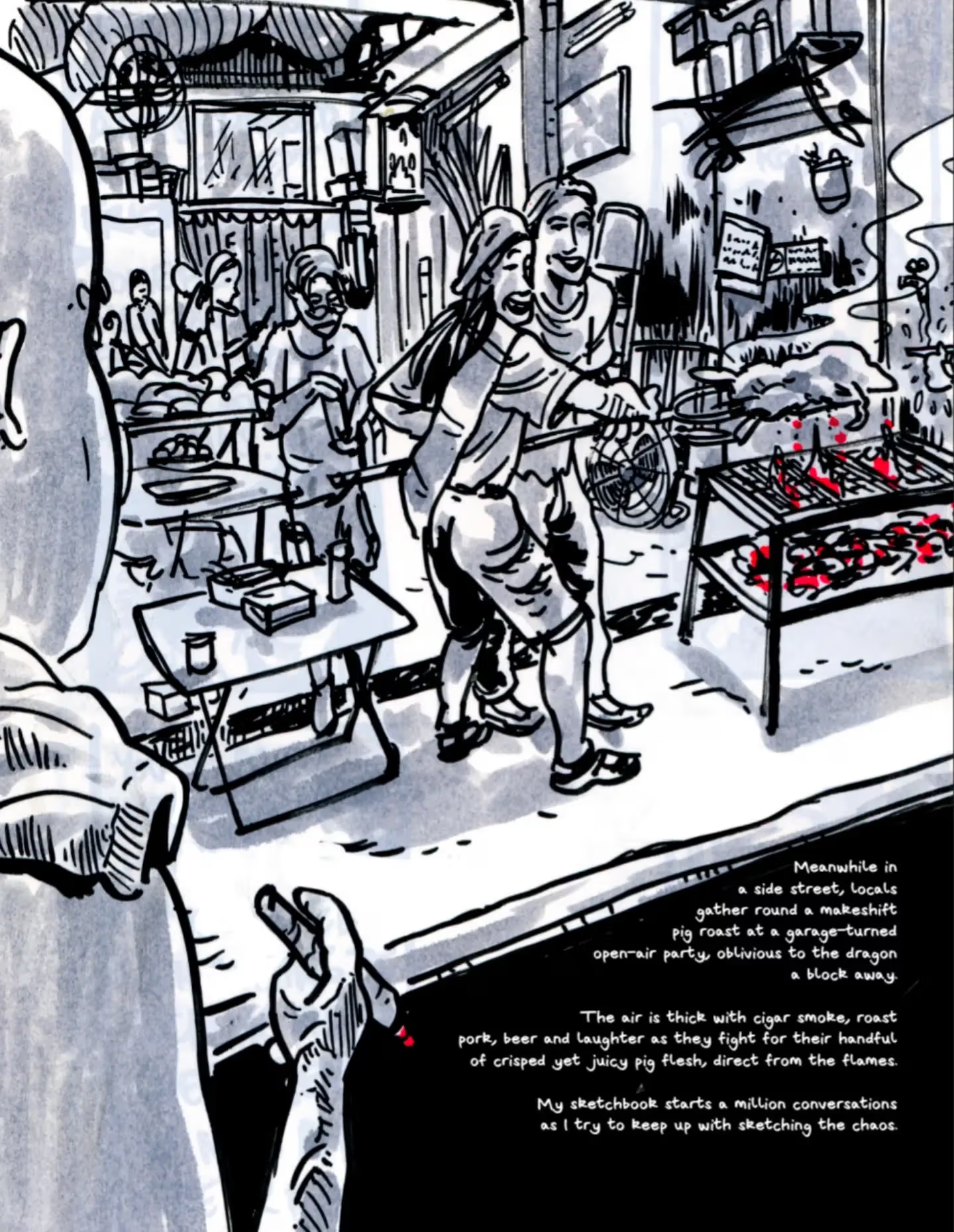
Another street-gathering page draws tables, people, long poles and a roasting setup in grey-black lines, then picks out the fire in red. A foreground hand holding a pen keeps the observer inside the image. The artist addresses Hong Kong cultural subjects including Tai Hang’s fire-dragon festival; this page shifts attention towards people gathering beside the celebration. A ritual’s centre need not be the only protagonist: roadside conversation, eating and the position from which one watches also build urban memories.
A street-gathering comic places a roast, people and the artist’s drawing hand within one scene.
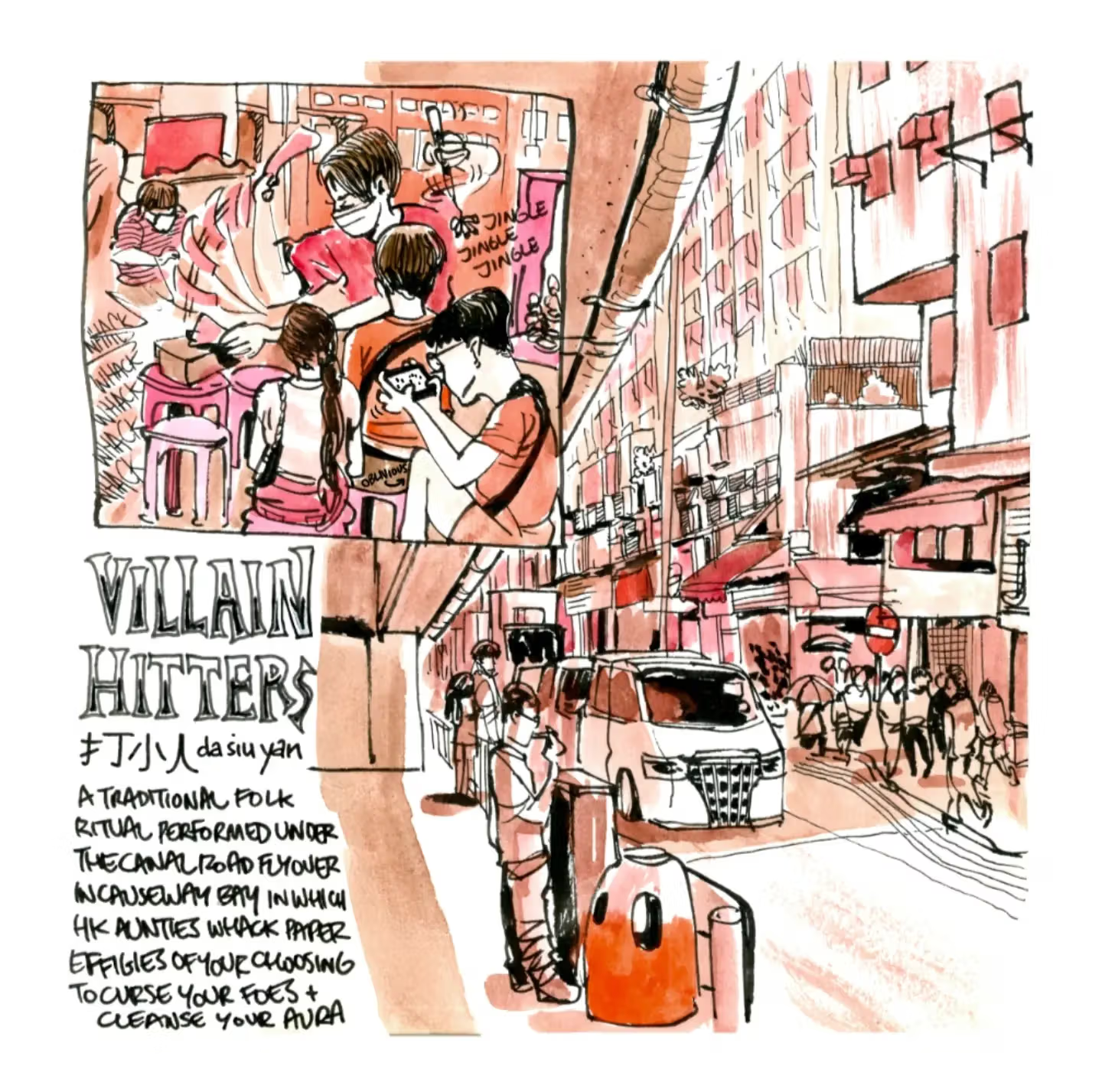
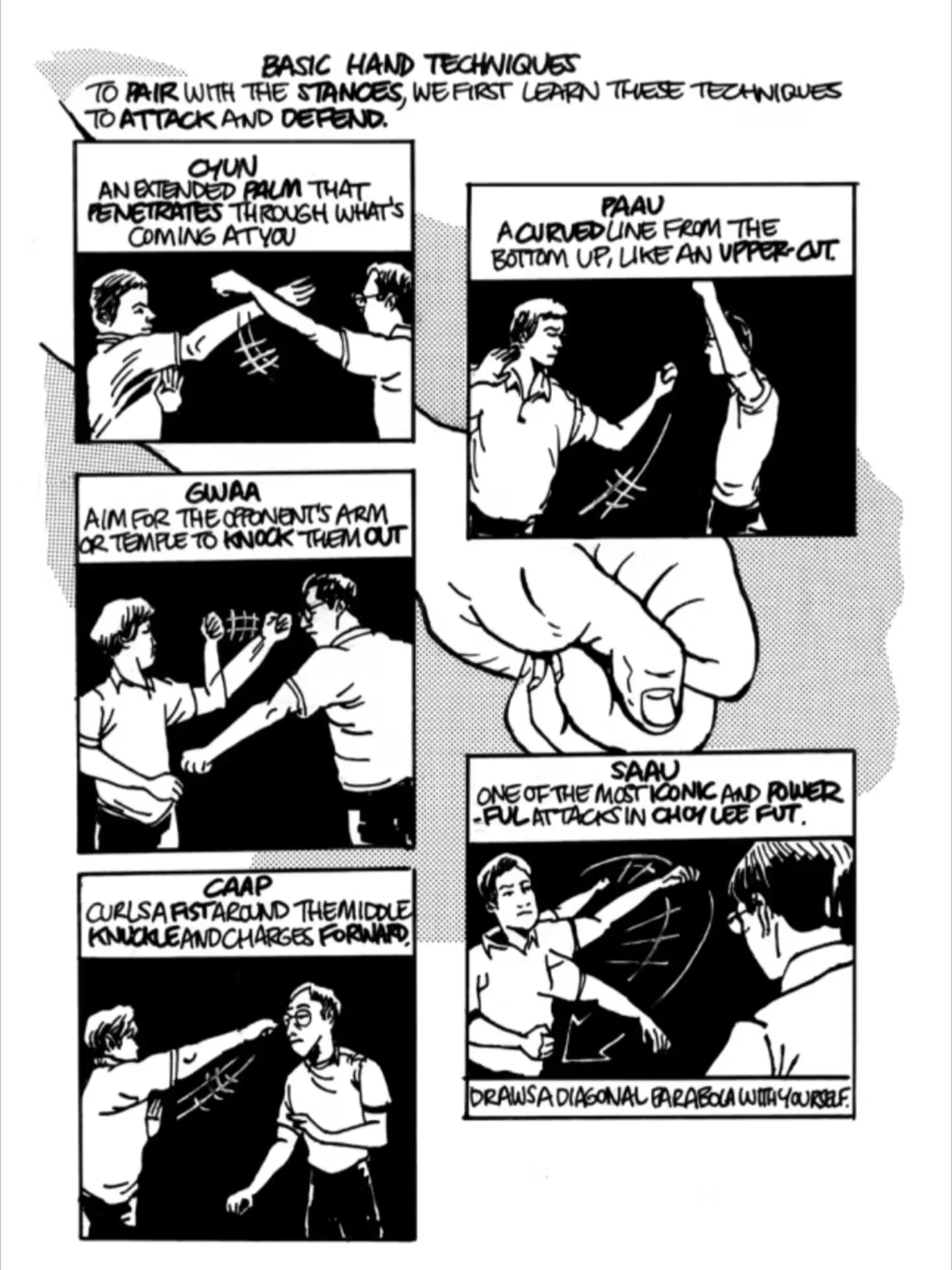
The villain-hitting page uses warm reds and oranges to combine flyovers, buildings, pedestrians and close views of the ritual. The martial-arts page instead uses black-and-white panels, a fist close-up and movement lines to convey bodily motion. Side by side, they show how wide views establish a setting while close-ups explain actions. Broad colour areas connect the street in the first, while arms stand out against dark backgrounds in the second. Both translate movement into an order for reading a page.
A martial-arts page uses panels and movement lines to make bodily gestures readable in sequence.
Free until October 28: keep the pace of looking with pen and paper
Based in Hong Kong, Dan Archer has worked with comics and on-location drawing for over 15 years. His debut graphic novel, Voices from Nepal, was published by University of Toronto Press in 2024. He also runs the XR studio Empathetic Media and researches biological signals and perspective-taking within immersive storytelling. When a work involves an interview, its speech bubbles use the interviewee’s own words, and he draws portraits during the conversation. The method connects images with spoken material while retaining scope to protect privacy.
The exhibition opens daily from 08:00 to 23:00 until October 28. Organised by the Hong Kong Arts Centre’s Comix Home Base and Dan Archer, it is sponsored by Etchr. The October 17 guided visit and sharing session has already ended; the current focus can be the comics, sketchbooks and original pages. Check the official exhibition information before visiting. Read the panel sequence first, then step back to consider the full page’s empty spaces and colour shapes: the two scales reveal the rhythm of hand-drawn storytelling.