SEIKO KX701S Arrives November 20: ±30 Seconds a Year and a Fresh Reading of a 1968 Dial
The ¥27,500 tax-inclusive clock retains original numeral forms with redesigned hands. Check accuracy conditions, three-year battery life and its 314 mm dimensions.
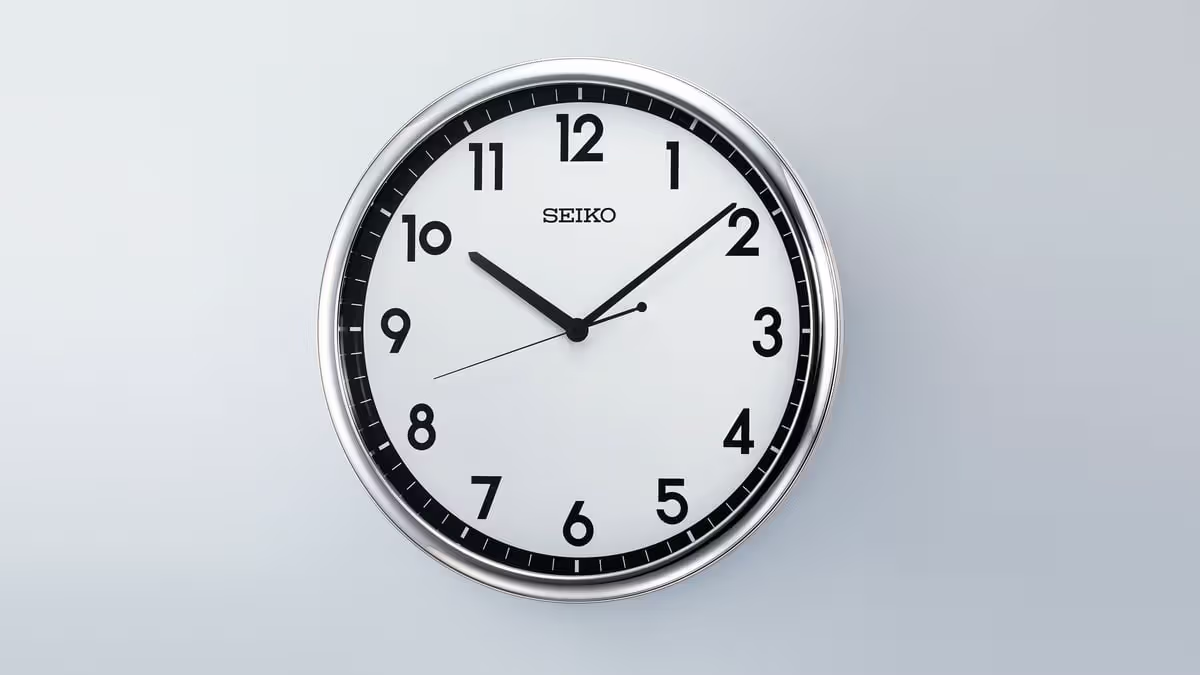
A wall clock is read many times a day, so useful improvements often concern legibility and maintenance. SEIKO plans to release the KX701S quartz wall clock on November 20, 2026, with a suggested tax-inclusive price of ¥27,500. Drawing on the 1968 SPX-961 household quartz clock, it retains a metal dial and familiar numeral language while updating the hands. Its new movement specifies accuracy of ±30 seconds per year, a different unit from common monthly figures.
Read annual accuracy together with its conditions
Official specifications state ±30 seconds per year when used between 5°C and 35°C, while the broader operating range is −10°C to 50°C. Those figures answer different questions: an environment suitable for operation does not establish identical accuracy at every temperature. This distinction matters in rooms with large temperature changes.
The brand notes that many previous quartz wall clocks had accuracy around ±20–30 seconds per month; the new movement expresses its specification annually. One coin battery offers approximately three years of operation, accompanied by smoothly sweeping seconds. These are official specifications and design targets. Consumption still relates to use, so three years is not an identical replacement deadline in every setting.
Numerals retained, hands renewed from a 1968 reference
Released in June 1968, the SPX-961 is described by SEIKO as the world's first household quartz wall clock. Japan's National Museum of Nature and Science registered it as important historical material in science and technology in 2020. The new model carries forward the original Arabic numeral shapes without reproducing every old detail.
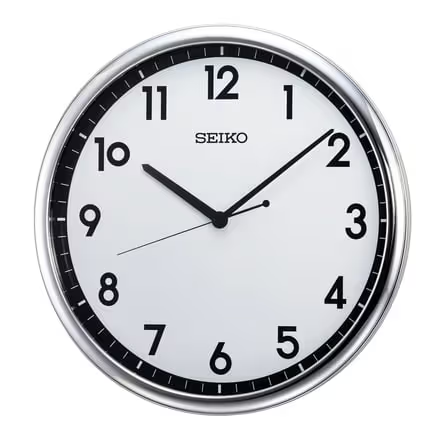
A black outer ring on the white-printed dial brings out white minute marks, while redesigned hour and minute hands improve reading from a distance. Front photographs reveal different weights for numerals, hands and the thin seconds hand, rather than treating all information equally. For a wall clock, that hierarchy affects a quick glance more directly than whether the frame looks retro.
A black ring, white marks and updated hands establish reading hierarchy.
Measure before placing a 314 mm clock on the wall
KX701S measures 314 mm high and wide, 36 mm deep and approximately 770 g. Its glossy silver-colored frame is plastic, with glass at the front; silver color does not make it an all-metal case. Metal refers to the inherited dial approach. Before mounting, use paper to compare its size against doorframes, shelves and seated sightlines, then check the wall attachment point.
Announced in October for November release, the clock invites comparison through accuracy units, reading design and everyday maintenance. The official SEIKO announcement lists full specifications. Decide how far away and under what light you will read it before comparing numerals and hands. The historical entry point may be 1968, but everyday use belongs to your present wall and line of sight.