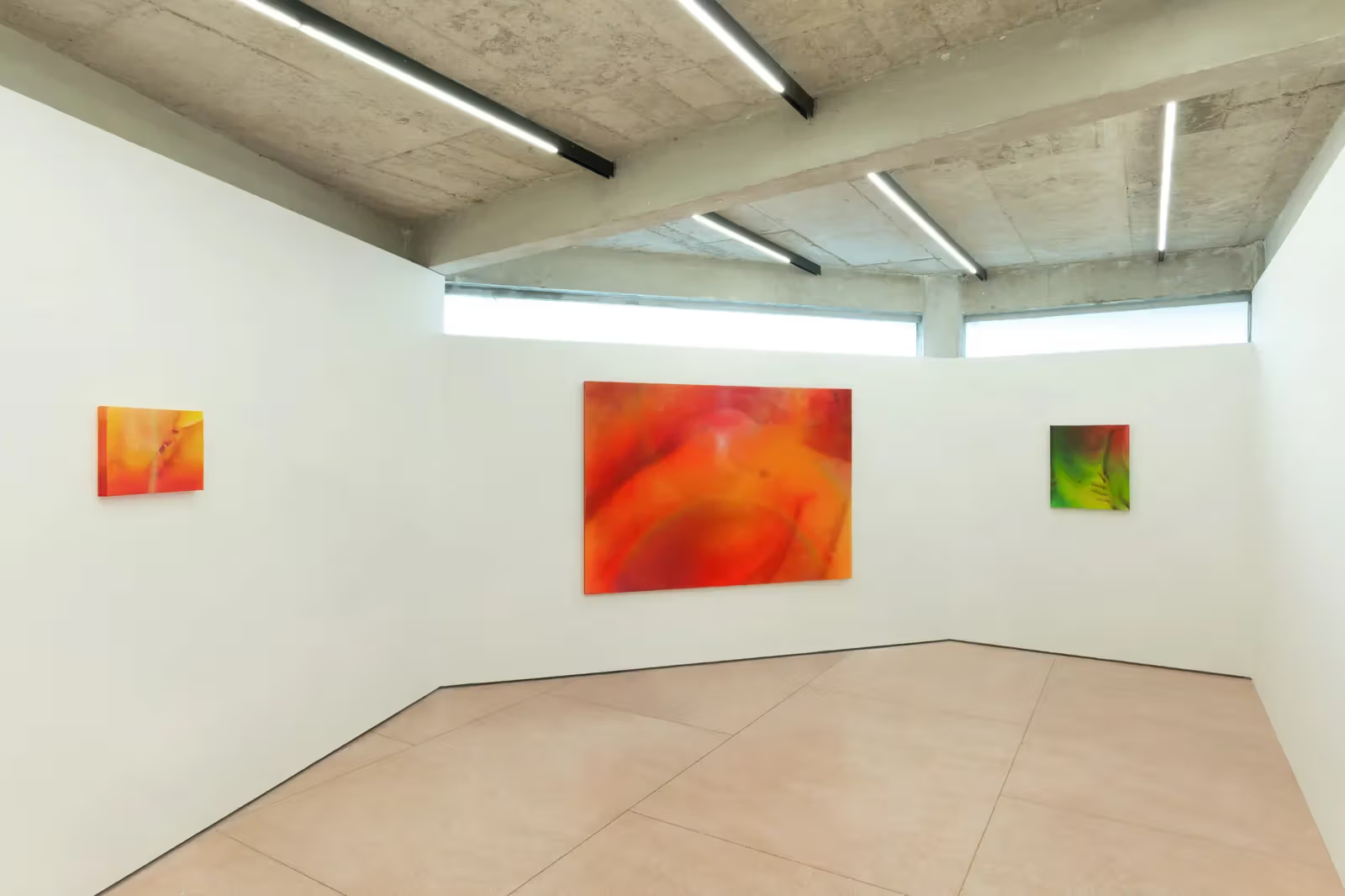
Light in a painting does not always come from the last brushstroke. Karen Shiozawa’s first Hong Kong exhibition, Twilight Planet, opened at Whitestone Gallery on October 24, 2026. Layers of paint and the removal of their surfaces allow underlying colours to emerge from darkness. These paintings reward two viewing distances: identify forms and light from afar, then move closer to see how covering, scraping and small textures bring them into being.
Reconstructing remembered light rather than reproducing a landscape
Born in 1998, the Japanese artist Karen Shiozawa spent part of her childhood in the Netherlands and earned an MFA from Tokyo Zokei University. European architectural elements such as windmills, arches and church spires recur in her paintings, without asking viewers to identify an exact location. Familiar yet indistinct forms seem closer to contours retained by memory: a certain brightness, a distant view or a space that cannot quite be described in full.
She builds a surface with several layers of paint, covers it with oil paint and gradually scrapes back the upper layers to reveal the colours beneath. Needle incisions and delicate tapping also contribute texture. That sequence matters because bright colours seem to seep out from within the painting rather than sit on top as final highlights. Works on display use oil, acrylic and alkyd resin on board, making layers of colour and surface traces part of the same scene.
Looking at Blue hour and Fireworks
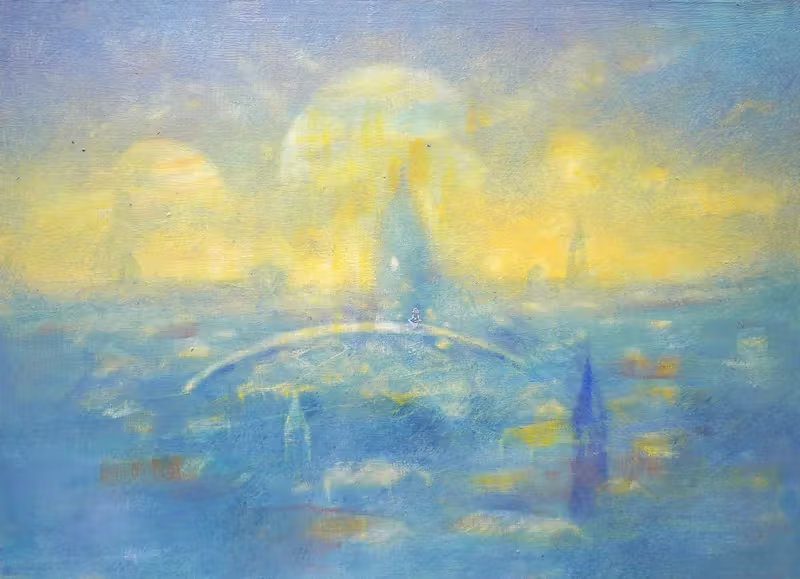
Blue hour, made in 2026, lays out a horizontal space in blue, with areas of yellow light in the upper part and distance, and a central architectural outline that appears only faintly. Rather than quickly spelling out windows, corners or streets, it allows the eye to move among soft colour fields. Measuring 33.3 by 24.2cm, the small work still retains a sense of depth. Instead of treating it as a record of a particular city, begin with how cool and warm colours guide your gaze.
Karen Shiozawa’s Blue hour (2026) builds a hazy architectural scene in blue and yellow layers.
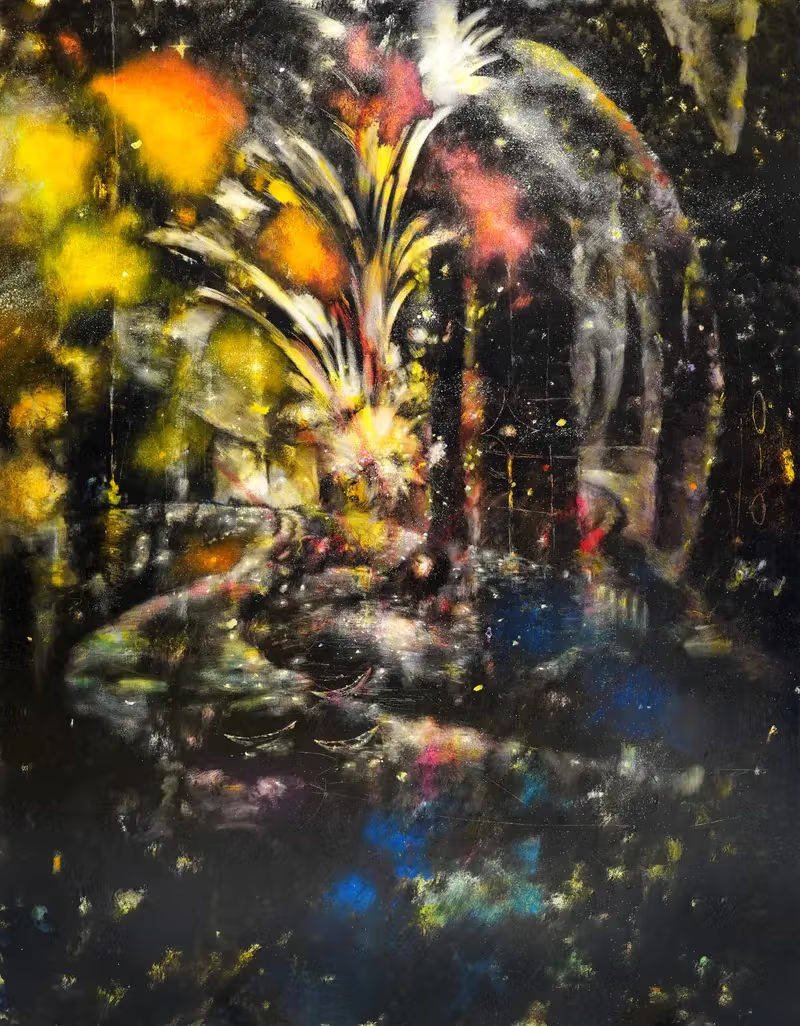
Fireworks, also from 2026, measures 116.7 by 91cm. A darker ground supports sprays of yellow, orange, red and white. Points of light and curved lines cross in the darkness, with blue and small reflection-like patches below. Compared with Blue hour, its shifts between light and dark are stronger and its lines feel more outwardly expansive. Seen together, the paintings show how similar layering methods can produce completely different visual speeds.
Dates and access: open Tuesday to Saturday
Twilight Planet runs until November 28, 2026 at Whitestone Gallery, 7/F M Place, 54 Wong Chuk Hang Road, Hong Kong. Regular opening hours are Tuesday to Saturday, 11am to 6pm; it is closed on Sundays, Mondays and public holidays. The October 24 opening reception has ended. Sunday, October 25 is also outside regular opening days, so the next regular visiting opportunity begins on Tuesday, October 27.
Try starting with the brightest area, then move your eye along the darker layers beside it, noticing when forms emerge and when they dissolve. Up close, scratches and tiny colour points break apart what seemed a continuous distant scene; from farther back, they become light and architecture again. Shifting distance makes the twilight in the title more than a time of day. It becomes a way to understand painting: forms are not yet fully clear, but light has already set memory in motion.