Roby Dwi Antono’s first Thai solo show opens October 27: SUDO RUNGU at MOCA turns a blacksmith’s sounds into memory
Charcoal, ember and ash connect three sections, a nine-metre painting and participatory charcoal work. The Bangkok show runs through January 3, 2027; preview the relationship between sound, body and memory.
What remains after the hammer falls silent? Indonesian artist Roby Dwi Antono will present his first solo exhibition in Thailand, SUDO RUNGU: Echoes of Fire, at MOCA BANGKOK. Curated by Loredana Pazzini Paracciani, its public exhibition period is October 27, 2026–January 3, 2027. His father’s work as a blacksmith and gradual hearing loss provide the starting point for paintings, drawings, photographs, video and participatory work. The exhibition has not yet opened.
Charcoal, ember and ash: three words to guide a visit
Sudo Rungu is a Javanese term for diminished hearing. Growing up in Ambarawa, Central Java, Roby absorbed the forge’s fire, charcoal smell and metallic sounds into personal memory. Instead of following a biographical timeline, the exhibition has three sections: Arang, Bara and Abu, meaning charcoal, ember and ash. They move from material left by combustion to heat still capable of changing metal’s form, then towards quiet traces, directing attention to the memory of labour.
Born in 1990 and now based in Yogyakarta, Roby developed his practice independently through drawing, illustration and graphic design before extending into painting, sculpture and installation. Discussions with the curator began in March 2024, and he visited MOCA to study the space in September 2025. The imagined figures thus connect back to family experiences revisited and reconsidered.
Viewers will leave traces as well as look at paintings
Ritual Arang invites visitors to select charcoal inscribed with words relating to work or life and use it to write or draw on a white canvas. As the words wear away, new marks remain on the canvas, and fallen charcoal dust becomes part of the work. One material undergoes both consumption and recording. The work will keep changing during the exhibition. Follow staff instructions when participating, rather than assuming every exhibit is an interactive object that can be touched.
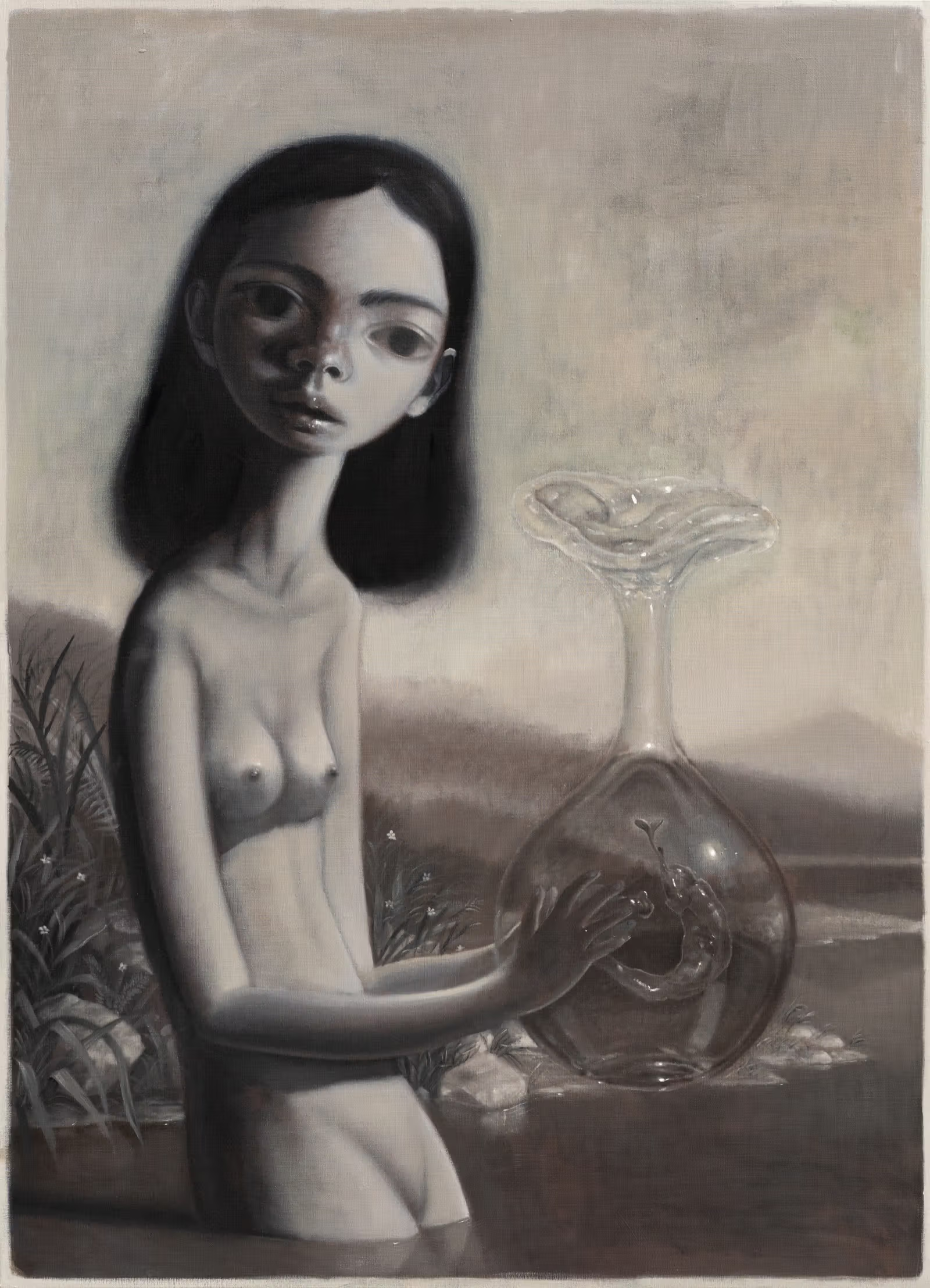
Another highlight, Residurungu, is nine metres long, forming a fragmented landscape of memory from ears, roots, water, houses and bodies. Dimming Memories depicts a figure holding a transparent vessel with an ear-like opening and imagery of the hippocampus, associated with memory formation, inside. Alternate between the whole and the details in the former; in the latter, compare a visible container with memory that resists being fixed. At different scales, the two works bring hearing back into visual experience.
Dimming Memories (2025) brings both a figure and a transparent vessel into focus.
Preview three artworks, then plan a visit from October 27
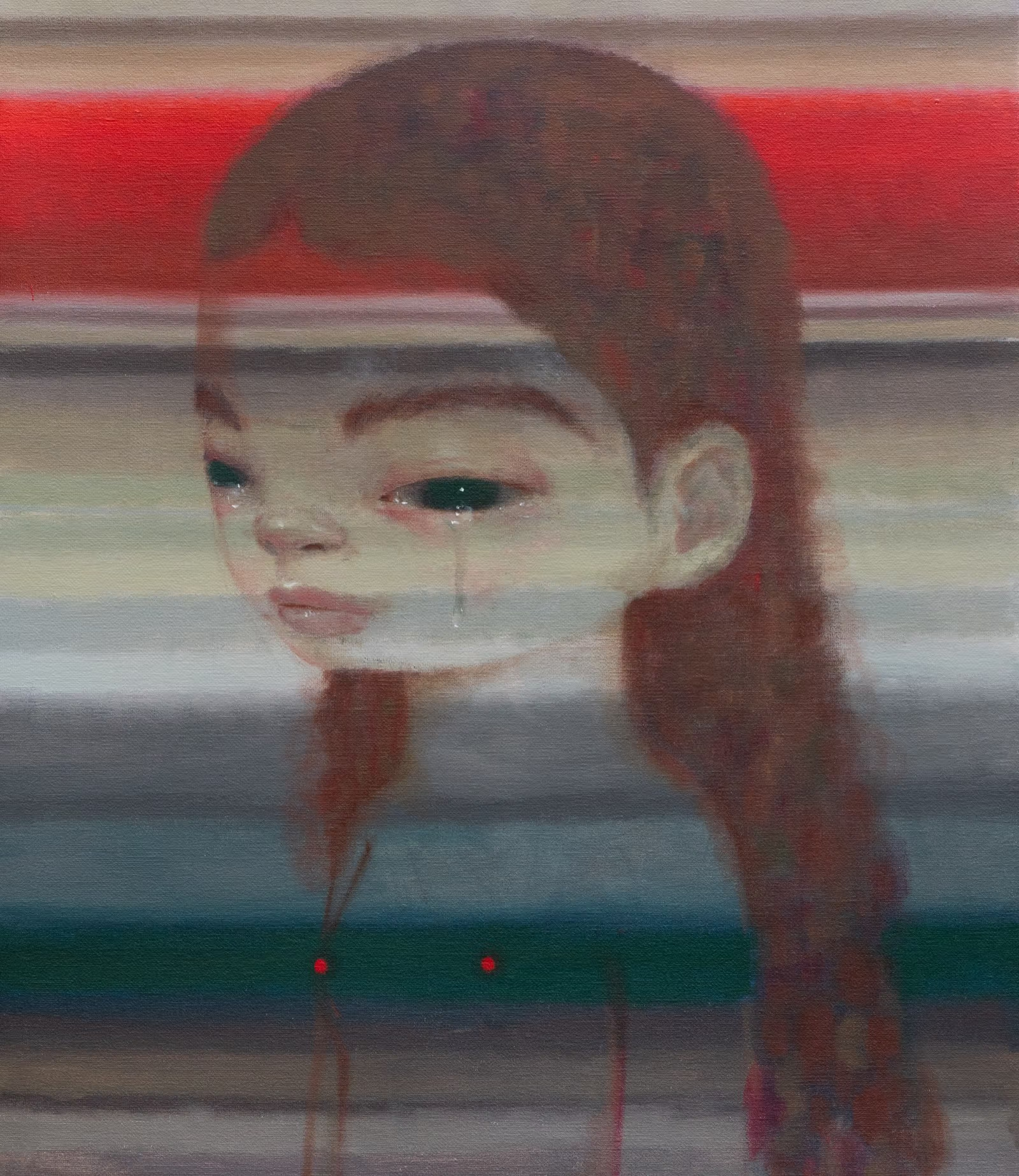
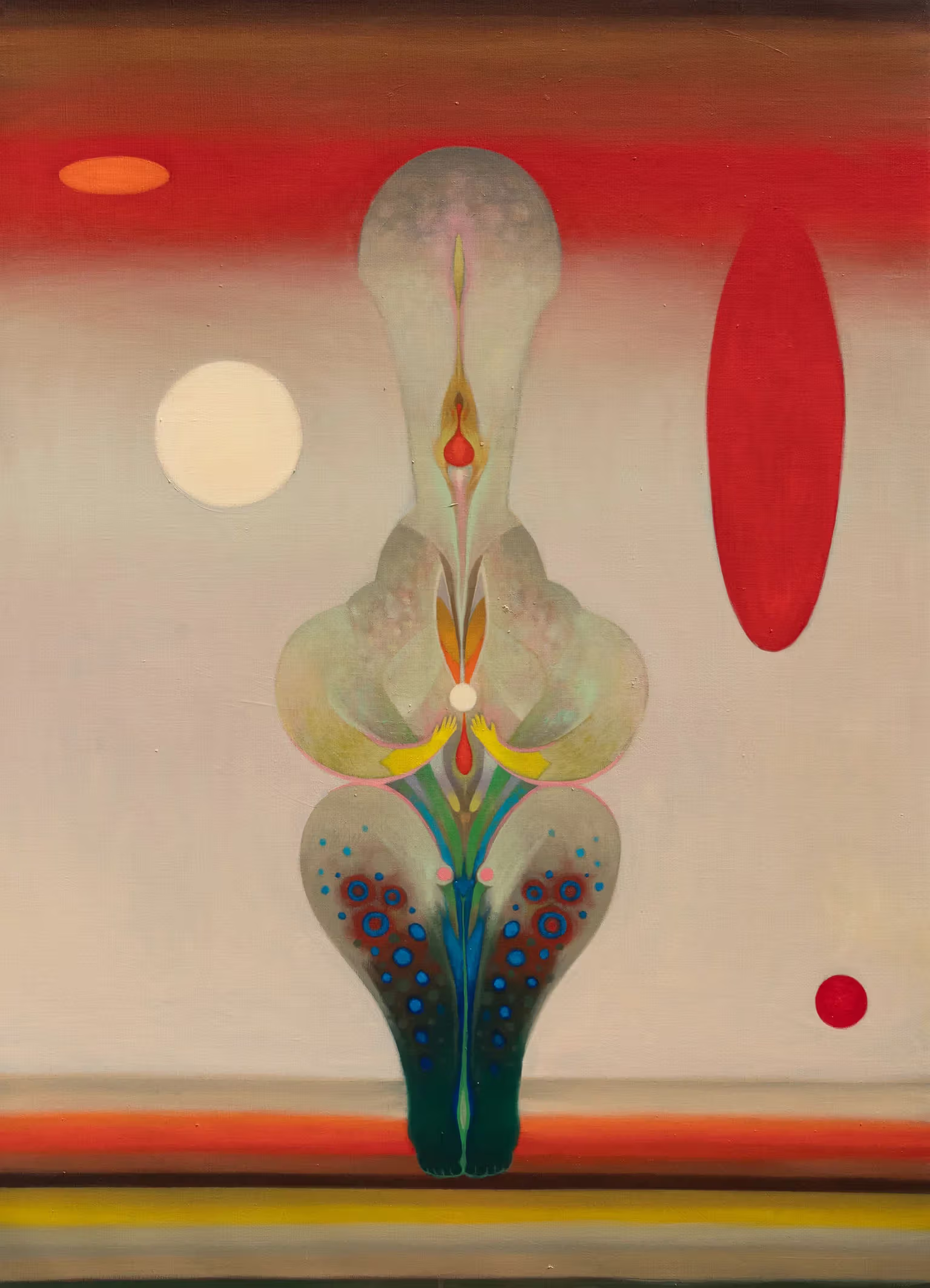
This article includes three officially released works. Sonus Extinctus (2026) combines a symmetrical central form, coloured dots and floating circles. Dimming Memories (2025) tends towards greyscale, with the transparent vessel and figure creating a slow exchange of gazes. Horizontal bands of colour pass through the face in Ultima Lacrima (2026). Compare their forms of concealment: internal structure, transparent surfaces and horizontal interference each alter recognition differently. All three images show individual artworks.
Sonus Extinctus (2026) places a symmetrical form and coloured dots against red and grey.
The exhibition occupies the G Floor Atrium and Temporary Exhibition Rooms 1–3 at MOCA, 499 Kamphaeng Phet 6, Lat Yao, Chatuchak. Regular hours are Tuesday–Sunday, 10:00–18:00, with Monday closure. An opening reception is separately listed for October 26 at 17:00; it does not move the regular exhibition period a day earlier. Plan your onward journey from Bang Khen station on the SRT Red Line, and confirm admission and the application of museum collection tickets with MOCA. Check the official exhibition page for updates or call +66 2 016 5666.