Gwangju’s Free ACT Art-and-Technology Exhibition Runs Through November 8: Talking Machines, Breath and Shared XR
ACC’s I, Human brings robotic responses, visitors’ breath and shared memory into art. Here are key works, general exhibition hours and the separate reservation arrangements for BLUR and TRACES.
ACT Festival 2026 at the National Asian Culture Center (ACC) in Gwangju takes the title I, Human: Responding to the Technecene. Its exhibition is open free of charge in ACC Creation Spaces 3 and 4 from October 23 to November 8. The curatorial term Technecene describes an age in which technology deeply changes sensation, judgment and human relationships; it is a term proposed for this edition, not an established geological epoch. A machine’s pauses, bodily responses and audience participation all become ways of reading the works.
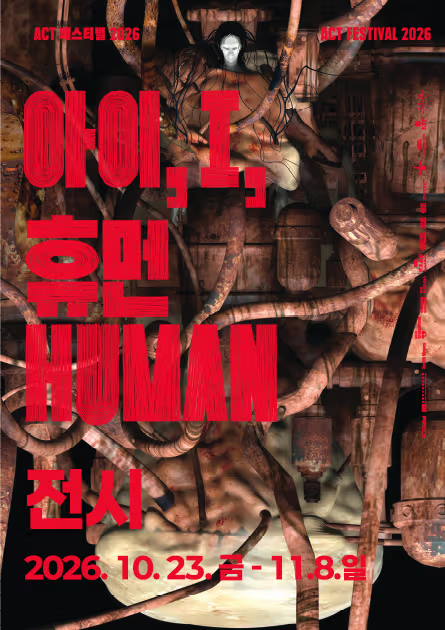
Official exhibition poster for ACT Festival 2026, I, Human.
Responsive machines, and images changed by a breath
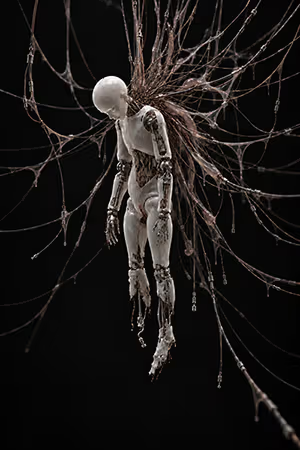
Robot K-456, created by Nam June Paik and Shuya Abe in 1964, provides a historical thread: an unstable mechanical body that can fall can also speak an artistic language. Jinah Roh’s Nerva artificia uses voice recognition and AI dialogue, exposing internal structures through translucent skin and extending cables behind the body like nerves. When visitors speak, the machine answers, subtly shifting its expression and gaze. It is an interactive sculpture, rather than proof that a machine has emotions.
Official artwork image of Jinah Roh’s Nerva artificia, with cables extending from its translucent mechanical body.
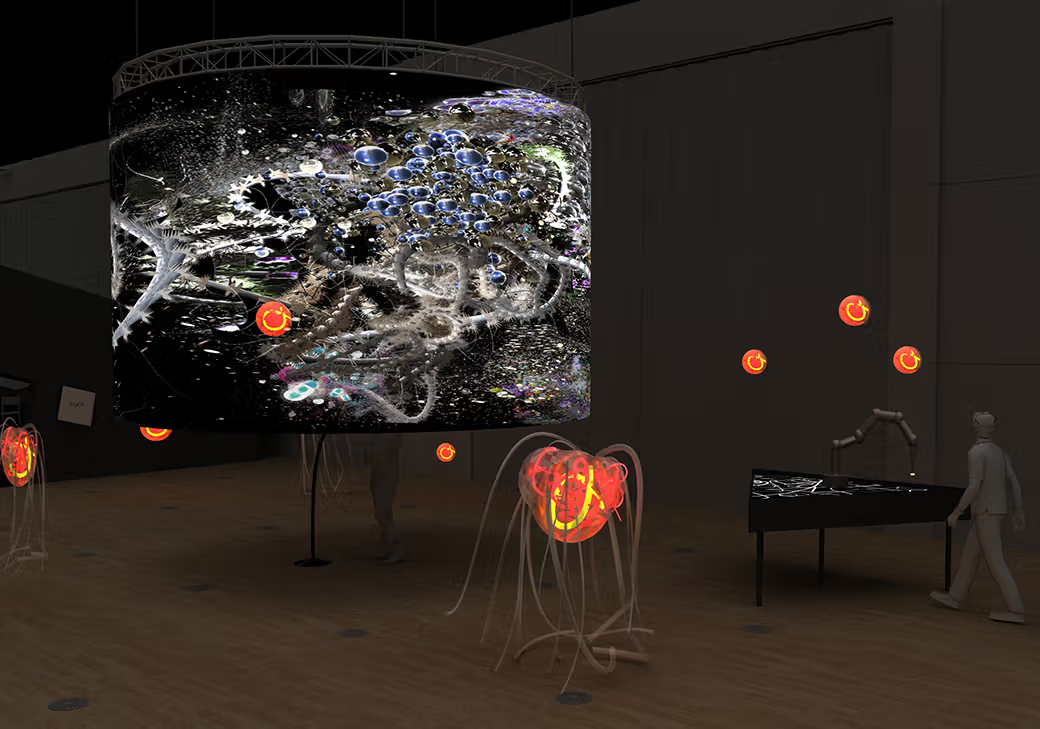
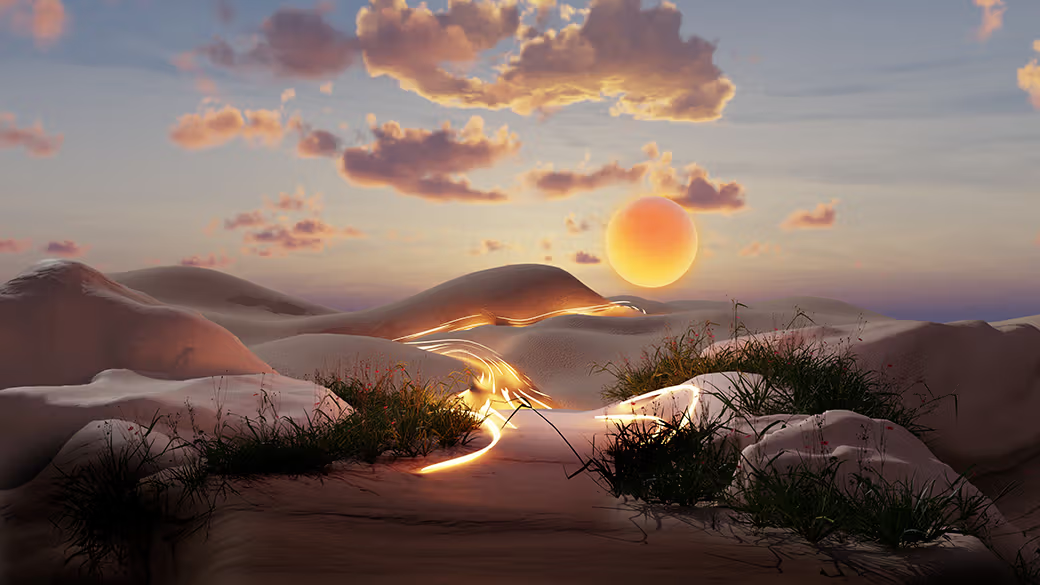
Hyeryun Jung’s From Śūnyatā reduces interaction to breathing. The work plans a cylindrical projection screen five metres in diameter and 3.2 metres high, combining environmental data, sensors and a robotic arm. A visitor breathes into the sensor and the projected world disappears; lines made by the arm in sand then return to the projection. The body is not only an audience standing before a screen, but an input to the system. The accompanying official image is a concept visual showing the installation’s relationships.
Handmade images and XR carry memory differently
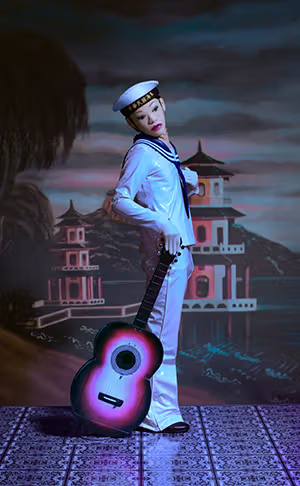
Taiwanese artist Wu Tien-chang’s Farewell, Spring and Autumn Pavilions offers another way of looking. The 2015 video combines masks, a sailor outfit and theatrical machinery in seemingly unreal scenes, made with physical sets, costume changes and continuous filming. It runs for four minutes and ten seconds, and does not become generative imagery because it appears in an AI-themed exhibition today. Wondering how the image was made shifts the technological question from old-versus-new categories to the ways human hands arrange bodies, history and visual illusion.
Official video artwork image of Wu Tien-chang’s Farewell, Spring and Autumn Pavilions, featuring a sailor figure and pavilion setting.
Vali Fugulin’s TRACES: The Grief Processor in Gwangju is a multi-user XR documentary, lasting approximately 25 minutes for two to four simultaneous participants. Re-researched and adapted from the 2025 original into a 2026 Gwangju version, it combines the creator’s experience of listening locally to mothers of the May 18 Democratic Uprising with images of the region. Participants bring one photograph and one short sentence about loss into a virtual forest, making private memory part of a shared space. This is the work’s narrative framework.
Official XR artwork image for TRACES: The Grief Processor in Gwangju.
General viewing is open; check XR time slots first
Another XR work, BLUR, is a collaboration between Craig Quintero and Phoebe Greenberg combining live performance, VR, AR and AI. Each session accommodates ten audience members and lasts about 45 minutes, including approximately 35 minutes of experience. Both BLUR and TRACES require separate reservation checks: free general admission does not mean a headset is immediately available at every time. Advance registration is through official Naver forms, and on-site participation may be possible only when spaces remain. Confirm a work’s session before arranging transport.
The exhibition opens Tuesday, Thursday, Friday and Sunday from 10:00 to 18:00, with Wednesday and Saturday extended to 20:00, and closes on Mondays. The address is 38 Munhwajeondang-ro, Dong-gu, Gwangju. The festival’s October 23 performance and October 24 dialogue have ended; the exhibition and bookable XR experiences remain options, with each programme following its own timetable. From machines and breath to handmade video and shared XR, different media bring viewers into the work in different ways.