How do 15 AI agents negotiate resources? Three rooms in Daito Manabe’s Relational Time in Taichung
Through January 3, 2027, three new works made for Taichung Art Museum connect autonomous societies, audience movement and accumulated effects, putting time into human–machine relations.
What might art become when AI participates in discussing resources and modelling a world? Daito Manabe’s RELATIONAL TIME—Life Beyond Simulation at Taichung Art Museum offers three scenarios. Running October 3, 2026–January 3, 2027, three new works are made for galleries A, B and C, allowing autonomous agents, bodily perception and audiovisual environments to act on one another at different speeds.
Gallery A: watch the agents debate, then examine cell forms
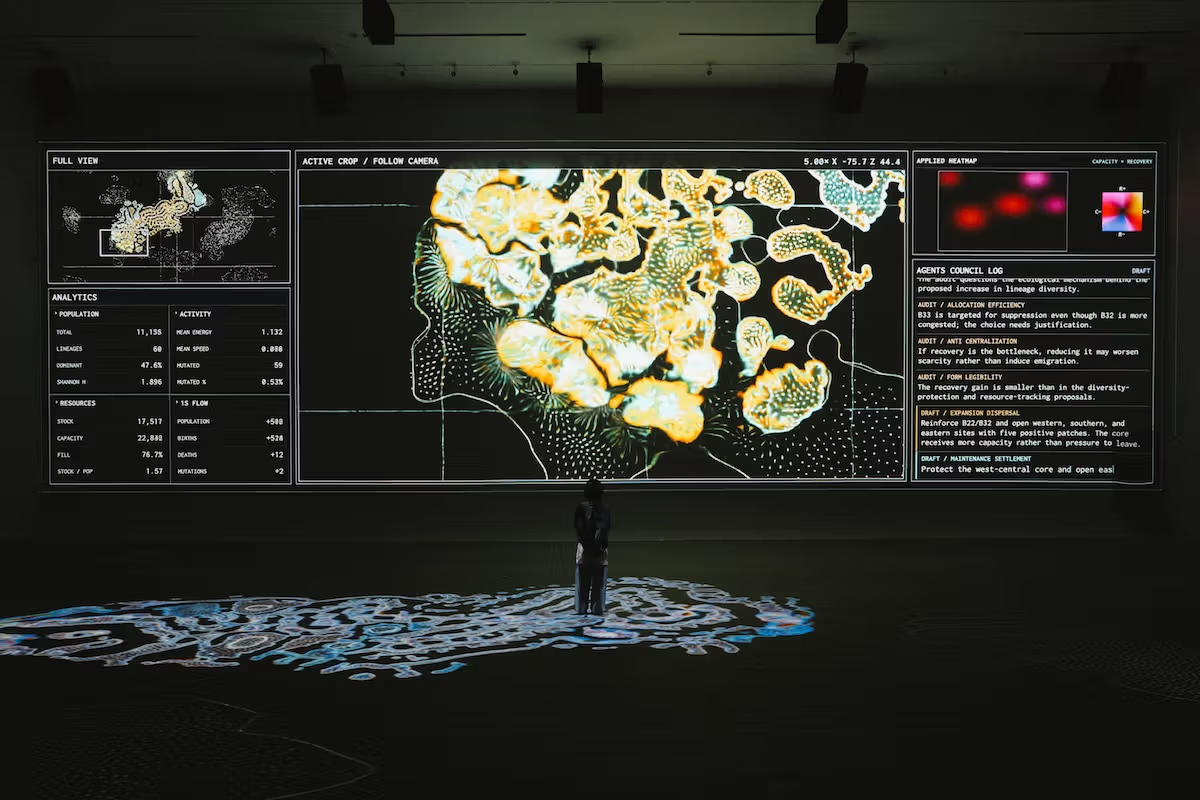
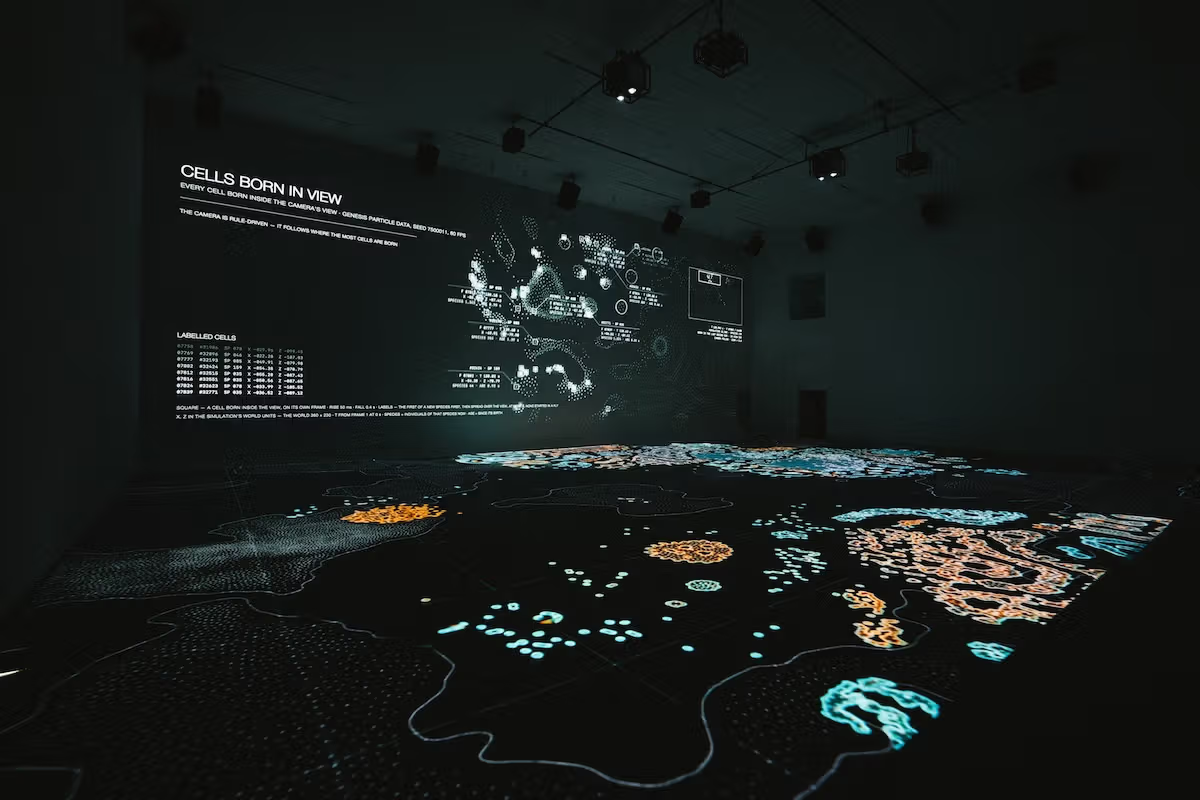
Gallery A’s artificial-life world begins with a single cell. Cells acquire resources, reproduce, mutate and die, while 15 AI agents discuss resource allocation from different perspectives. Selected proposals affect local conditions, and the resulting forms and distributions inform subsequent modelling. During opening hours, however, visitors see records calculated and produced in advance. Further computation and audiovisual production happen after closing, so the next day’s world includes changes accumulated while visitors were absent.
Wall and floor projections form a changing artificial-life environment.
Attention can move between projection and agent discussion: how are resources chosen, which environment is retained, and what distribution follows? These questions approach the relational core more closely than whether a cell looks beautiful. Agent negotiation does not mean human society has been completely replicated; it places a cycle of allocation, response and renewed judgment on an observable stage.
Visitors pause before a large projection.
Gallery B: a person’s pause changes immediate sound and images
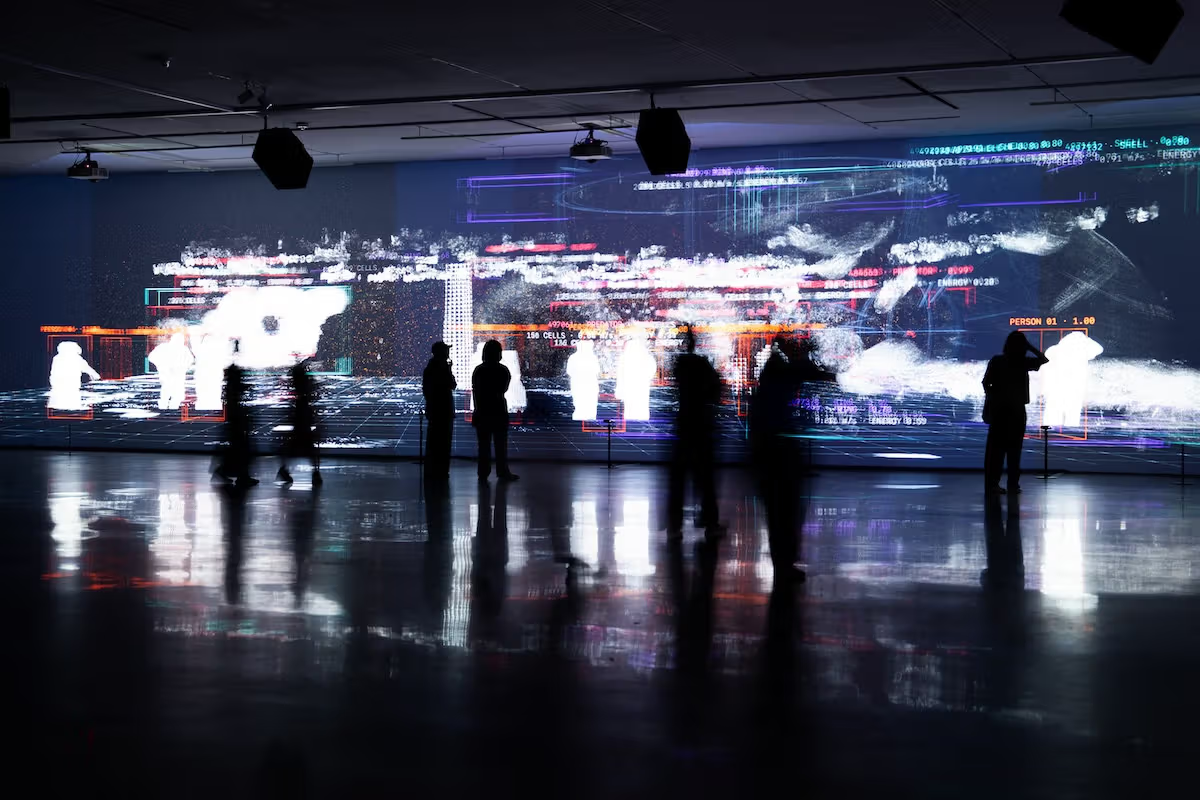
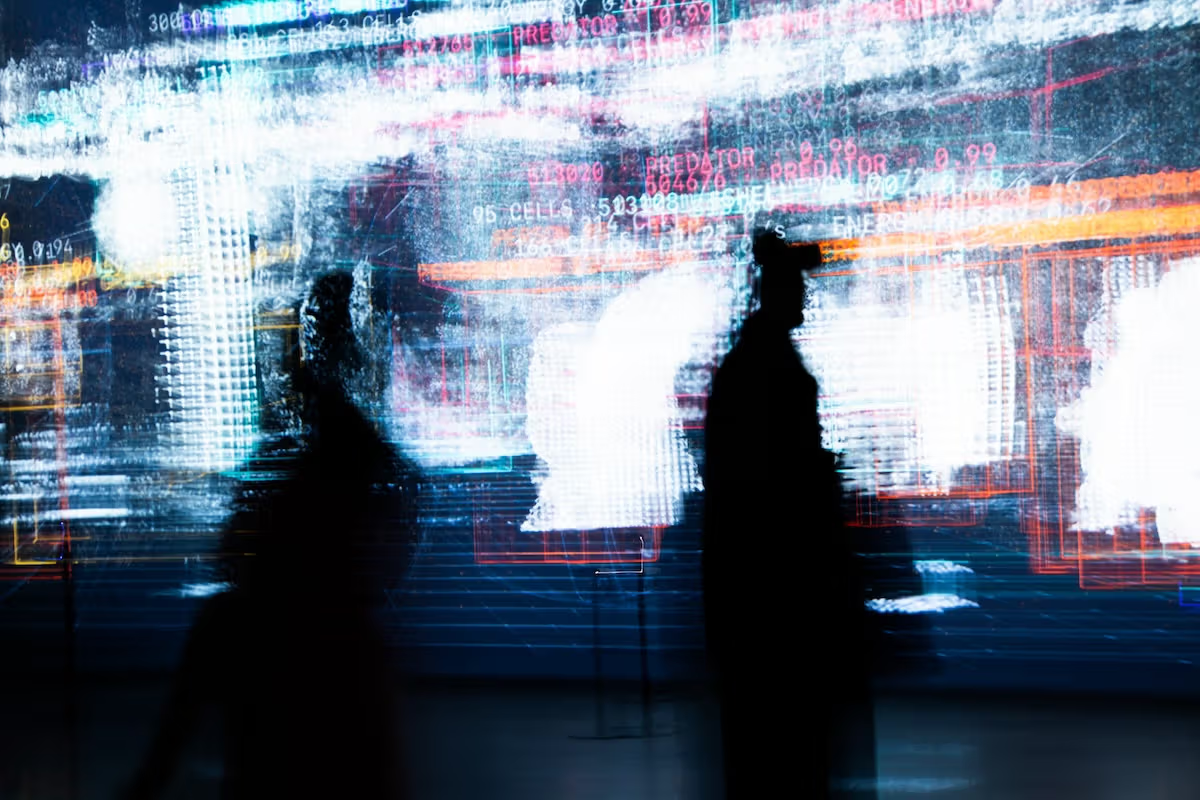
In Gallery B, visitors’ positions and movements affect images on three walls and spatial sound. Approaching, pausing and walking through the room alter its response. AI-authored visual code and dialogue help shape this world, but the agent process at the venue is staged with material prepared in advance. It should not be described as large-language-model agents negotiating live in front of every visitor. The immediate interaction is between bodies and the audiovisual environment.
Moving silhouettes overlap with the exhibition’s audiovisual imagery.
The two rooms therefore offer different temporal scales. Gallery A presents records formed during absence; Gallery B brings current movement directly into sound and images. Try pausing in B before changing position to compare the response. “Beyond simulation” does not claim a computer has produced true life. It brings bodily response time alongside the longer process needed to develop the conditions of expression.
Gallery C: a neural network turns stimuli into sound and light
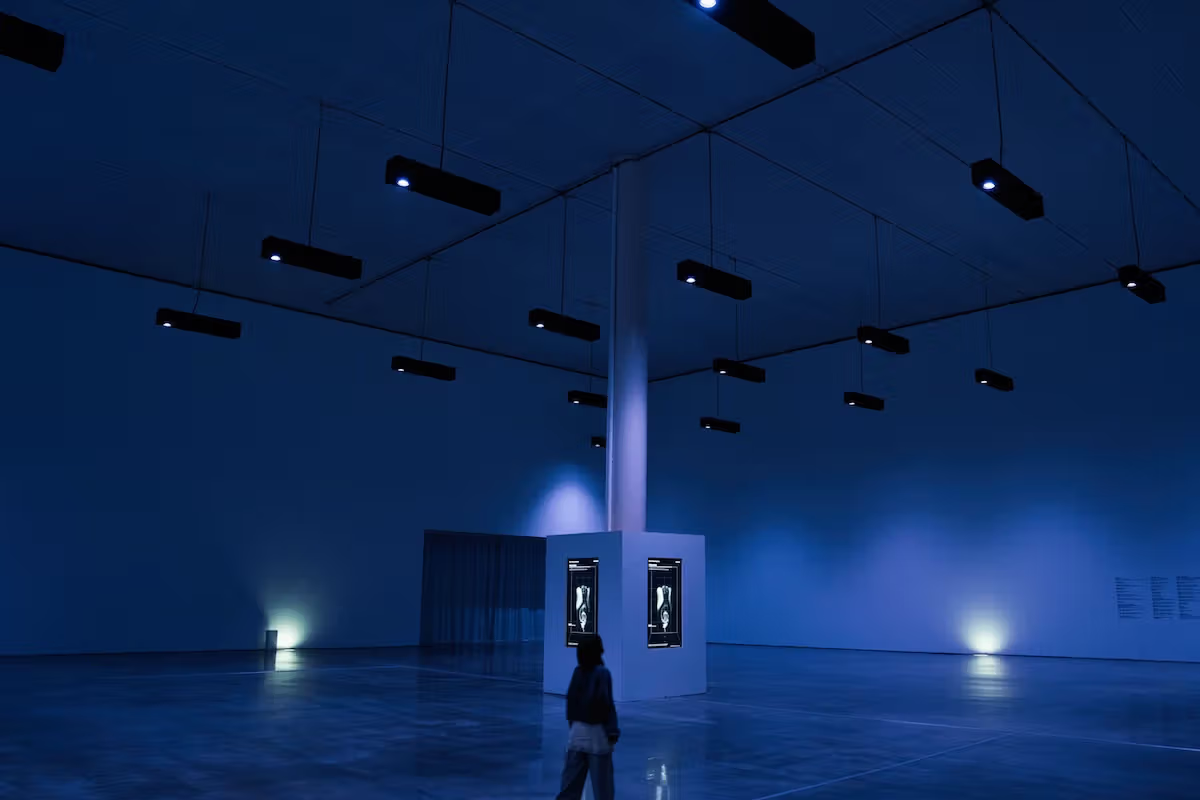
Gallery C feeds visitors’ positions into a modified fly-vision model. Neural activity appears on a central four-sided display and becomes sound and light distributed across 24 overhead positions. Pathways carrying more signals become more likely to do so again, with changes accumulating throughout the exhibition. Here, attention can turn to how movement enters another model of perception and how earlier activity affects subsequent responses.
Sound equipment and light distributed through a gallery.
Curated by Joel Kwong, this first major solo exhibition outside Japan does not compress all time into one speed: machines calculate rapidly, while people understand change through memory, waiting and sensation. Standard admission is NT$100, Taichung residents NT$50, and visitors aged 65 or older or under six enter free, according to eligibility rules. Identify a feedback relationship in one room, then compare another. This reveals what each system does through time more clearly than rushing through every technical term.