Hong Kong Museum of Art’s On Ink and Bamboo opens October 30: nearly 200 sets of works, with free admission
Dr Kössen M. T. Ho has donated over 340 items from the Hua-e Jiaohui Lou Collection. Nearly 200 sets will be displayed in the museum’s third-floor Chinese Antiquities Gallery from October 30 to April 7, 2027.
A flower painting can become a bamboo object through design and carving, while lines carved around a cylinder can return to paper as an ink rubbing. On Ink and Bamboo: The Hua-e Jiaohui Lou Donation opens at the Hong Kong Museum of Art on October 30, 2026, and runs until April 7, 2027. Admission to the exhibition in the Chinese Antiquities Gallery on 3/F is free. Nearly 200 sets of works create opportunities to compare bamboo and wood carvings with painting, calligraphy and rubbings. This is a preview: the exhibition has yet to open.
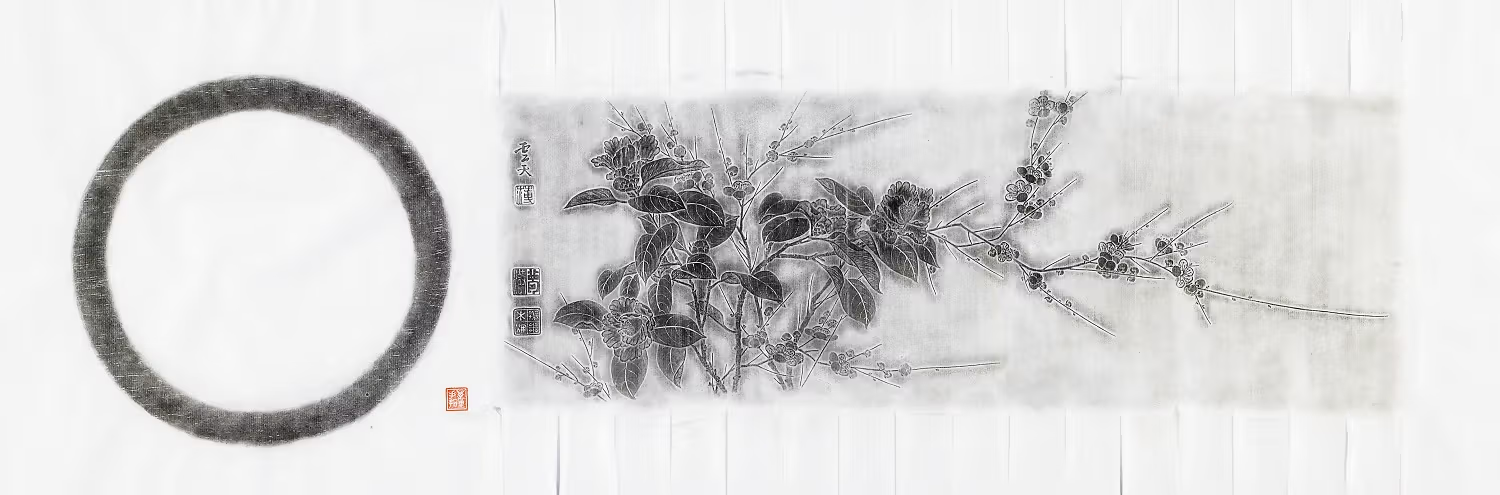
The related 2009 rubbing returns the cylindrical brush pot’s imagery to a paper surface.
Over 340 donated items, nearly 200 sets on show
The donation from Dr Kössen M. T. Ho comprises over 340 items, including textiles, with modern bamboo carvings forming its largest category. The museum describes it as the largest donation of bamboo carvings to a Hong Kong museum in forty years. The donation and the display are different counts: the former is expressed as items, the latter as nearly 200 sets. Keeping those units distinct helps explain why a set of wrist-rests or a multi-leaf album cannot simply be added up as single objects.
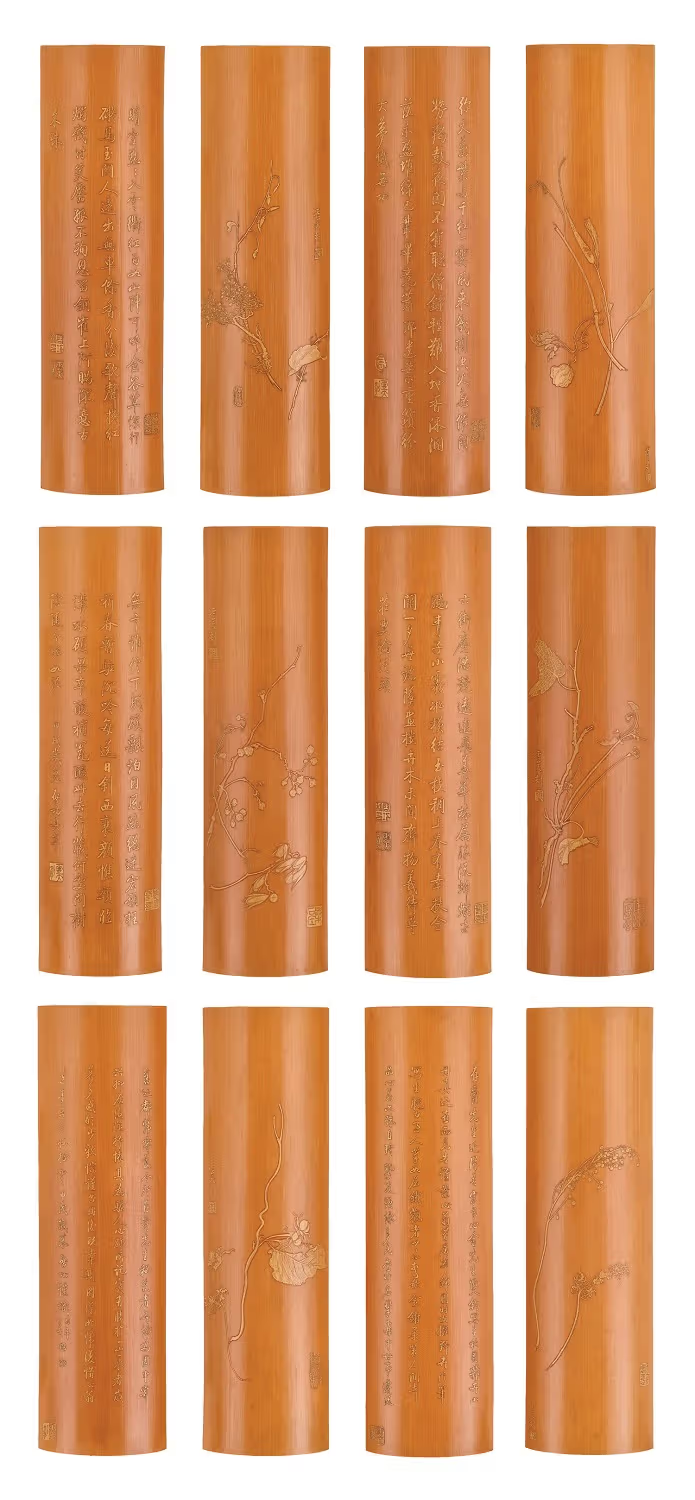
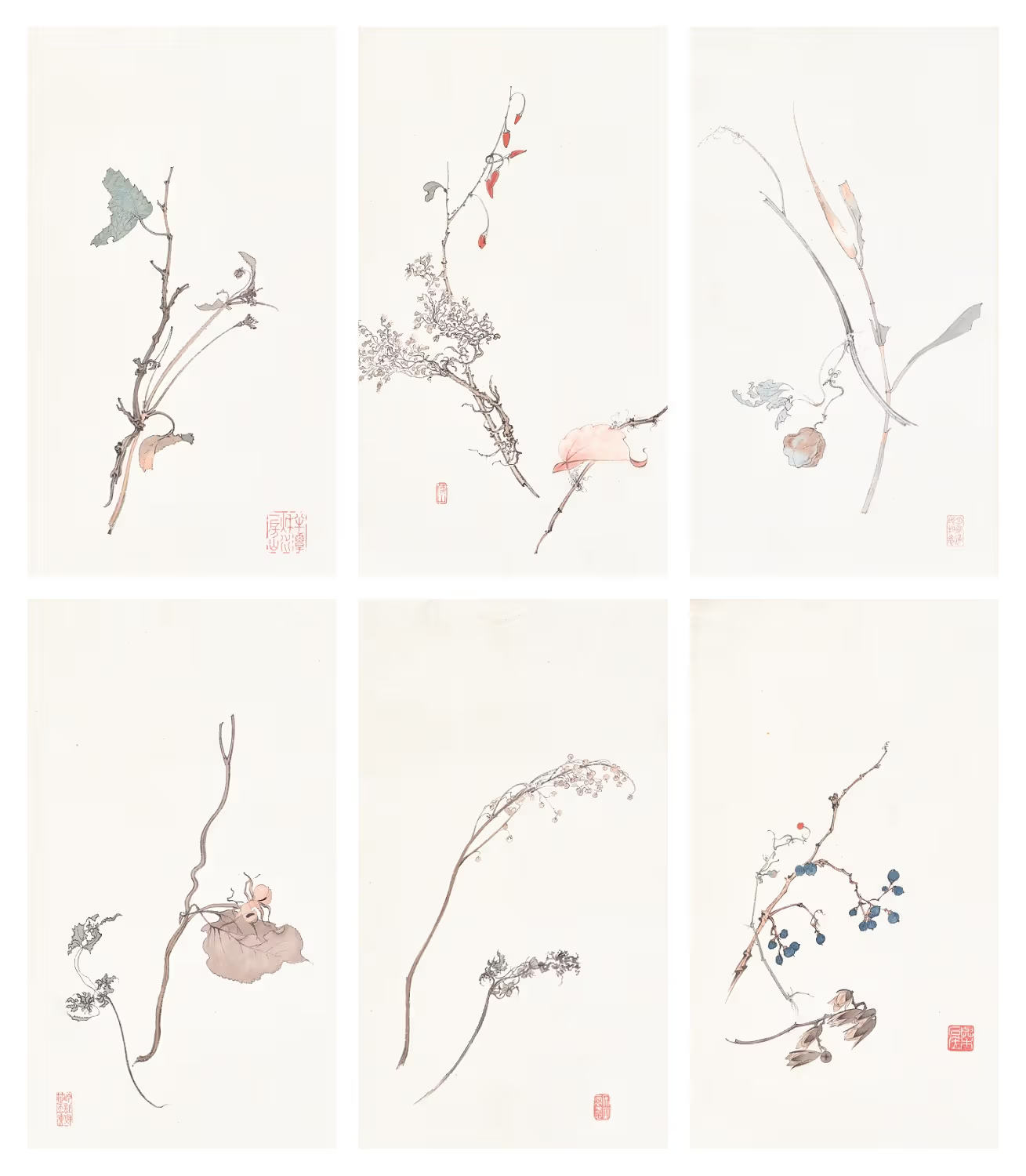
One set comprises twelve wrist-rests carved with Pu Ru’s Flowers in Autumn Garden in liuqing low relief, made in 2009–2010. Bo Yuntian carved them, Qi Gong supplied the calligraphy and Ho designed them. Each is 33.9 cm high and 9.8 cm wide, with flowers and writing arranged along the slender bamboo surface. Pu Ru’s undated Flowers in Autumn Garden is an album of six leaves in ink and colour on paper, each 36.4 × 20.3 cm. Follow the branches first, then compare how writing and empty space adapt to a flat page or a narrow object.
Pu Ru’s six-leaf Flowers in Autumn Garden album offers a reference for comparing flowers on paper with their translation into bamboo carving.
Reading a brush pot alongside its rubbing
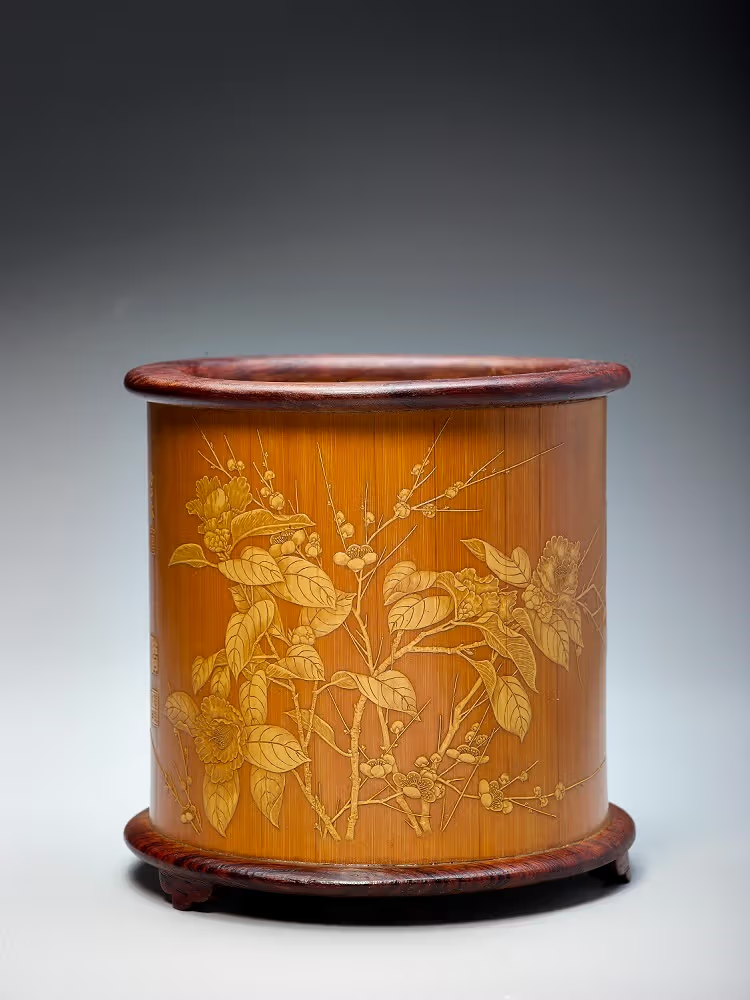
A more direct pairing brings together the 2009 brush pot carved with plum blossom and camellia from Song Hundred Flowers in liuqing low relief and its related rubbing. Carved by Bo Yuntian and designed by Ho, the bamboo pot is 15.8 cm high and 17 cm in diameter. Fu Wanli made the rubbing, also designed by Ho, which measures 23.8 × 68.5 cm. A cylindrical object is viewed around its circumference; the rubbing spreads the imagery across paper, changing the direction in which it is read.
The 2009 brush pot carved with plum blossom and camellia from Song Hundred Flowers in liuqing low relief carries flowering branches around its cylinder.
In the official images, flowering branches extend across the golden-coloured pot, with its darker rim and base defining upper and lower boundaries. The rubbing translates flowers, leaves and writing into black and grey, with a circular motif beside them. Viewing the two together reveals a shift from an arrangement around an object to a composition on paper. Begin with the entire shape, then select a small branch to compare: the difference lies in material and viewing method, as well as in identifying the flowers.
From wrist-rests to a water pot: the scale of use
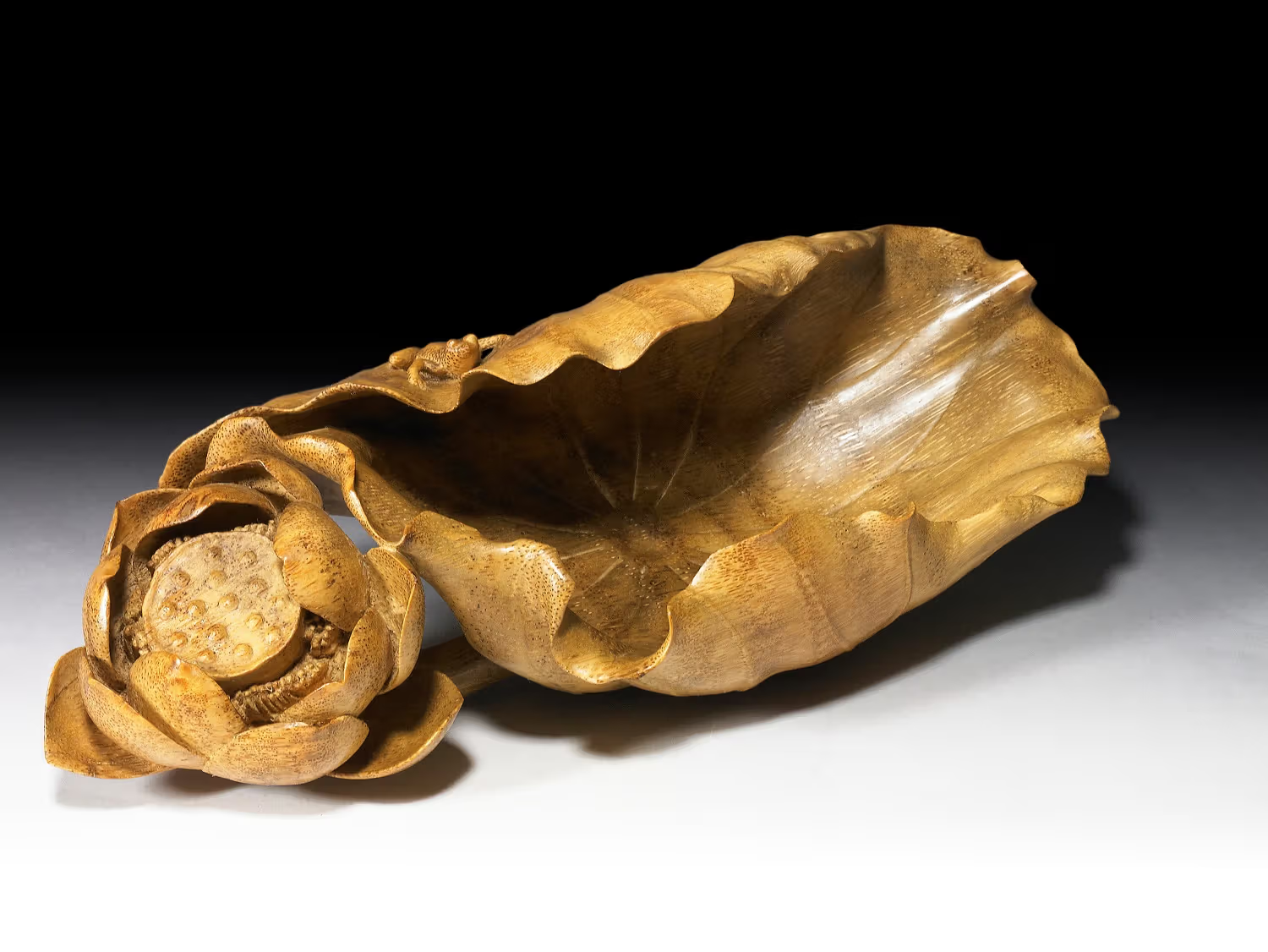
Zhou Hansheng’s 1998 water pot in the form of a lotus, carved in the round from bamboo root, offers another scale of object. Measuring 9.2 cm high, 31.6 cm wide and 13 cm deep, it appears in the official photograph as an undulating leaf-shaped vessel with a lotus and small animal details. Its outline follows the root’s form, contrasting with the regular cylindrical brush pot. From supporting a wrist while writing to holding brushes or water, everyday functions give floral imagery different places in three dimensions.
Zhou Hansheng’s 1998 bamboo-root lotus water pot follows the undulations of a leaf.
The Hong Kong Museum of Art is at 10 Salisbury Road, Tsim Sha Tsui. Regular hours are Monday to Wednesday and Friday, 10:00–18:00, and weekends and public holidays, 10:00–21:00. It closes on Thursdays except public holidays. The exhibition starts on October 30. Explore the official highlights and exhibition dates beforehand, then use paper works, bamboo objects and rubbings as three points along your own comparison route.