NFL COLOR FIELD Moves Painting Into the End Zone, From Paris to a Planned Miami Edition
The Paris debut ran October 23–24. Jammie Holmes brought a painting of a child and morning glories to a flag-football field; a new Miami installation is planned for December, with the artist and program still to be announced.
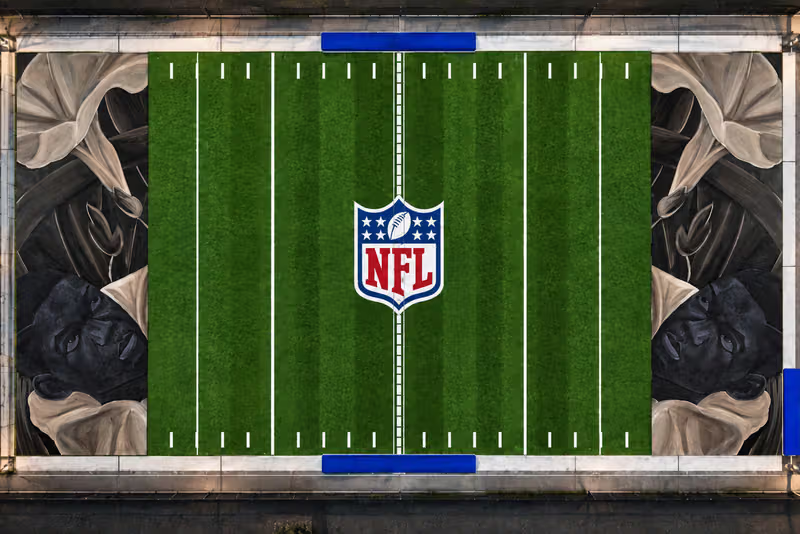
The first NFL COLOR FIELD presentation took place in Paris on October 23–24, 2026, bringing a Jammie Holmes painting to a flag-football field beneath the Eiffel Tower. Rather than a jersey graphic or sideline billboard, it became a hand-painted end zone encountered within a sporting space. The two-day Paris event has ended. The next edition is planned for Miami Art Week in December, with the artist and program still to be announced; the Paris arrangements should not be assumed to apply there.
How does a painted child enter a football field?
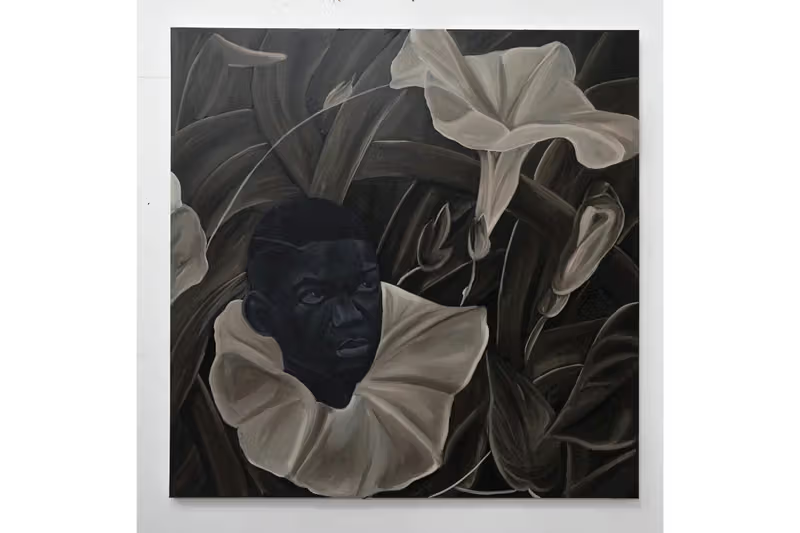
The starting point was Holmes’s Untitled (2024), depicting a child emerging among morning glory flowers and addressing the brevity of childhood and the intention involved in parenting. In the original painting, the dark face, white collar and petals overlap; the figure does not stand entirely apart from its surroundings. Enlarging those layers onto a field changes how they can be read. Color and outline register first from a distance, while a closer view lets the eye follow the edges between person and plants. The image no longer depends on a single frontal viewpoint.
Holmes’s Untitled (2024), showing a child and morning glories, provided the original for the Paris field adaptation.
An end zone is both a scoring destination and a prominent place for team identity. The published design mock-up keeps the green playing surface and yard lines in the center, with figures and flowers extending across the ends. Sporting rules and painted imagery share a plane. Rather than shrinking the painting to the size of a logo, this arrangement gives the figure visual weight beyond the boundaries. The overhead image here is a design mock-up, not a photograph of the completed Paris installation, and cannot establish every finished brushstroke.
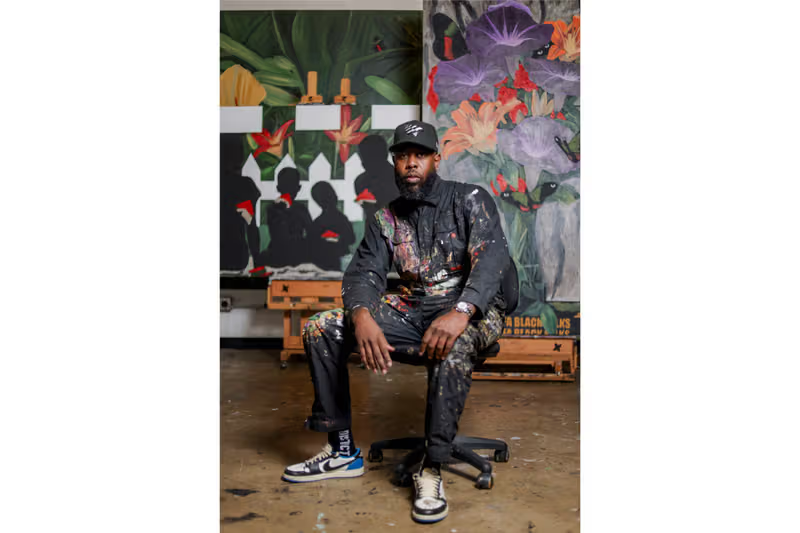
Jammie Holmes seated in his studio, with figure and flower paintings behind him.
Six muralists and field expertise make the work possible
One field specialist and six muralists produced the hand-painted end zone in New York before it was transported to Paris and assembled for NFL Experience Paris presented by Wilson. This process differs from simply printing a large poster: the image must accommodate a ground-level scale while sitting alongside the field’s use. The design question is how an original composition remains recognizable in a space people can move through and view from different directions, beyond the straightforward enlargement of an image file.
Holmes was born in Louisiana and is a longtime New Orleans Saints fan, giving his connection to the field a specific context. Yet the painting remains concerned with children, family and time; a sporting collaboration has not turned every element into a story about winning. For viewers unfamiliar with his work, understanding the relationship between original painting and field adaptation reveals more than remembering a campaign slogan. The painting, studio portrait and field mock-up should also be read separately, each answering a different question about the work, its maker or its setting.
After Paris, the Miami program remains to be announced
COLOR FIELD extends NFL Artist Replay, launched in 2023, and was conceived and curated with Jasmine Martin of Pivotal Arts. In Paris, the artwork entered a public environment that also offered flag-football experiences and exchanges, allowing visitors to encounter an image through sport before discovering its artist. Whether that encounter develops into sustained attention depends on how future work and its context are presented. The involvement of a major sports institution alone cannot guarantee an artistic impact.
For a look at the actual Paris presentation, see the Saints’ COLOR FIELD Paris recap. December’s Miami edition is to feature a new installation and activities. Holmes has not been confirmed as its artist, and there is insufficient information to specify a venue or visiting hours. Keeping the completed Paris work separate from the forthcoming Miami plans makes the series easier to assess: will it retain one visual language, or invite different artists to reinterpret the field?